
Washington has threatened to sever every economic lifeline sustaining Tehran. But years of sanctions have pushed much of Iran’s remaining China trade towards independent refiners, opaque intermediaries and non-dollar channels with less exposure to the US system. That does not make American financial power ineffective. It makes each additional step harder and potentially more costly. And for now, the sharp fall in Iranian oil exports is being driven primarily by war and physical blockade—not the financial sanctions announced this week.
25 August 2026 · ~16 minute read
CROSSWISE RESEARCH
Independent Research A + independent Gemini Research B · A/B gap analysis · targeted verification · hostile red-team audit · adjudication · primary sanctions records · maritime tracking · financial-system evidence · material uncertainties retained
Research cut-off: 25 August 2026
WHY THIS STORY
Washington says it wants to economically isolate Iran.
On 24 August, the US Treasury launched Operation Economic Outcast, presenting it as a major escalation in the pressure campaign against Tehran.
Nearly 60 individuals, entities and vessels were sanctioned.
Treasury widened potential secondary-sanctions exposure across five sectors:
· aviation
· digital assets
· gold
· shipping
· technology
And foreign governments, companies and financial institutions were warned that continued Iran-related activity could eventually cost them access to the American financial system.
The language was deliberately maximalist. Treasury has adopted a “zero-leakage” approach and says it intends to sever Iran’s remaining economic lifelines.
But one country sits at the centre of the problem: China.
China absorbs the overwhelming majority of Iran’s seaborne crude exports—more than four-fifths by current commercial tracking, with US estimates putting the share around nine-tenths.
If Washington wants genuine economic isolation, that trade matters.
Yet Treasury did not begin by cutting China’s largest banks from the US financial system.
Asked about the pace of escalation and why Treasury was not moving immediately to its most disruptive options, Secretary Scott Bessent said:
“Why would I want to blow up the global financial system?”
But he also made clear that Treasury was not finished.
Bessent said he expected another major sanctions announcement involving a financial institution before the end of the week.
That makes the present moment unusually revealing.
Washington is not simply deciding whether sanctions work. It is deciding how far up the enforcement ladder it is willing to climb.
The investigation found that Iran’s remaining China trade no longer depends principally on the sorts of globally exposed companies US sanctions are best at frightening.
Years of enforcement have helped push the residual business towards independent Chinese refiners, shadow shipping, intermediaries, renminbi settlement, and commercial actors with comparatively less exposure to the United States.
That creates a possible selection effect. The firms with the most to lose from US exclusion tend to leave first. The trade that remains becomes disproportionately concentrated among actors with less to lose.
But there is an important methodological limitation. We cannot yet cleanly observe how much that process has reduced the marginal effectiveness of financial sanctions because another force is simultaneously suppressing the trade.
The United States and Israel have been at war with Iran since February 2026. War-related disruption had already pushed Iranian oil flows lower by June. Then, in mid-July, Washington resumed enforcement of what US officials and current reporting have described as a maritime blockade.
By August, Iranian crude deliveries into China had fallen sharply. Only after that contraction was already underway did Treasury announce the 24 August sanctions package.
So the most visible evidence of Iranian economic isolation today—the disappearance of barrels—is not primarily evidence that this week’s sanctions have already succeeded. It is evidence of war and physical coercion.
Crosswise chose this story because it exposes three different questions that are often collapsed into one:
Can America make Iran poorer?
Can America stop Iran trading?
Can America force Iran to change policy?
The answers are not the same.
RESEARCH SUMMARY
Crosswise conducted two independent research passes, followed by an A/B gap analysis, targeted verification of disputed claims, a hostile red-team review, and final adjudication.
The investigation tested what Treasury actually imposed on 24 August; what secondary sanctions mean operationally; Treasury’s zero-leakage objective; the chronology of the US–Israel war; the renewed maritime blockade; Iranian oil exports; China’s share of those exports; independent Chinese refiners; Chinese state oil companies; RMB settlement; the current role of Chinese banks; Bank of Kunlun; the 2012–15 Iran sanctions experience; sanctions versus blockade causality; Treasury’s escalation options; globally systemic Chinese banks; financial spillovers; Treasury-market retaliation; critical-mineral retaliation; and what sanctions success should actually mean.
Several precise-looking claims were rejected during verification.
· a research-generated breakdown claiming 42 individuals, 65 shell companies, 18 vessels and four Chinese intermediaries in the 24 August package;
· a purported 45-day Malaysia/Singapore sanctions ultimatum;
· a fully mapped rural-Chinese-bank → Iranian-central-bank payment chain;
· a stable $10–15-per-barrel Iranian crude discount;
· a $50 “usable revenue” figure per barrel;
· a 30% sanctions tax;
· a 400-vessel Iran-specific shadow fleet;
· claims that all Chinese independent refiners have zero US exposure;
· claims that China’s largest banks are currently proven to clear Iranian oil payments.
Those claims either failed verification or exceeded what the evidence could support.
01 — WHAT WE KNOW
“Economic D-Day” was not maximum sanctions on day one
The rhetoric was more sweeping than the immediate legal action.
Treasury sanctioned nearly 60 individuals, entities and vessels and expanded potential sanctions exposure across aviation, digital assets, gold, shipping and technology.
It also suspended several general licences covering activities including education, remittances, conferences, sport and academic exchanges, subject to wind-down provisions.
But the package did not immediately impose the most disruptive available secondary sanctions against China’s largest financial institutions.
Instead, Washington combined actual designations, expanded legal exposure and threatened escalation.
So the 24 August package is both an enforcement action and an ultimatum.
And that ultimatum is already approaching its next test. Bessent said Treasury expected to announce sanctions on a major financial institution before the end of the week. He did not identify the institution.
Whether that target proves peripheral, systemically important, Chinese, or elsewhere will tell us something about how quickly Washington is prepared to climb the sanctions ladder.
Secondary sanctions work by threatening something more valuable than Iran
The basic mechanism is straightforward. A foreign institution can be forced to choose between continuing specified business with Iran and retaining access to the United States financial system.
For a globally active bank, that choice can be extraordinarily asymmetric. Iran-related business may be worth millions. Access to US correspondent banking, dollar clearing, American securities, international trade finance, multinational clients and global counterparties can be worth vastly more.
That is why secondary sanctions can work even when the original transaction occurs outside US territory, involves no American company, and is not denominated in dollars.
The United States does not necessarily need control over the underlying transaction. It needs the targeted institution to value continued access to the US-centred financial system.
That remains an exceptionally powerful source of leverage. But it depends on one condition: the target must still have something meaningful to lose.
China is Iran’s overwhelmingly dominant oil customer
The precise percentage varies depending on tracking methodology, whether crude and condensates are combined, how relabelled cargoes are treated, dark AIS activity, ship-to-ship transfers and destination inference.
Commercial tracking places China at more than four-fifths of Iranian seaborne crude exports. US government estimates have put the share around 90%.
Crosswise therefore avoids pretending there is one exact percentage. The safe conclusion is stronger than the precision anyway: China is by far Iran’s dominant remaining oil outlet.
But China’s major state refiners are not the principal buyers
Large, globally exposed Chinese state oil companies have generally avoided direct purchases of sanctioned Iranian crude.
The principal buyers are instead independent Chinese refiners—the so-called teapots. Treasury itself says these independent refiners purchase the majority of Iranian oil entering China.
That structure is economically logical. A company with fewer US assets, less international financing, fewer multinational customers and lower dependence on global dollar markets is generally less vulnerable to American sanctions than a globally integrated state major.
But that does not make independent refiners sanctions-proof. Treasury has documented cases where some teapots used the US financial system or purchased American goods.
The better conclusion is: they are generally harder targets because their exposure to the United States is smaller and uneven.
Iran’s trade has adapted around the sanctions system
Iranian crude can move through chains involving shadow shipping, ship-to-ship transfers, origin relabelling, intermediaries, independent refiners and non-dollar settlement.
RMB plays a significant role. That allows a specific Iran–China transaction to occur without using dollars.
But that does not make the broader institution immune to American pressure. A Chinese bank settling in RMB may still rely on dollar correspondent relationships, US markets, international counterparties and global trade finance.
The distinction is important: transaction-level dollar bypass does not equal institution-level sanctions immunity.
We cannot prove that China’s largest banks currently sit at the centre of the trade
Crosswise found no publication-grade public evidence demonstrating that ICBC, Bank of China, China Construction Bank or Agricultural Bank of China are currently directly clearing identifiable 2026 Iranian oil transactions.
That does not prove they have no exposure. It means the evidence does not establish the claim.
This matters because several of those institutions are formally classified as global systemically important banks. Systemic importance makes them highly consequential potential sanctions targets. It does not prove Iran-related misconduct.
The current direct role of Chinese G-SIBs is therefore: NOT DEMONSTRATED.
Bank of Kunlun shows both Chinese adaptation and American reach
The historical Bank of Kunlun case is one of the most useful precedents.
China concentrated substantial Iran-related payment activity through Kunlun. That helped shield larger Chinese institutions from direct Iran exposure. In effect, risky business was compartmentalised into a bank more suited to carrying it.
That supports Chinese ring-fencing.
But Washington sanctioned Kunlun in 2012. And when US pressure intensified again later, Kunlun curtailed Iran-related payment services.
That supports American coercive leverage.
The case therefore does not prove either side possesses unlimited power. It shows something more interesting: China can concentrate sanctions-sensitive commerce inside specialised nodes—but those nodes can themselves become vulnerable once isolation becomes costly enough.
The evidence is consistent with a sanctions-selection effect
The mechanism is intuitive. A globally exposed company sees the sanctions threat and exits Iran business. A smaller company takes its place. That firm may eventually be sanctioned. The trade moves again through another intermediary, another vessel, another refinery or another settlement mechanism.
Each round can impose real cost. But the remaining trade can become disproportionately populated by actors prepared to tolerate exclusion from conventional Western finance.
This creates a possible selection effect: earlier sanctions remove the easiest actors to deter first.
The evidence supports the direction of that mechanism. What we cannot yet establish is how much it has already reduced the marginal effectiveness of the current financial campaign.
Because physical coercion is simultaneously suppressing the trade, the cleaner test will come if and when the blockade eases.
The war began damaging Iranian oil flows before the renewed blockade
The United States and Israel have been at war with Iran since February 2026. That context is essential.
Iranian crude deliveries into China averaged approximately 1.4 million barrels per day in 2025.
By June 2026, Kpler put flows at approximately 785,000 bpd—the lowest level in years.
That decline preceded the renewed July blockade.
So the physical-cause chronology is: WAR FIRST → BLOCKADE INTENSIFIES THE CONSTRAINT → 24 AUGUST FINANCIAL PACKAGE.
The maritime blockade intensified the contraction
US enforcement of the maritime blockade resumed in mid-July.
The term blockade is not merely Crosswise shorthand: it has been used in current official and major-media descriptions of the operation.
Kpler subsequently estimated China-bound Iranian flows at approximately 823,000 bpd in July and 534,000 bpd provisionally in August.
The exact figures remain tracking estimates rather than perfect census data. Dark vessels, transponder shutdowns and origin masking create uncertainty.
But the chronology is unambiguous. The sharp physical contraction was already underway before Treasury announced its 24 August package.
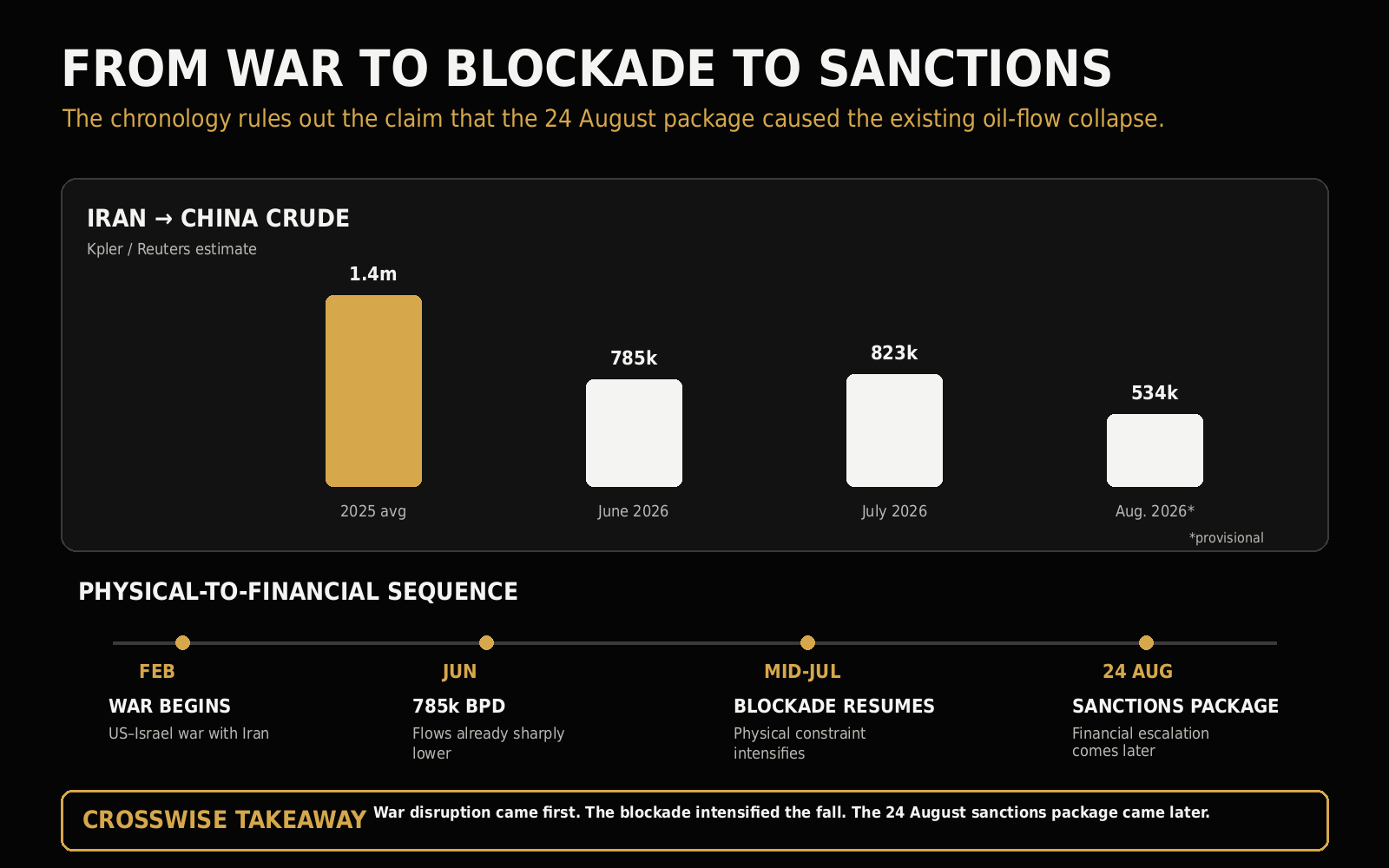
FIGURE 1 — War → blockade → sanctions: the chronology behind the oil-flow collapse.
So the new sanctions did not cause the collapse already visible in the data
This is one of the edition’s clearest findings.
The current oil-flow decline cannot reasonably be presented as evidence that Economic D-Day is already working.
The decline began earlier. The stronger causal explanation is: 1) war disruption; 2) energy and shipping disruption; 3) renewed physical blockade; 4) only then the 24 August sanctions escalation.
That does not make financial sanctions unimportant. It means the current missing barrels are primarily a physical-coercion story.
Physical and financial coercion solve different problems
Financial coercion attempts to make commerce illegal, expensive, risky, difficult to finance and difficult to monetise.
Physical coercion attempts to prevent the commodity from moving at all.
Under current conditions, physical coercion is producing the clearer immediate effect on export volumes.
That balance could change. A blockade may not be sustainable indefinitely. If shipping normalises, the financial architecture again becomes central.
Washington has an escalation ladder—not one financial nuclear option
The sanctions debate is often framed too crudely. It is not leave China untouched versus fully block ICBC.
Treasury can climb gradually through vessels; shell companies; traders; independent refiners; financial intermediaries; smaller banks; correspondent-account restrictions; subsidiary-level sanctions; restrictions against larger banks; and full blocking sanctions against globally systemic institutions.
It can also use licences, wind-down periods, transaction-specific prohibitions and narrower banking restrictions.
So either America does nothing or detonates the global financial system is a false binary.
The higher Washington climbs, the more expensive the weapon becomes
At the lower end, sanctioning a shadow tanker creates minimal direct systemic risk.
At the upper end, restricting a major Chinese G-SIB could affect international trade finance, correspondent banking, corporate payments, US companies, financial markets and the wider US–China relationship.
That produces a central relationship: target importance rises → potential leverage rises; but simultaneously collateral cost rises.
This is the credibility frontier. American power does not hit a simple hard ceiling. It becomes progressively more expensive to exercise.
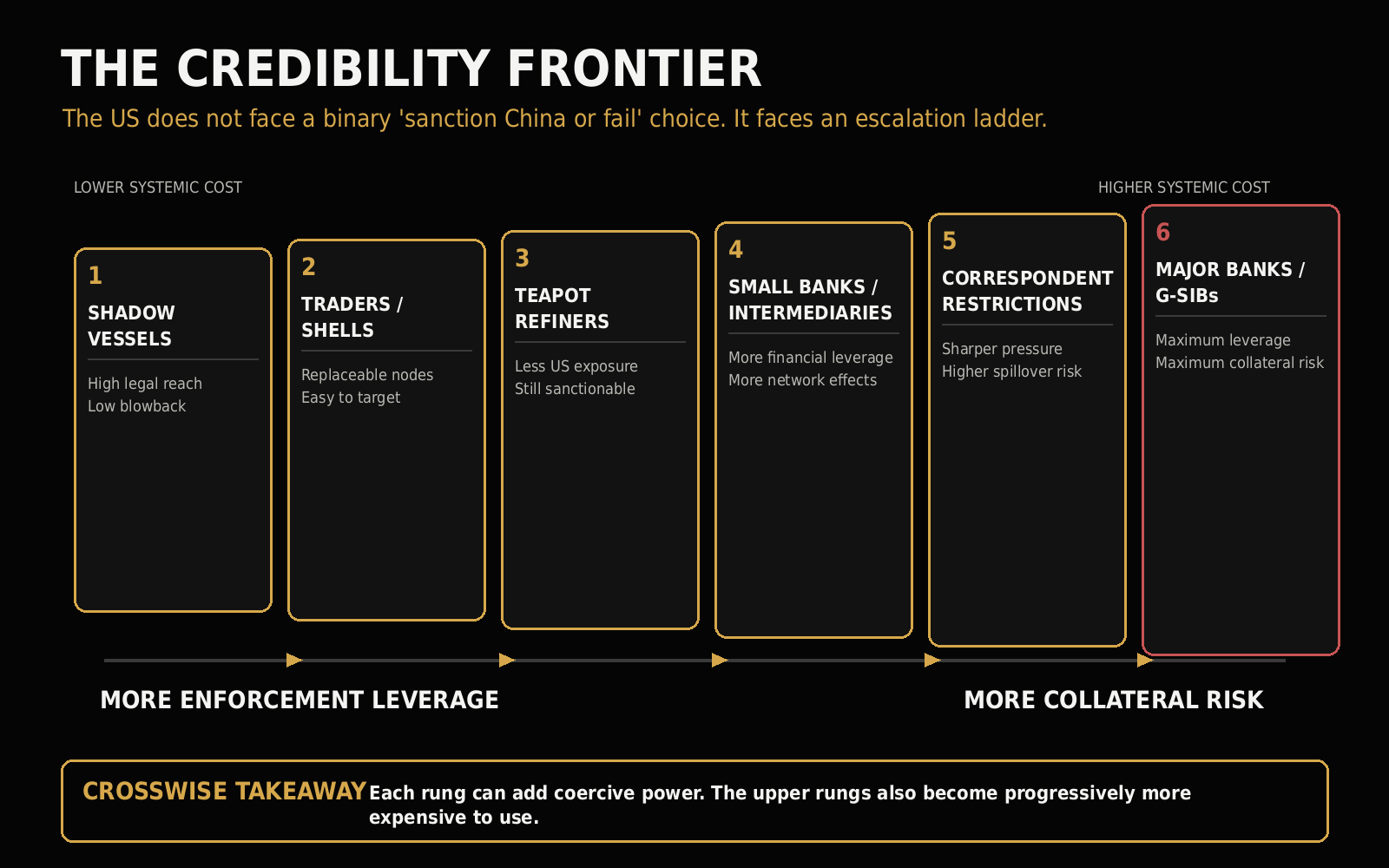
FIGURE 2 — The credibility frontier: more consequential targets offer more leverage, but also more blowback.
Bessent’s remark is evidence of calibration, not surrender
When Bessent asked why he would want to “blow up the global financial system,” he was explaining the pace and sequencing of sanctions escalation.
The remark is revealing. But it does not mean China’s large banks can never be sanctioned.
Treasury has intermediate options. The better interpretation is that Washington recognises that upper-end financial coercion produces collateral costs beyond Iran.
And Bessent’s promised financial-institution designation before the end of this week means that proposition is about to face a live test.
China can retaliate outside finance
The sanctions contest is not confined to banking.
The familiar fear is that China dumps US Treasuries. That is generally overstated.
China remains a significant holder, and in an already stressed bond market large sales could create some additional volatility at the margin. But Beijing has been reducing its Treasury holdings for years without demonstrating an ability to simply crash the market at will.
A more credible source of leverage lies elsewhere.
China remains heavily positioned in supply chains for rare-earth processing, permanent magnets, gallium, germanium and other strategic materials. And Beijing has demonstrated a willingness to use export controls.
That creates an important cross-domain relationship: American financial chokepoints can be answered with Chinese industrial chokepoints.
The capability is established. Whether Beijing would deploy that leverage specifically in response to Iran-related US sanctions is not.
02 — THE PERSPECTIVES
THE CASE FOR MAXIMUM PRESSURE: CHINA WILL NOT RISK ITS BIGGER INTERESTS FOR IRAN
The strongest pro-sanctions case is straightforward.
Iran matters to China. But America and the wider global financial system matter much more.
Cheap Iranian oil is attractive to independent refiners. It is not obviously worth risking major banks, international markets, technology access, global trade and US financial relationships.
Washington therefore may never need to impose its most disruptive sanction. The threat may be sufficient.
Historically, institutions have often abandoned Iran business before formal designation because exclusion from the US system would be too costly.
Under this interpretation, the most effective sanction is the one Treasury never needs to impose.
Strongest evidence: Large internationally exposed Chinese firms generally avoid Iranian crude. Bank of Kunlun later curtailed Iran-related business under renewed US pressure.
Weakness: The residual trade has increasingly migrated towards actors less sensitive to that threat.
CROSSWISE WEIGHT: MODERATE–HIGH
THE CASE THAT SANCTIONS ARE SELECTING FOR HARDER TARGETS
The strongest opposing argument is structural.
Earlier rounds of sanctions have already removed many of the easiest actors.
The companies still willing to conduct Iran business are increasingly comfortable operating through limited Western exposure, opaque ownership, shadow logistics and non-dollar payment mechanisms.
Sanctioning them can still impose cost. But if one tanker is replaced, one refinery substituted or one intermediary recreated, Washington may be disrupting nodes more effectively than it is shutting the network.
The evidence is consistent with this mechanism. What is not yet proven is its current magnitude.
Because the blockade is suppressing trade physically, we cannot cleanly observe how resilient the residual financial network would be on its own.
CROSSWISE WEIGHT: MODERATE–HIGH as a mechanism; UNRESOLVED as a measured current diminishing-returns effect.
THE CASE THAT THE FINANCIAL DEBATE IS CURRENTLY SECONDARY
The strongest challenge to the entire sanctions frame is simple.
The oil is already difficult to move.
A blockade can achieve something financial sanctions cannot: prevent the commodity from reaching the buyer regardless of payment method.
Under current conditions, war and physical interdiction are doing more visible work on export volumes than the sanctions announced this week.
CROSSWISE WEIGHT: HIGH for current conditions.
Limitation: If the blockade eases, the financial question becomes central again.
THE CASE THAT DOLLAR POWER REMAINS UNIQUE
RMB settlement does not eliminate the structural importance of the US financial system.
The United States does not need every Iran transaction to be denominated in dollars. It needs important foreign institutions to continue valuing US banking access, American markets, dollar liquidity and international counterparties.
That remains a formidable source of power.
CROSSWISE WEIGHT: HIGH
THE CASE THAT CHINA HAS ITS OWN CHOKEPOINTS
American policymakers cannot assume coercion is one-way.
China possesses material leverage in industrial supply chains. That gives Beijing potential retaliation options in sectors where substitution is slow.
The capability is real. But willingness is conditional.
China would have to weigh retaliation against damage to its own exporters, acceleration of Western diversification and escalation in wider US–China relations.
CROSSWISE WEIGHT: Capability HIGH; Probability of use over Iran sanctions MODERATE / UNRESOLVED.
03 — EVIDENCE CHECK
CLAIM: “Economic D-Day imposed maximum sanctions immediately.”
CROSSWISE: FALSE / MISLEADING
Treasury imposed a substantial package. But the most consequential potential sanctions remain available for escalation. And Bessent has already said another major financial-institution designation is expected before the end of the week.
CLAIM: “Washington has sanctioned China’s major banks over Iran.”
CROSSWISE: FALSE
It has not done so in the current package.
CLAIM: “China is Iran’s dominant oil customer.”
CROSSWISE: SUPPORTED
China absorbs the overwhelming majority of Iranian seaborne crude. The exact share depends on methodology.
CLAIM: “Chinese state oil companies dominate Iranian purchases.”
CROSSWISE: NOT SUPPORTED
Independent refiners are the principal current buyers.
CLAIM: “The teapots are immune to American sanctions.”
CROSSWISE: FALSE / OVERSTATED
Their lower international exposure can make them harder to deter. It does not make them immune.
CLAIM: “Paying in renminbi defeats US sanctions.”
CROSSWISE: FALSE / MISLEADING
RMB settlement reduces dollar dependence for the transaction. It does not automatically remove the participating institution from US sanctions exposure.
CLAIM: “China’s largest banks currently finance Iran’s oil trade.”
CROSSWISE: NOT ESTABLISHED
Crosswise found no publication-grade evidence proving current direct G-SIB clearing of Iranian crude payments.
CLAIM: “America must sanction a Chinese G-SIB or its Iran policy fails.”
CROSSWISE: NOT SUPPORTED
Washington possesses a broad escalation ladder below full blocking sanctions.
CLAIM: “Major Chinese banks are simply too big to sanction.”
CROSSWISE: OVERSTATED
Systemic importance raises the cost of sanctions. It does not create legal immunity.
CLAIM: “Bessent admitted America has hit the sanctions ceiling.”
CROSSWISE: OVERSTATED
His comment demonstrates concern about collateral costs and sequencing. It does not establish an absolute ceiling.
CLAIM: “The collapse in Iranian oil exports proves the 24 August sanctions are working.”
CROSSWISE: FALSE / CAUSALLY MISLEADING
The decline began during the war and accelerated after the renewed July blockade. The 24 August package arrived later.
CLAIM: “The blockade proves financial sanctions failed.”
CROSSWISE: ALSO FALSE
The instruments solve different problems. A blockade stops physical movement; financial sanctions increase the cost and difficulty of trading and monetising whatever can still move.
CLAIM: “Iran still sells some oil, so sanctions do not work.”
CROSSWISE: FALSE
Sanctions can reduce buyer competition, increase logistics costs, constrain financing, impair settlement and reduce realised revenue without eliminating every barrel.
CLAIM: “If sanctions worked, Iran would already have capitulated.”
CROSSWISE: TOO SIMPLE
Economic degradation is supported; operational constraint is partly supported; coercive political success is not established.
CLAIM: “Zero leakage is realistically achievable.”
CROSSWISE: NOT SUPPORTED
It is Washington’s stated enforcement doctrine. The evidence does not establish literal elimination of all leakage as an achievable endpoint.
CLAIM: “China can crash the Treasury market by selling its holdings.”
CROSSWISE: OVERSTATED
Large sales could create additional volatility, particularly in already-stressed market conditions, but China cannot convert its holdings into a costless financial weapon.
CLAIM: “Critical minerals could constrain US escalation.”
CROSSWISE: SUPPORTED AS CAPABILITY
China possesses material industrial leverage. Whether it would use that leverage specifically over Iran-related sanctions is unresolved.
04 — WHAT WE DON’T KNOW
1. Which Chinese banks currently handle Iran-related oil settlement
Crosswise could not map the current network bank by bank to publication standard. We cannot establish which smaller banks are involved, transaction values, whether larger banks participate indirectly, or how much settlement occurs outside conventional banking.
2. How much Iranian oil income is genuinely usable
A barrel reaching China does not reveal whether Tehran receives freely convertible currency, restricted RMB, purchasing power inside China, barter value or third-country settlement. Gross oil sales are therefore not the same as strategically usable foreign exchange.
3. How resilient the independent-refinery network would be without the blockade
Independent buyers appear more sanctions-resistant than major state refiners. But the current physical blockade prevents us from cleanly observing how resistant the network would be to financial pressure alone. This is why the sanctions-selection thesis remains partly a forward-looking hypothesis.
4. How quickly sanctioned buyers are replaced
There are many independent refiners. But Crosswise cannot presently quantify substitution speed, additional discounts, financing penalties or the capacity limit of replacement buyers.
5. Iran’s precise sanctions haircut per barrel
Crosswise rejected false precision here. Realised value varies with crude grade, benchmark, shipping, war risk, discounts or premiums, intermediaries and settlement restrictions. The direction of economic loss is supported. The exact number is not.
6. How long the blockade can be sustained
The present blockade carries military risk, diplomatic cost, shipping disruption, escalation risk, legal and political constraints. If it ends, financial sanctions again become much more important.
7. How far Washington is actually willing to climb
Treasury possesses extensive legal authorities. We do not know what target comes next, whether this week’s promised institution is Chinese, how systemically important it will be, or what collateral cost Washington will tolerate.
8. Whether China would protect Iran commerce at significant cost to itself
China opposes unilateral US sanctions. That does not tell us how far Beijing would go to protect Iranian trade. Its wider interests with the United States, global markets, financial institutions and technology supply chains are much larger.
9. Whether China would retaliate through critical minerals
China possesses the capability. That is high confidence. Its willingness to use that capability specifically in response to Iran-related sanctions is unresolved.
10. Whether current economic pressure will change Iranian policy
Iran is experiencing severe economic stress. That does not establish whether Tehran will negotiate, alter nuclear policy, change regional strategy, escalate or absorb the pressure.
11. Whether zero leakage is a literal objective or maximalist enforcement language
Treasury uses the phrase. In practice, policymakers may regard lower revenue, fewer buyers, impaired settlement and greater transaction costs as meaningful success even with continuing leakage.
05 — CROSSWISE ASSESSMENT
American financial power over Iran remains formidable.
But the evidence does not show that financial sanctions are currently responsible for the sharp collapse in Iranian oil exports.
The chronology matters.
The US–Israel war began in February. Iranian oil deliveries into China had already fallen sharply by June. Washington then resumed enforcement of its maritime blockade in July. Only after that physical contraction was clearly underway did Treasury launch Operation Economic Outcast on 24 August.
Financial sanctions and physical interdiction therefore need to be separated.
Sanctions attempt to make commerce more expensive, more dangerous, harder to finance and harder to monetise.
A blockade can prevent the commodity from moving.
Under current conditions, physical coercion is producing the clearer effect on export volume.
That is not evidence that financial sanctions have failed. It means today’s most visible indicator—the missing barrels—is being driven primarily by another instrument.
The financial question becomes more interesting if physical restrictions ease.
Then Washington confronts an Iran–China trade system that has adapted to years of enforcement.
Large internationally exposed Chinese companies generally avoid Iranian crude. Independent refiners dominate much of what remains. RMB settlement and opaque intermediaries reduce direct dependence on the conventional dollar channel.
The evidence is therefore consistent with a sanctions-selection effect: internationally exposed firms tend to leave first, increasing the share of residual commerce conducted by actors with less to lose from American exclusion.
But we should not claim more than the evidence shows.
Whether that process has already produced materially diminishing returns for the current financial campaign cannot be cleanly measured while the blockade is simultaneously suppressing the trade.
The post-blockade environment would provide a much better test.
Washington also does not face a binary choice between leaving Chinese finance untouched and fully blocking a Chinese G-SIB.
Treasury has a long escalation ladder. It can move through vessels, refiners, traders, intermediaries, smaller banks, correspondent restrictions, subsidiaries and progressively larger financial institutions.
As Washington climbs that ladder, potential leverage rises. So do the costs.
That is the credibility frontier.
The existence of systemic Chinese banks does not mean American financial power ends. It means the most consequential uses of that power become increasingly expensive.
Bessent’s comment about not wanting to “blow up the global financial system” should therefore be read as a statement about calibration rather than surrender.
And Treasury may already be preparing to test the next rung. Bessent says another major financial-institution sanctions announcement is expected before the end of this week.
If Treasury imposes materially stronger restrictions—particularly against a Chinese institution—without producing significant collateral disruption, the credibility frontier moves upward. If the target is peripheral, the central question remains unresolved.
China also possesses economic leverage of its own. Its strongest retaliation may not be financial. It may lie in industrial supply chains for rare earths, magnets, gallium, germanium and other strategically important inputs.
China’s capability to impose such costs is clear. Its willingness to deploy them over an Iran-related sanctions dispute is not.
So the evidence supports a narrower conclusion than either extreme in the sanctions debate.
America can make Iran considerably poorer and its trade considerably harder without economically isolating China.
Washington retains enormous financial leverage and a substantial escalation ladder below full blocking sanctions against China’s largest banks.
But the residual Iran–China trade has increasingly shifted towards independent refiners, opaque intermediaries and non-dollar channels with comparatively less exposure to the United States.
That does not make the network immune. It makes it harder to coerce.
The evidence is consistent with the idea that sanctions progressively select for tougher residual targets—but the present blockade prevents us from cleanly measuring how much that effect has reduced the marginal power of financial sanctions today.
Washington therefore faces a credibility frontier, not a simple sanctions ceiling.
Right now, physical power is stopping more barrels than financial power.
If the blockade eases, the cleaner test begins: Can Washington’s financial threat still deter the actors that years of sanctions have left behind?
CROSSWISE CONFIDENCE
China is Iran’s dominant oil customer: VERY HIGH
The exact percentage varies by methodology, but the concentration is overwhelming.
Independent Chinese refiners are the principal buyers: HIGH
Supported by US government and commercial evidence.
The current export collapse predates the 24 August sanctions package: VERY HIGH
The chronology is clear.
War and physical blockade explain most of the current export contraction: HIGH
The physical decline began before the financial package.
The 24 August sanctions package caused the existing oil collapse: VERY LOW
Chronology contradicts the proposition.
Iran–China trade has shifted towards comparatively lower-US-exposure actors: MODERATE–HIGH
Directionally well supported. Precise evolution over time is not directly measured.
This shift has already produced demonstrable diminishing financial returns: UNRESOLVED
The blockade prevents a clean test.
RMB settlement eliminates US leverage: LOW
Transaction-level dollar avoidance is not institution-level immunity.
Current direct Chinese G-SIB involvement is demonstrated: LOW
No publication-grade proof establishes that role.
Washington can impose severe pressure without fully blocking a Chinese G-SIB: HIGH
Treasury possesses substantial intermediate tools.
Systemic importance raises the cost of upper-end US sanctions: HIGH
This is the core credibility-frontier finding.
Literal zero leakage through financial sanctions alone is achievable: LOW
The evasion architecture makes complete elimination extremely difficult.
Sanctions are causing economic degradation: HIGH
Economic impact is strongly supported.
Sanctions are producing operational constraints on some Iranian state capacity: MODERATE–HIGH
Likely, but difficult to isolate precisely.
Sanctions have achieved Iranian political capitulation: NOT ESTABLISHED
Economic pain and coercive political success are separate tests.
China possesses significant critical-mineral retaliation capability: HIGH
The industrial concentration and existing export-control capability are established.
China would use critical-mineral retaliation specifically over Iran sanctions: MODERATE / UNRESOLVED
Capability does not establish willingness.
WHAT WOULD CHANGE OUR ASSESSMENT?
Bessent’s promised financial-institution sanction lands against a significant Chinese target
If Treasury materially escalates against a major Chinese institution this week and financial markets absorb it with limited disruption, the credibility frontier moves upward.
A globally integrated Chinese institution voluntarily exits Iran business solely because of the current threat
That would strongly support the argument that Treasury can exploit upper-end leverage without needing to impose its most disruptive sanctions.
Warning periods expire, Chinese activity continues and Washington does not escalate
That would weaken the credibility of future secondary-sanctions threats.
Oil exports rebound after the blockade eases despite continuing financial sanctions
That would strengthen the conclusion that physical interdiction was doing most of the immediate work. It would also provide the cleanest test of the sanctions-selection hypothesis.
Iranian exports remain severely depressed after physical constraints disappear
That would shift considerably more causal weight towards financial sanctions.
Chinese state oil majors openly resume Iranian crude purchases
That would represent a material increase in Beijing’s willingness to expose internationally integrated firms.
Transparent evidence ties a Chinese G-SIB directly to large current Iran settlement flows
That would materially alter the bank-level analysis.
China retaliates through critical-mineral restrictions
That would confirm that US financial coercion must be analysed together with Chinese industrial leverage.
CROSSWISE RADAR
EUROPE · INDUSTRIAL POLICY
Europe’s second China shock is increasingly becoming a competitiveness problem rather than merely a tariff problem. Product-specific duties can change trade flows. They cannot solve energy-cost disadvantages, weak investment or slower industrial cycles.
What to watch: whether Brussels moves from trade defence towards explicit preservation of selected strategic industrial capabilities.
ICELAND · EUROPEAN UNION
Iceland’s EU referendum remains too close to call. The critical distinction is still between support for reopening negotiations and support for eventual membership.
What to watch: whether the 29 August result is treated as a negotiating mandate—or inaccurately reported as a decision to join the EU.
INDONESIA · CHINA
Indonesia continues testing whether multi-alignment can prevent economic concentration from becoming strategic dependence. Chinese economic and industrial ties are deepening while Jakarta simultaneously broadens its Western and regional security relationships.
What to watch: ownership, technology-transfer and supply-chain terms in defence-industrial cooperation.
ARCTIC SHIPPING
China’s Northern Sea Route service is entering its commercial test. Transit time alone does not establish a viable liner service.
What to watch: load factors, return cargo, insurance, reliability and whether repeat operations expand after the current season.
THE RECEIPTS
Research cut-off: 25 August 2026
RESEARCH LEDGER
Research A: independent source-led investigation.
Research B: independently commissioned Gemini research pass.
Post-research process: Research A → independent Research B → A/B gap analysis → targeted verification → editorial judgment → complete draft → Claude hostile red team → adjudication → final corrected master.
The final evidence base draws principally on US Treasury / OFAC; maritime tracking; sanctions-law authorities; Chinese corporate and regulatory material; globally systemic bank classifications; critical-mineral data; independent commodity and financial reporting.
Crosswise does not count repeated media stories based on the same Kpler estimate, Treasury release, OFAC designation or official statement as independent corroboration.
CORE EVIDENTIARY CHAINS
1. US TREASURY / OFAC — 24 AUGUST PACKAGE
Used to establish Operation Economic Outcast; nearly 60 sanctioned targets; sectoral determinations covering aviation, digital assets, gold, shipping and technology; zero-leakage language; general-licence changes; and secondary-sanctions architecture. Type: primary / official. Limitation: Treasury’s own claims about policy effectiveness are not treated as independent evaluation.
2. US TREASURY / OFAC — HISTORICAL SECONDARY-SANCTIONS AUTHORITY
Used for correspondent-account restrictions; payable-through-account restrictions; Bank of Kunlun enforcement; and historical sanctions mechanisms. Type: primary / legal.
3. KPLER — IRAN→CHINA OIL FLOWS
Used for the principal monthly series: ~1.4m bpd average in 2025; ~785k June 2026; ~823k July; ~534k provisional August. Type: commercial maritime intelligence. Limitation: dark AIS activity, ship-to-ship transfers, relabelling and destination inference mean these are estimates rather than perfect census data.
4. REUTERS + KPLER — WAR / BLOCKADE / FLOW CHRONOLOGY
Used for the February-onward war context; renewed blockade enforcement in July; timing relative to declining oil flows; and shipping disruption. Important source-independence caveat: the physical-flow series and much of the war/blockade causal chronology sit partly within the same Reuters/Kpler evidentiary ecosystem. They should not be treated as fully independent corroborating chains.
5. US GOVERNMENT + COMMERCIAL TRACKING — CHINA SHARE
Used to establish that China absorbs the overwhelming majority of Iranian seaborne crude. Commercial tracking places the share above 80%; US estimates place it around 90%. Limitation: denominator and tracking methodology vary.
6. TREASURY + INDEPENDENT ENERGY REPORTING — BUYER STRUCTURE
Used to establish that independent Chinese refiners buy the majority of Iran’s China-bound crude; large state refiners generally avoid direct exposure; and some independent refiners retain limited US-system connections.
7. BANK OF KUNLUN RECORD
Used for historical Iran-related payment concentration; Chinese compartmentalisation; 2012 US sanctions; and later curtailment of Iran-related payments. This chain supports both Chinese adaptation and US coercive reach.
8. FSB — CHINESE G-SIB STATUS
Used to establish systemic importance of major Chinese banks. Limitation: G-SIB designation does not imply current Iran involvement.
9. CHINESE BANK CORPORATE DISCLOSURES
Used for scale, interconnectedness and international operations. Not used as evidence of Iran-related misconduct.
10. US / INTERNATIONAL CRITICAL-MINERAL DATA
Used to assess China’s industrial leverage in rare earths, magnets, gallium, germanium and strategic-material processing.
11. CHINESE EXPORT-CONTROL RECORD
Used to establish that Beijing possesses and has previously used industrial export controls. This supports retaliation capability, not certainty that China will retaliate over Iran sanctions.
HOW CROSSWISE COUNTS
Crosswise does not treat repetition as corroboration.
If multiple outlets quote the same Kpler tanker estimate, that remains principally one maritime-tracking chain.
If several articles quote the same Treasury designation notice, that remains one Treasury chain.
If Treasury describes its own sanctions as successful, that is evidence of Treasury’s assessment—not independent proof that Treasury’s assessment is correct.
Likewise: AI agreement is not corroboration. Research B generated several highly specific claims that failed primary verification. They were removed rather than averaged into the article.
CLAIMS REJECTED OR DOWNGRADED DURING VERIFICATION
· the Research B 42/65/18/4 sanctions breakdown;
· the purported 45-day Malaysia/Singapore ultimatum;
· the fully specified regional-bank → Iranian-central-bank payment chain;
· a stable $10–15 Iranian crude discount;
· a $50 usable-revenue-per-barrel model;
· a 30% sanctions tax;
· a 400-vessel Iran-specific shadow fleet;
· universal zero US exposure among teapot refiners;
· proven current Chinese G-SIB participation in Iran clearing;
· the proposition that critical-mineral retaliation is certain simply because China possesses the capability;
· the proposition that measurable diminishing financial returns have already been demonstrated under current blockade conditions.
KEY CLAIMS TRIANGULATED
1. Operation Economic Outcast immediately imposed maximum sanctions.
Finding: false / misleading.
2. China’s major banks were sanctioned.
Finding: false.
3. China is Iran’s overwhelmingly dominant oil customer.
Finding: supported.
4. Independent refiners dominate Chinese buying.
Finding: supported.
5. Teapots are immune to US pressure.
Finding: false / overstated.
6. RMB settlement eliminates US leverage.
Finding: false.
7. China’s G-SIBs currently process Iranian oil payments.
Finding: not demonstrated.
8. Bank of Kunlun proves US sanctions simply defeated China.
Finding: partly supported / incomplete.
9. Bank of Kunlun demonstrates Chinese compartmentalisation.
Finding: supported with qualification.
10. The 24 August sanctions caused the current collapse in oil flows.
Finding: contradicted.
11. War and physical blockade are currently major causal drivers.
Finding: strongly supported.
12. America must fully sanction a Chinese G-SIB to exert severe pressure.
Finding: not supported.
13. China’s systemic banks are absolutely too big to sanction.
Finding: overstated.
14. Treasury has substantial intermediate options.
Finding: supported.
15. Literal zero leakage is presently demonstrably achievable.
Finding: not supported.
16. Continued exports prove sanctions have failed.
Finding: false.
17. Economic degradation equals political capitulation.
Finding: false.
18. China can costlessly crash the Treasury market.
Finding: overstated.
19. China possesses meaningful critical-mineral retaliation capability.
Finding: supported.
20. China will necessarily deploy that capability over Iran sanctions.
Finding: unresolved.
WHAT WE COULD NOT OBTAIN
· which Chinese banks currently process specific Iran oil-settlement flows;
· how much Iranian RMB is restricted versus freely transferable;
· Iran’s exact net usable revenue per sanctioned barrel;
· a current Iran-specific shadow-fleet size under one consistent definition;
· precise substitution rates among Chinese independent refiners;
· Treasury’s confidential escalation plans;
· the identity of the financial institution Bessent says will be targeted later this week;
· Beijing’s internal threshold for defending Iran-related commerce;
· the probability or magnitude of Chinese critical-mineral retaliation;
· the causal connection between current economic pressure and any eventual Iranian political concession.
Those uncertainties remain explicit.
RADAR SOURCES
EUROPE · INDUSTRIAL POLICY
Eurostat; ECB; European Commission; industrial-policy research; specialist and independent European business reporting.
ICELAND · EU
Alþingi; Government of Iceland; EFTA/EEA; Statistics Iceland; Central Bank of Iceland; Gallup; Maskína; EU institutional material; Icelandic reporting.
INDONESIA · CHINA
Indonesian and Chinese government records; SIPRI; Australian, US and Japanese defence documentation; trade statistics; specialist defence reporting.
ARCTIC SHIPPING
Rosatom / Northern Sea Route Administration; Centre for High North Logistics; carrier documentation; maritime intelligence; Suez Canal Authority.
FOUND SOMETHING WE MISSED?
Crosswise welcomes evidence that challenges its conclusions.
If you possess a sanctions record, banking document, vessel dataset, trade record, primary government document, financial filing or other evidence that could materially alter this assessment:
editor@readcrosswise.com
Material factual errors will be corrected transparently rather than silently amended.
CROSSWISE
The facts. The perspectives. The evidence. The unknowns. Our assessment.
One consequential story each weekday. Read crosswise.