
Canada is far more exposed to a trade rupture than the United States. But North American manufacturing was deliberately built as an integrated regional system, and Washington is increasingly asking whether that system should serve regional efficiency or specifically American industrial capacity. Existing USMCA evidence suggests the two goals can diverge: tighter localisation can raise domestic parts production while increasing vehicle costs and outside imports.
CROSSWISE RESEARCH
Independent Research A + independent Gemini Research B · A/B gap analysis · targeted verification · Claude hostile red-team audit · adjudication · primary tariff law · Statistics Canada value-added data · USITC modelling · material uncertainties retained
Research cut-off: 26 August 2026
WHY THIS STORY
Washington has reopened one of the largest questions in global trade: what happens when a government tries to make a regional production system more national?
The immediate dispute is with Canada. The United States has imposed new tariff measures on selected Canadian goods, threatened much broader automotive tariffs from January 2027, and declined to extend USMCA for a fresh 16-year term during the 2026 joint review.
The surface story is another North American trade fight. The deeper story is more consequential.
North American manufacturing was not built around neat national boxes. It was deliberately organised around a regional production platform: US engineering and demand, Canadian assembly and inputs, Mexican production, cross-border suppliers and continental scale.
That creates an analytical trap. A product can be Canadian for customs purposes while containing substantial US-origin inputs. But the red-team review also found the opposite trap: the United States has already tried to design around this problem by excluding identified US content from the baseline tariff base for qualifying automobiles.
So the question is not simply whether America is tariffing itself. That formulation is too crude.
The real question is whether Washington can sacrifice some of the efficiency of North American integration and receive enough specifically American productive capacity in return.
The issue is not free trade versus protectionism. It is regional industrial efficiency versus national industrial localisation.
RESEARCH SUMMARY
Crosswise conducted two independent research passes, then ran an A/B gap analysis, targeted verification and a hostile red-team review before adjudication.
The strongest early frame was: “Can America tariff Canada without tariffing itself?” That frame did useful discovery work, but it did not survive intact.
The key red-team correction was tariff-design specific: under the baseline Section 232 auto regime, USMCA-qualifying Canadian and Mexican vehicles can identify US content, and the 25% tariff applies to the non-US content. That substantially weakens the claim that the baseline auto tariff directly taxes all American content returning from Canada.
But the correction does not eliminate US self-cost. It changes its location. The cost is less about directly taxing US parts and more about disrupting a production system whose efficiency depends on regional scale, predictable rules and cross-border specialisation.
The final article therefore tests three propositions:
· Canada bears the larger aggregate immediate risk because its auto sector depends overwhelmingly on US demand.
· Canadian manufactured exports contain substantial gross US imported input content, so customs nationality and economic origin diverge.
· Tighter localisation can produce upstream US gains while creating downstream competitiveness costs, a trade-off already visible in USMCA evidence.
01 — WHAT WE KNOW
The current dispute has three different tariff layers
The first is the baseline automotive tariff architecture, including a 25% Section 232 tariff with provisions allowing identified US content in qualifying Canadian/Mexican vehicles to be excluded from the tariff base.
The second is the July Section 338 action: an additional 50% tariff on nearly $20bn of specified Canadian imports, through separate actions covering categories including motor vehicles, alcoholic beverages and dairy.
The third is the threatened January 2027 escalation: President Trump has threatened a broader 50% tariff on Canadian cars, trucks and automotive parts. That is a future threat, not current universal law.
These layers must not be merged. The legal basis, coverage and tariff base differ.
Canada is much more exposed to the US market overall
Canada’s automotive sector is overwhelmingly dependent on American demand. Verified evidence shows more than 93% of Canadian motor-vehicle exports go to the United States.
In 2024, 76.4% of Canadian automobile and light-duty vehicle output and payroll employment depended on US demand.
That makes Washington’s leverage real. Canada cannot rapidly redirect North American-specification vehicles, plant capacity and supplier networks to Europe or Asia.
The United States also has concentrated dependencies on Canada
The relationship is asymmetric, not one-sided. Canada depends on the US broadly; the US depends on Canada selectively.
Energy is the clearest example. Canada is the primary source of US crude imports, with US imports from Canada around 3.9m bpd in 2025 and US crude exports back to Canada much smaller.
Other concentrated dependencies include potash, aluminium, selected metals and specialised automotive inputs.
The trade deficit is fundamentally shaped by energy
The US goods deficit with Canada was about $48.3bn in 2025. Canadian energy exports are large enough that energy more than accounts for that headline goods deficit.
That matters because a deficit driven by crude imports is not the same thing as a deficit proving broad Canadian manufacturing displacement of US industry.
Once energy is separated, the US-Canada trade relationship looks materially different from the political rhetoric around the headline deficit.
Customs nationality and economic nationality are not the same
Statistics Canada provides the edition’s strongest quantitative spine. In 2024, Canadian production generated approximately C$922bn in exports. About C$644bn went to the United States. Producing those US-bound exports required roughly C$118bn of imported inputs from the United States.
For Canadian manufacturing shipments to the US, worth approximately C$324bn, more than one-quarter reflected embedded US imported content.
This does not mean the same thing as US value added or US GDP contribution. It is gross imported US input content. But it still shows that the customs label “Canada” can overstate how economically Canadian some exports are.
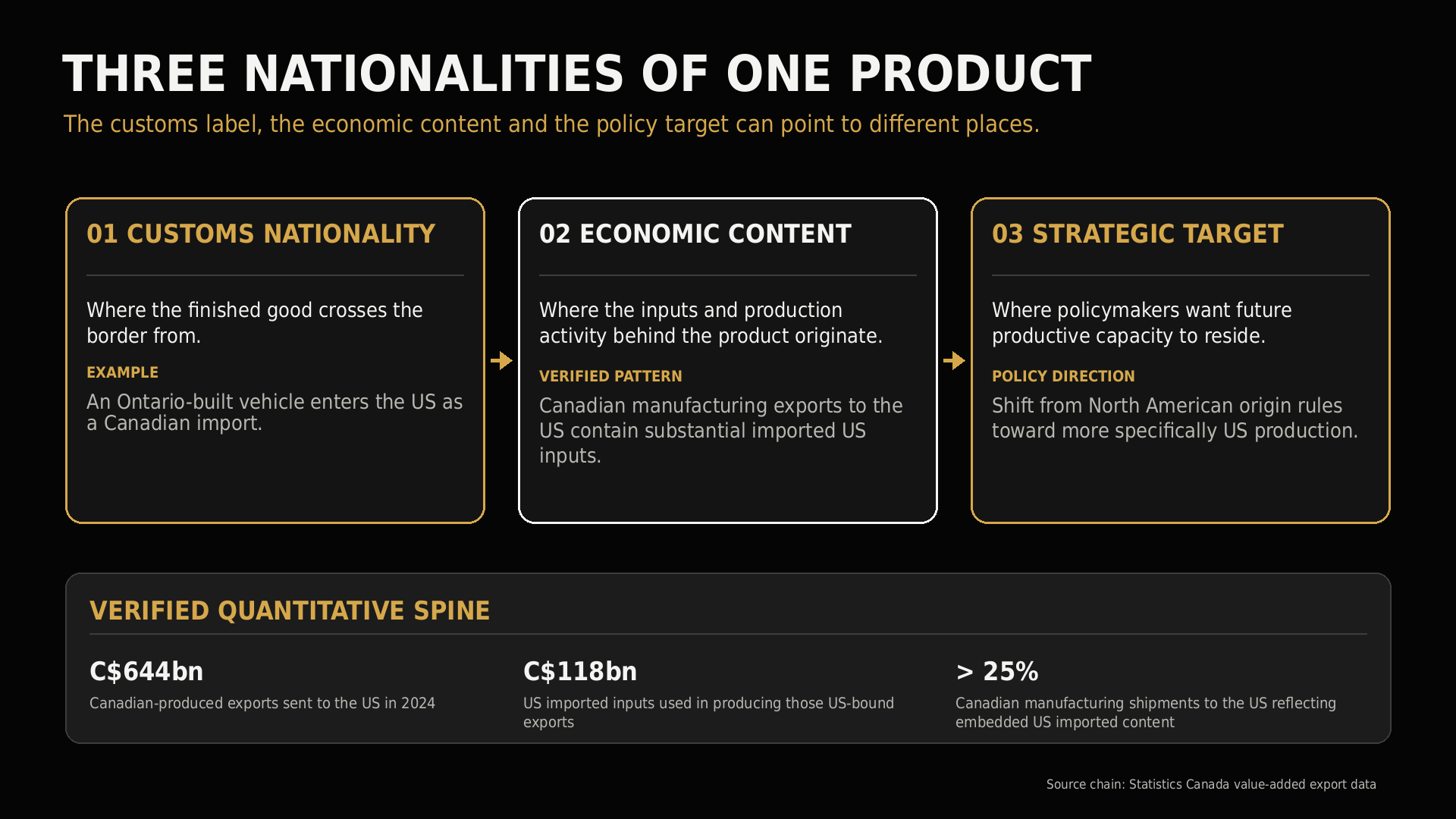
FIGURE 1 — Customs nationality, economic nationality and strategic nationality can diverge inside one North American product.
The US government has already tried to avoid directly taxing US content
This is the most important correction from the hostile red team. For USMCA-qualifying automobiles under the baseline tariff architecture, identified US content can be carved out of the tariff base.
That means the strongest simple version of “America is tariffing itself” is wrong. The policy is not blindly taxing every American part embedded in a Canadian-built vehicle.
But avoiding direct taxation of US content does not remove all US cost. Regional scale, component flows, compliance systems and investment decisions can still be disrupted.
USMCA already tested localisation
USMCA tightened automotive rules of origin relative to NAFTA. Light vehicles and core parts require 75% regional value content. Passenger vehicles face a 40% labour-value-content requirement, and trucks 45%, tied to production by workers earning at least $16/hour. Manufacturers also face a 70% North American steel/aluminium purchasing requirement.
USITC analysis found that these rules increased US parts and materials activity. But the same modelling also found slight increases in vehicle prices, slight reductions in some light-vehicle measures and increased imports from outside USMCA.
That is the core trade-off: localisation can strengthen parts of the domestic supply chain while making the final product more expensive or less competitive.
The 50% US-content proposal changes the philosophy
Current USMCA logic is regional: production qualifies when enough value is North American.
Current reporting indicates that Washington has proposed a 50% specifically US-made content floor during the review process. Crosswise treats this as a reported negotiating proposal, not enacted law.
If adopted, it would shift the philosophy from North American localisation toward US-specific localisation inside a regional agreement.
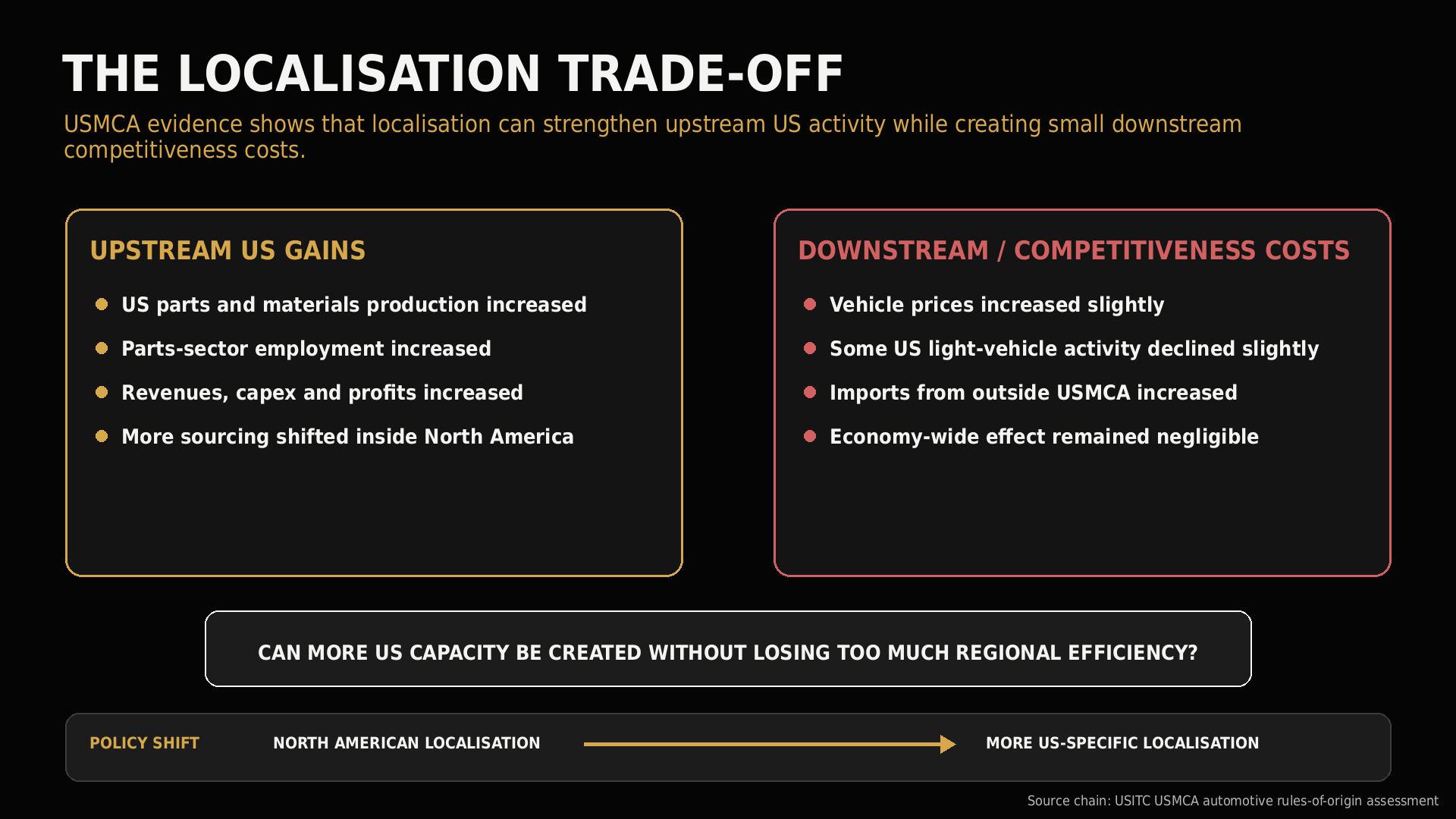
FIGURE 2 — Localisation can produce upstream gains and downstream costs at the same time.
02 — THE PERSPECTIVES
THE CASE FOR THE US POSITION: THE TRANSITION COST IS WORTH IT
The strongest case for Washington is that the current North American supply chain is exactly what policy is meant to change.
Canada’s automotive dependence gives the United States real leverage. If future market access requires more production inside the United States, companies may reallocate plants, suppliers and investment south of the border.
Short-run disruption then becomes the cost of rebuilding more national industrial capacity.
Weakness: the net reshoring payoff is not yet observable, and short-run production systems are sticky.
THE CASE AGAINST: LOCALISATION CAN WEAKEN THE PRODUCT IT PROTECTS
The strongest counterargument is that North American integration exists because it lowers costs and expands scale.
USITC evidence already shows the trade-off in smaller form: tougher local-content rules increased upstream US activity while raising prices and increasing outside imports.
The risk is that America obtains more domestic content per vehicle but fewer competitive North American vehicles.
Weakness: this is a risk, not a proven outcome of the current proposal.
THE CASE THAT THIS IS REALLY USMCA RENEGOTIATION
The threatened 50% tariff may be less a desired steady-state policy than a bargaining instrument.
Under this view, Washington is using maximum-pressure tariff threats to force Canada into stronger origin rules and more US-content commitments.
Weakness: threats can still create real investment uncertainty even if they are bargaining tools.
THE CASE THAT CANADA WILL CONCEDE
More than nine-tenths of Canadian motor-vehicle exports go to the US. That asymmetry is hard to escape.
Canada can retaliate politically and possesses concentrated leverage in energy and critical inputs, but it cannot easily replace the US auto market.
Weakness: bargaining pain does not guarantee Ottawa will concede every US demand.
03 — EVIDENCE CHECK
CLAIM: “The US is currently applying a universal 50% tariff on Canadian autos.”
CROSSWISE: FALSE
The 50% across-the-board automotive measure is a threatened January 2027 escalation, not current universal law.
CLAIM: “The July Section 338 action was just the same as the 25% auto tariff.”
CROSSWISE: CONTRADICTED
The Section 338 action imposed additional 50% duties on specified Canadian imports. It must be separated from the baseline Section 232 auto tariff.
CLAIM: “USMCA is ending now.”
CROSSWISE: FALSE
The agreement remains in force. Non-extension increases annual-review uncertainty; it does not immediately terminate USMCA.
CLAIM: “Canadian manufacturing exports embed substantial US inputs.”
CROSSWISE: SUPPORTED
Statistics Canada shows C$118bn of US imported inputs used in producing C$644bn of Canadian-produced exports to the US, and more than one-quarter embedded US imported content in Canadian manufacturing shipments to the US.
CLAIM: “That embedded content equals US value added.”
CROSSWISE: FALSE / MISLEADING
The correct phrase is gross imported US input content. It is not the same as US value added or US GDP contribution.
CLAIM: “Every Canadian-built vehicle contains 20–25% US value.”
CROSSWISE: NOT ESTABLISHED
Crosswise rejected that vehicle-level estimate. The verified data are at the aggregate manufacturing level.
CLAIM: “The baseline auto tariff directly taxes identified US content.”
CROSSWISE: GENERALLY NOT SUPPORTED
For qualifying vehicles, identified US content can be excluded from the tariff base.
CLAIM: “Tariffs can still impose costs on US industry.”
CROSSWISE: SUPPORTED
Even with a US-content carve-out, tariffs and localisation can raise costs through supply-chain restructuring, reduced scale, compliance costs, retaliation and downstream price effects.
CLAIM: “Tighter localisation automatically makes North America less competitive.”
CROSSWISE: NOT SUPPORTED
The trade-off is conditional. It depends on productivity, investment, scale and how the rules are designed.
CLAIM: “Existing USMCA rules produced both upstream gains and downstream costs.”
CROSSWISE: SUPPORTED
USITC evidence supports this directional trade-off, though many effects were slight and economy-wide effects were negligible.
CLAIM: “Current 2026 policy has already produced major reshoring.”
CROSSWISE: NOT ESTABLISHED
Announced or theoretical relocation is not completed capacity. The current evidence does not prove net-positive reshoring.
CLAIM: “Canada has no leverage.”
CROSSWISE: FALSE
Canada has concentrated leverage in energy, potash, aluminium and selected inputs, even though aggregate bargaining power favours Washington.
04 — WHAT WE DON’T KNOW
The exact US-content share of a representative Canadian-built vehicle
The verified Statistics Canada evidence is excellent at aggregate manufacturing level. It does not give a publication-grade model-by-model vehicle percentage.
The exact tariff incidence
A tariff is legally paid by the importer of record. The economic burden can be divided among Canadian exporters, US importers, manufacturers, dealers, consumers and exchange-rate effects. Crosswise cannot yet quantify the exact split for this regime.
The final design of the January 2027 threat
The broad 50% tariff remains threatened future policy. Its final legal architecture, exemptions and US-content treatment are not yet known.
Whether the 50% US-content proposal becomes binding
The proposal is supported by reporting, but it is not enacted law and Crosswise has not found a primary final negotiating document.
Whether companies will actually reshore
Tariffs and rules can change investment. But large-scale completed reshoring attributable to the current escalation has not yet been demonstrated.
How far Canada would go with energy leverage
Canada has concentrated leverage, especially in crude. But using it would also impose self-cost and be constrained by geography, contracts and market alternatives.
Whether national localisation raises productivity
More domestic content can be strategically valuable. It is not yet proven that the additional capacity would be productive enough to offset lost regional efficiency.
05 — CROSSWISE ASSESSMENT
The United States has far greater aggregate leverage over Canada than Canada has over the United States.
That is clearest in automotive manufacturing. Canadian vehicle exports overwhelmingly depend on the US market, and more than three-quarters of Canadian automobile/light-duty vehicle output and payroll employment depend on US demand.
Washington therefore has a real coercive instrument. This is not a symmetrical trade fight.
But it is also not a clean national-versus-foreign production fight.
North American manufacturing was deliberately built as a regional platform. Canadian exports to the United States contain substantial gross US imported input content. US firms sell components into Canadian production and depend on regional scale, predictable rules and cross-border specialisation.
The customs label “Canada” therefore does not fully describe the economic content of the good. A Canadian export can be partly a return of prior US input content.
However, the hostile red team found the essential correction: the baseline auto tariff architecture already tries to account for this problem. For qualifying automobiles, identified US content can be excluded from the tariff base. That means the simple “America is taxing its own parts” frame is too crude.
The deeper cost is not primarily literal self-taxation. It is the cost of reconfiguring a continental production system.
Localisation can generate domestic gains. USITC evidence shows existing USMCA rules increased US parts and material activity. But the same evidence shows localisation can also raise vehicle costs, slightly weaken some final-vehicle activity and increase imports from outside the region.
That is the trade-off now facing Washington.
If tighter rules and tariff threats produce durable, productive US capacity, the short-run cost may be strategically rational.
If they mostly raise costs, delay investment and make North American vehicles less competitive against outside producers, then the policy may strengthen the nationality of production while weakening the industry it aims to protect.
The evidence does not yet settle that long-run question.
Canada bears the larger immediate risk. The United States bears a smaller but real transition and competitiveness cost. Whether that cost buys enough durable US productive capacity remains unresolved.
CROSSWISE CONFIDENCE
Canada is more dependent on the US overall: HIGH
The asymmetry is clear, especially in autos.
Canadian auto dependence on the US is extreme: VERY HIGH
More than 93% of Canadian motor-vehicle exports go to the US.
Canadian manufacturing embeds substantial gross US imported input content: VERY HIGH
Statistics Canada provides strong primary evidence.
That content equals US value added: LOW / FALSE
It is gross imported input content, not GDP contribution.
Baseline tariff architecture shields identified US content: VERY HIGH
This is the central red-team correction.
Tariffs can still impose indirect US industrial costs: HIGH
Through supply-chain restructuring, compliance costs, downstream prices, retaliation and investment uncertainty.
Those costs are already proven severe: UNRESOLVED
Magnitude is not established.
USMCA localisation created upstream gains and downstream costs: HIGH
Supported by USITC, with magnitude discipline.
Current 2026 policy has caused major reshoring: NOT ESTABLISHED
No completed large-scale reshoring attributable to the policy has been demonstrated.
US policy is moving toward more US-specific localisation: MODERATE-HIGH
Supported by reporting on the 50% US-content proposal, but not enacted law.
More US localisation necessarily reduces competitiveness: LOW
The trade-off is conditional, not inevitable.
Canada has concentrated leverage in selected inputs: HIGH
Energy is the clearest example.
Canada has equal overall bargaining power: LOW
Aggregate dependence favours Washington.
WHAT WOULD CHANGE OUR ASSESSMENT?
Major automakers commit large US reshoring projects explicitly because of current tariff policy
This would materially strengthen the long-run industrial-sovereignty case.
Those projects enter construction and production
Announcements alone are not enough. Completed capacity would demonstrate actual rather than rhetorical reshoring.
US vehicle prices remain broadly unchanged while Canadian production collapses
That would weaken the competitiveness-cost argument.
Canadian producers successfully redirect a large share of auto exports away from the US
That would weaken the bargaining-asymmetry thesis.
Outside vehicle imports gain substantial US share as localisation tightens
That would strengthen the warning that localisation can undermine final-product competitiveness.
The 50% US-content proposal disappears during negotiations
That would weaken the regional-to-national localisation interpretation.
Auto-specific value-added data show negligible US input content in Canadian-built vehicles
That would weaken the economic-nationality argument substantially.
CROSSWISE RADAR
IRAN · SANCTIONS
Bessent’s promised major financial-institution sanction remains the live test of Washington’s credibility frontier.
What to watch: whether the target is Chinese, systemic or peripheral.
ICELAND · EU
Iceland’s referendum remains a vote on reopening negotiations, not accession itself.
What to watch: whether media coverage preserves that distinction.
CHINA · YUAN
Beijing continues to resist rapid currency appreciation despite a vast trade surplus.
What to watch: whether stronger CNY pressure tests the competitiveness of export margins.
UKRAINE · DONBAS
The proposed free economic zone in eastern Donbas remains the most unusual sovereignty mechanism on the table.
What to watch: whether economic administration can actually postpone territorial sovereignty.
THE RECEIPTS
Research cut-off: 26 August 2026
Research ledger
Research A: independent source-led investigation.
Research B: independent Gemini research pass.
Post-research process: A/B gap analysis -> targeted verification -> Claude hostile red-team audit -> adjudication -> final corrected master.
Core evidence chains: US tariff law and proclamations; USTR materials; Statistics Canada value-added export data; USITC USMCA automotive rules-of-origin modelling; USMCA legal text; EIA crude trade data; company and industry reporting; Reuters reporting on current negotiations and threats.
Core evidentiary chains
1. US tariff law / Federal Register / presidential proclamations
Used to establish tariff layers, Section 232 US-content carve-out, Section 338 architecture and the difference between enacted measures and future threats.
2. USTR and CBP-related materials
Used for Section 338, USMCA review framing and official tariff architecture.
3. Statistics Canada value-added export data
Used for C$644bn US-bound Canadian-produced exports, C$118bn imported US inputs and >one-quarter embedded US imported content in manufacturing shipments to the US. This is one primary chain, not many.
4. Statistics Canada automotive dependence data
Used for >93% vehicle-export dependence and 76.4% auto output/payroll dependence on US demand.
5. USITC USMCA automotive rules-of-origin modelling
Used to establish upstream parts/material gains, slight downstream vehicle effects, price effects and outside-import effects. Model results are treated with magnitude discipline.
6. EIA energy trade data
Used to establish Canada’s crude importance to US import supply and the energy character of the bilateral deficit.
7. Reuters / current reporting
Used for the January 2027 tariff threat, reported 50% US-content proposal, Detroit cost estimates and Honda investment uncertainty. Repeated reporting based on the same industry estimate is not counted as independent corroboration.
Claims rejected or downgraded
· America literally taxes all US parts inside Canadian cars.
· 20–25% of every Canadian-built vehicle is US value added.
· C$118bn equals US value added.
· USMCA is ending now.
· All Canadian autos currently face a universal 50% tariff.
· The Section 338 tariff is just the normal 25% auto tariff.
· 50% US content is enacted law.
· Detroit will definitely lose $2bn per company.
· Honda proves continent-wide investment paralysis.
· Canada can easily weaponise energy.
· Foreign vehicles all face only 2.5% while Canadian vehicles face 50%.
· Tighter localisation necessarily harms competitiveness.
· Current tariffs have already produced major reshoring.
What we could not obtain
· model-specific US input content in representative Canadian-built vehicles;
· exact tariff incidence across exporters, importers, manufacturers and consumers;
· the final legal design of any January 2027 tariff escalation;
· a primary enacted text for the reported 50% US-content proposal;
· completed large-scale reshoring attributable to the current tariff threat;
· the precise investment impact of annual USMCA reviews;
· whether national localisation will ultimately raise or lower US automotive productivity.
Found something we missed?
Crosswise welcomes evidence that challenges its conclusions. If you possess a tariff ruling, value-added dataset, company filing, plant-level investment record, customs document or other evidence that materially alters this assessment, contact: editor@readcrosswise.com
CROSSWISE
The facts. The perspectives. The evidence. The unknowns. Our assessment.
One consequential story each weekday. Read crosswise.