
China has moved Arctic container shipping beyond the demonstration stage, launching a scheduled seasonal service to Northern Europe. The route is dramatically faster for some cargoes and strategically interesting. But its current scale is tiny, its economics remain opaque, and its usefulness is constrained simultaneously by seasonality and dependence on Russia.
CROSSWISE RESEARCH
34 source items materially used · ~22 evidentiary chains across the lead analysis · 6 core quantitative evidentiary chains · 15 primary/official records · 10 key claims deliberately triangulated
Research cut-off: 21 August 2026
VIEW THE RECEIPTS ↓
WHY THIS STORY
For more than a decade, China and Russia have talked about turning the Arctic into a meaningful commercial corridor.
This week, that ambition became more concrete.
Chinese carrier Sea Legend has begun a scheduled seasonal container service linking China with Northern Europe through Russia's Northern Sea Route.
The headline is seductive:
China has found a faster route to Europe that bypasses Suez and the Red Sea.
That could have significant implications for global trade, China's strategic vulnerability and Russia's position in the Arctic.
But successful voyages are not the same thing as a scalable shipping system.
Crosswise chose this story because the central question can be tested:
What has China actually created?
We tested the new service against transit times, cargo volumes, vessel capacity, the Suez baseline, Arctic seasonality, Russian control of the route, major-carrier policies and the commercial economics that remain publicly unavailable.
01 — WHAT WE KNOW
China has crossed an important threshold.
Arctic container shipping between China and Europe is no longer confined to isolated demonstration voyages.
Sea Legend has scheduled eight approximately weekly westbound sailings during the 2026 Arctic season using seven vessels.
The first, Dubai Tower, departed Ningbo-Zhoushan on 15 August carrying cargo including batteries, energy-storage systems and solar products.
The service is real.
But the word regular requires qualification.
It is a scheduled seasonal service, not a year-round liner network.
Sea Legend's announced programme runs from approximately 15 August to 3 October.
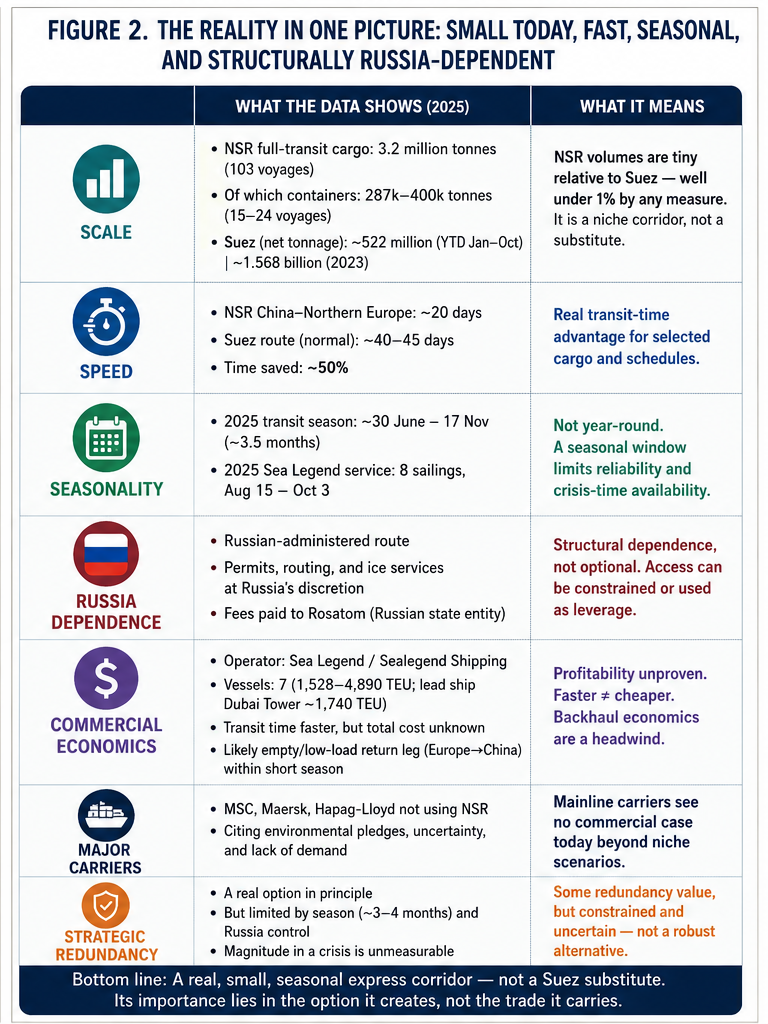
The broader Northern Sea Route can be physically navigable for longer. In 2025, full transit voyages were recorded from approximately 30 June to 17 November.
But navigation depends on:
- vessel ice class;
- actual ice conditions;
- operating area;
- weather;
- and Russian navigation rules.
Three different concepts should therefore not be confused:
the observed NSR transit season;
the conditions under which individual vessels are permitted and physically able to navigate;
and
Sea Legend's commercial service window.
They are not the same.
The Arctic can be significantly faster
The strongest commercial argument for the route is geography.
Recent China–Northern Europe Arctic voyages have taken roughly 20 days.
Sea Legend is marketing its new service at approximately 20–22 days to Northern Europe.
That is materially faster than many conventional Asia–Europe liner services.
But the often-repeated claim that the Arctic route “halves” shipping time depends heavily on the comparator.
Against a Cape of Good Hope diversion, the saving can approach that magnitude.
Against a direct, normally functioning Suez voyage, it is smaller.
And conventional liner services often make several port calls while the Arctic service is closer to point-to-point transport.
The defensible conclusion is therefore:
For selected China–Northern Europe cargoes, the Northern Sea Route can materially reduce transit time.
Not:
The Arctic universally halves Asia–Europe shipping time.
The scale gap remains enormous
This is where the strategic narrative meets the commercial baseline.
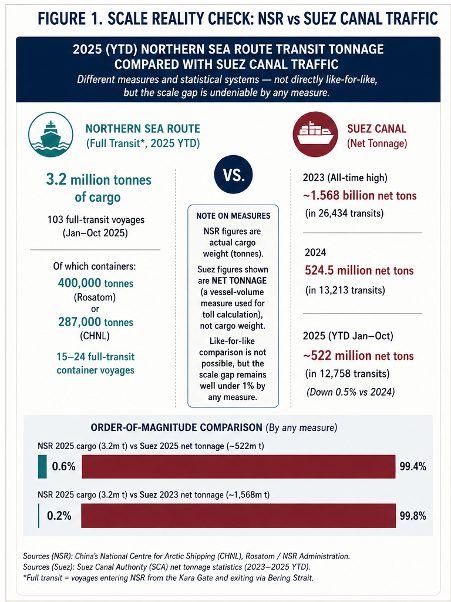
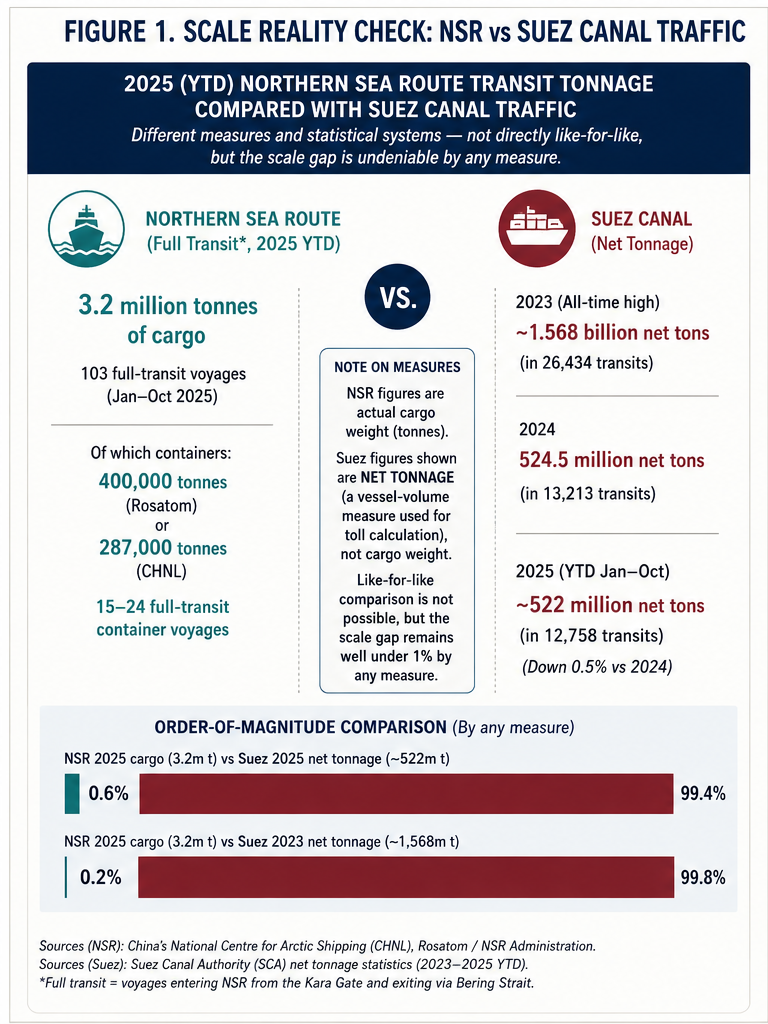
In 2025, approximately 3.2 million tonnes of cargo made full transits of the Northern Sea Route, according to vessel-based analysis from the Centre for High North Logistics.
That includes:
- tanker cargo;
- bulk cargo;
- LNG;
- general cargo;
- and containers.
It is not a China–Europe container figure.
Now compare that with actual cargo quantity through Suez.
The Suez Canal Authority reports approximately:
1.323 billion tonnes of cargo in 2023, before the Red Sea crisis severely disrupted traffic;
and
464.4 million tonnes of cargo in 2025, during the heavily disrupted period.
That puts all NSR full-transit cargo at approximately:
0.24% of 2023 Suez cargo
and
0.69% of disrupted 2025 Suez cargo.
The two authorities use different statistical systems, so those percentages should be treated as indicative scale comparisons rather than precision market-share estimates.
But the orders-of-magnitude gap is not ambiguous.
Even after one of the worst disruptions in Suez's modern history:
All Northern Sea Route transit cargo amounted to less than 1% of Suez cargo throughput.
And China–Europe containers represent only a fraction of that Arctic total.
FIGURE 1 — SCALE REALITY CHECK: NSR vs SUEZ
Container traffic is smaller still
Even within the NSR's small transit total, container traffic is limited.
Official Russian figures put containerised transit cargo at approximately 400,000 tonnes in 2025.
Independent vessel-based analysis from CHNL estimates approximately 287,000 tonnes.
Crosswise has not resolved the difference.
CHNL recorded 15 container-ship full transits. Rosatom has cited 24 container transit voyages.
The discrepancy may reflect different definitions: a container ship is not necessarily the same statistical category as a voyage carrying containerised cargo.
Crosswise therefore does not silently select whichever number better supports the story.
What the evidence establishes is narrower:
Container transit through the NSR is growing, but remains extremely small relative to established Asia–Europe shipping.
The vessels reveal the likely market
Sea Legend's seven ships range from roughly 1,500 TEU to 4,890 TEU, with the lead vessel Dubai Tower at roughly 1,740 TEU.
That is commercially meaningful capacity.
It is also a fraction of the capacity of the ultra-large container vessels routinely deployed on mainstream Asia–Europe services.
This matters because container shipping is not simply about getting a ship from A to B.
Large liner networks depend on:
- vessel scale;
- intermediate port calls;
- cargo aggregation;
- transshipment;
- equipment positioning;
- predictable weekly frequencies;
- and high vessel utilisation.
The Russian Arctic coastline provides little equivalent intermediate container market.
That creates another problem: backhaul.
A fast westbound China–Europe service is much less attractive economically if it cannot find sufficient Europe–Asia cargo for the return voyage. Empty or lightly loaded return legs impose repositioning costs and reduce vessel utilisation.
Crosswise could not obtain Sea Legend's actual eastbound load factors.
But the structural challenge exists regardless of the confidential numbers.
This is one reason the route may be better suited to a narrower market:
direct, high-value, time-sensitive China–Northern Europe freight.
The first 2026 cargoes—batteries, energy-storage systems and solar equipment—are consistent with that possibility.
Russia is not merely beside the route
The Northern Sea Route operates within a Russian-administered maritime system.
Russian authorities control navigation permissions and operating rules.
The system administered through Rosatom and Russian authorities provides or coordinates:
- navigation permits;
- vessel monitoring;
- hydrographic information;
- ice information;
- route support;
- icebreaker assistance where required;
- and search-and-rescue coordination.
This creates an important strategic distinction.
China can use the NSR to reduce exposure to Suez and the Red Sea.
But it cannot currently use the corridor independently of Russia.
That does not mean every vessel requires a Russian nuclear icebreaker beside it.
Some summer voyages can proceed without direct escort when vessel capability and conditions permit.
The more accurate formulation is:
Icebreaker dependence is conditional. Dependence on the Russian-administered system is structural.
Climate change is opening access—not guaranteeing reliability
The physical Arctic is changing rapidly.
Multi-year sea ice has declined dramatically over recent decades, increasing the period during which commercial navigation can be attempted.
That is one reason the NSR is becoming more usable.
But:
Less average ice does not mean predictable open water.
Arctic navigation still faces:
- mobile first-year ice;
- severe weather;
- fog;
- darkness;
- remoteness;
- incomplete hydrographic coverage;
- limited emergency infrastructure;
- and significant year-to-year variation.
The 2025 season illustrates the distinction.
Full transits continued for roughly four and a half months.
That does not mean ships enjoyed four and a half months of easy open-water navigation.
Accessibility is increasing.
Reliability is a separate question.
The largest container carriers remain unconvinced
The strongest counterevidence comes from the companies that operate the global liner system.
MSC explicitly says it will not use the Northern Sea Route, citing unpredictable ice, severe weather, incomplete charting, limited infrastructure, weak emergency response and environmental risk.
Hapag-Lloyd has committed to avoiding Arctic shipping under the Arctic Shipping Corporate Pledge.
Maersk has similarly said it does not intend to use Arctic routes, citing the fragility of the environment.
Their abstention does not prove Sea Legend cannot build a viable niche.
It establishes something narrower:
The world's largest liner networks do not currently see sufficient advantage to adopt the NSR for mainstream container operations.
That is important evidence against the proposition that the new service already represents the beginning of an inevitable wholesale shift in Asia–Europe shipping.
Insurance and sanctions add structural friction
Crosswise could not obtain a reliable voyage-specific Arctic insurance premium.
That does not mean the direction of risk is unknowable.
Arctic shipping creates additional underwriting complexity through:
- ice exposure;
- remoteness;
- limited salvage capability;
- weaker search-and-rescue coverage;
- pollution-response difficulty;
- and potentially severe loss consequences.
Russia adds a separate layer.
European cargo owners, banks, insurers and shipping companies must consider whether particular Russian counterparties, services, ports or payments create sanctions or compliance exposure.
The precise cost cannot be stated from public evidence.
The qualitative direction is clearer:
Arctic and Russia-linked operations create additional insurance and compliance friction rather than eliminating it.
02 — THE PERSPECTIVES
There is no meaningful Left-versus-Right framework here.
The serious disagreement concerns commercial scale, strategic redundancy, climate accessibility, Russia dependence and what the first scheduled service tells us about the route's future.
CHINA: TODAY'S SCALE MAY MISS TOMORROW'S OPTION
China's strongest strategic case does not require the NSR to rival Suez today.
Beijing's Polar Silk Road ambitions predate the current Middle East crisis by years.
The new service can therefore be interpreted as another step in a long-term effort to create additional trade options.
From this perspective, a seasonal route can have value even while carrying a tiny fraction of China's trade.
It can:
- shorten selected journeys;
- build Arctic operating experience;
- create backup capacity;
- deepen China–Russia logistics integration;
- and establish infrastructure and commercial routines that could scale as Arctic accessibility changes.
The strongest version of the argument is not:
“The NSR has replaced Suez.”
It is:
“This is what the early stage of a much larger corridor looks like.”
That proposition cannot yet be dismissed.
But neither is it established.
THE GLOBAL LINERS: A FAST VOYAGE IS NOT A SHIPPING SYSTEM
The major carriers see a different problem.
Container shipping is a network business.
Mainstream Asia–Europe services depend on enormous ships, dense port rotations, transshipment hubs, equipment positioning, year-round frequency and high utilisation.
The NSR currently offers:
- smaller vessels;
- seasonal operations;
- little intermediate cargo;
- Arctic operational risk;
- Russia-related compliance complexity;
- and uncertain backhaul economics.
A 20-day direct voyage can therefore be technically impressive without being commercially superior to a slower system offering vastly more capacity and connectivity.
The strongest objection is:
Shipping customers buy networks and reliability, not merely nautical miles.
RUSSIA: THE ROUTE IS A LONG-TERM INFRASTRUCTURE PROJECT
Russia's strongest argument is temporal.
Moscow has spent years building:
- Arctic ports;
- nuclear icebreakers;
- LNG infrastructure;
- navigation systems;
- and the institutional architecture of the Northern Sea Route.
Most NSR cargo remains associated with Russian Arctic energy and resource projects.
But greater Chinese participation could gradually add international transit to that base.
From Moscow's perspective, today's small container volumes may simply represent an early stage of state-supported infrastructure whose commercial importance emerges over decades.
The weakness is straightforward:
investment targets are not forecasts.
Building infrastructure does not guarantee that global liner economics will eventually favour the route.
THE SEASONAL-EXPRESS CASE
A third interpretation currently fits much of the evidence.
The NSR may not need to resemble Suez at all.
Its near-term market could instead consist of:
- premium freight;
- urgent industrial components;
- batteries;
- energy equipment;
- direct China–Northern Europe cargo;
- and specialised seasonal capacity.
That would make it a maritime express corridor, rather than an alternative global liner network.
But there is a major evidentiary limitation:
Crosswise has not obtained enough public data to establish whether Sea Legend is making money.
The interpretation is plausible.
The commercial model is not yet proven.
EUROPE: FASTER CARGO, DEEPER RUSSIA EXPOSURE
European importers face a trade-off.
Selected cargo may arrive faster.
But the route places Europe-bound supply chains inside a Russian-administered maritime system at a time when relations with Moscow remain deeply adversarial.
Its attractiveness therefore depends not only on transit time but on:
- sanctions;
- insurance;
- financing;
- legal exposure;
- political relations;
- and European companies' willingness to route supply chains through Russian-controlled Arctic waters.
03 — EVIDENCE CHECK
CLAIM: “China has opened a regular Arctic container route to Europe.”
CROSSWISE: SUPPORTED — WITH AN IMPORTANT QUALIFICATION
Eight scheduled sailings using seven vessels represent a real service rather than another isolated trial.
But it is seasonal.
The accurate description is:
China now has a scheduled seasonal Arctic container service to Europe.
CLAIM: “The Arctic route halves shipping time.”
CROSSWISE: MISLEADING WITHOUT A COMPARATOR
Roughly 20-day Arctic voyages are genuinely fast.
A near-50% saving is plausible against Cape diversions or some multi-stop schedules.
It is not a universal comparison against a normally functioning direct Suez route.
CLAIM: “This is the early stage of a much larger China–Europe Arctic corridor.”
CROSSWISE: PARTLY SUPPORTED / UNRESOLVED
There is evidence supporting the proposition:
- scheduled service has replaced isolated trials;
- container transits are growing;
- China has pursued Arctic shipping for years;
- Russia continues investing in route infrastructure;
- and the transit-time advantage is real.
There is also substantial evidence against assuming scale will follow automatically:
- current transit volumes remain tiny;
- vessels are relatively small;
- major liners abstain;
- the commercial season is short;
- profitability is opaque;
- backhaul economics are uncertain;
- and the system remains Russia-dependent.
The 2026 service is evidence that a larger corridor could emerge.
It is not yet evidence that one will.
CLAIM: “The route can replace Suez.”
CROSSWISE: NOT SUPPORTED AT CURRENT SCALE
The like-for-like cargo comparison is stark.
2025 NSR full-transit cargo: ~3.2m tonnes.
2025 Suez cargo: ~464.4m tonnes.
2023 Suez cargo: ~1.323bn tonnes.
The NSR therefore remains below 1% of Suez cargo throughput even against the canal's severely disrupted 2025 performance.
CLAIM: “Tiny volumes make the route strategically irrelevant.”
CROSSWISE: NOT SUPPORTED
Strategic utility is not determined solely by market share.
Selected high-value or critical cargo could derive meaningful benefit from an additional route.
But this needs qualification.
The route's redundancy is constrained simultaneously by seasonality and Russian control.
A crisis outside the usable Arctic season may make the option unavailable.
A crisis involving Russian leverage could do the same.
The route therefore offers conditional redundancy, not a robust all-weather alternative.
CLAIM: “Climate change is making the NSR commercially viable.”
CROSSWISE: PARTLY SUPPORTED
Climate change is increasing physical accessibility.
Commercial viability depends on much more:
- reliability;
- vessel economics;
- insurance;
- infrastructure;
- cargo;
- backhaul;
- and network effects.
Accessibility is a necessary condition.
It is not sufficient proof of commercial competitiveness.
CLAIM: “The route reduces China's geopolitical dependence.”
CROSSWISE: MISLEADING
The route diversifies geography.
It does not eliminate dependence.
China can reduce exposure to some southern maritime risks while increasing reliance on a Russian-administered system.
Whether Beijing considers that a favourable strategic trade is a different question.
CLAIM: “Every Arctic sailing requires Russian icebreaker escort.”
CROSSWISE: FALSE
Direct icebreaker assistance depends on vessel capability and ice conditions.
Russian administrative control does not.
Icebreaker dependence: conditional.
Russian-system dependence: structural.
CLAIM: “The Arctic route is cheaper than Suez.”
CROSSWISE: NOT ESTABLISHED
Crosswise could not obtain sufficiently transparent data on:
- freight rates;
- load factors;
- insurance;
- Russian service charges;
- subsidies;
- return-leg utilisation;
- or profitability.
Faster does not automatically mean cheaper.
CLAIM: “Sea Legend says the route cuts CO₂ by around 50%, therefore Arctic shipping is greener.”
CROSSWISE: NOT ESTABLISHED
Sea Legend has promoted a roughly 50% emissions-reduction claim based largely on the shorter route.
Crosswise could not independently verify that figure.
Route-level environmental performance depends on:
- vessel size;
- load factor;
- speed;
- ice resistance;
- fuel;
- black-carbon effects;
- potential ice
CLAIM: “Sea Legend says the route cuts CO₂ by around 50%, therefore Arctic shipping is greener.”
CROSSWISE: NOT ESTABLISHED
Sea Legend has promoted a roughly 50% emissions-reduction claim based largely on the shorter route.
Crosswise could not independently verify that figure.
Route-level environmental performance depends on:
- vessel size;
- load factor;
- speed;
- ice resistance;
- fuel type;
- black-carbon emissions;
- potential icebreaker assistance;
- return-leg utilisation;
- and the environmental consequences of an accident in remote Arctic waters.
A shorter voyage can consume less fuel.
That does not establish that the complete Arctic transport system produces 50% lower environmental impact.
The company claim should therefore be treated as promotional and unverified, not as an established benefit of the route.
CLAIM: “Rising Northern Sea Route cargo proves China–Europe Arctic trade is scaling rapidly.”
CROSSWISE: MISLEADING
Most Northern Sea Route cargo is still associated with Russian Arctic energy and resource projects.
Full-transit cargo is much smaller than total NSR cargo.
Containerised transit is smaller again.
And China–Europe container traffic represents only part of that containerised transit.
Headline growth in total NSR cargo therefore cannot be treated as equivalent to growth in China–Europe container trade.
CLAIM: “Major global liners rejecting the Arctic proves the route is commercially unviable.”
CROSSWISE: TOO STRONG
MSC, Maersk and Hapag-Lloyd currently avoid Arctic routing.
That is important evidence about:
- mainstream liner economics;
- environmental concerns;
- operational risk;
- network compatibility;
- and corporate policy.
It is not proof that a smaller specialist carrier cannot make a narrower service work.
Sea Legend may be pursuing a market that the largest global networks are not designed to serve.
04 — WHAT WE DON'T KNOW
1. Whether Sea Legend is making money
This is the largest commercial uncertainty.
Crosswise could not obtain:
- audited route profitability;
- average booked freight rates;
- actual load factors;
- negotiated Russian service charges;
- voyage-specific insurance pricing;
- state subsidies;
- or complete return-leg utilisation.
The service may be commercially profitable.
It may be strategically subsidised.
It may sit somewhere between the two.
Public evidence cannot presently distinguish those possibilities.
2. Whether the return leg works economically
The route's westbound proposition is clear: move selected Chinese cargo to Northern Europe quickly.
The eastbound economics are much less transparent.
Container shipping becomes substantially less efficient when vessels return lightly loaded or when empty equipment must be repositioned.
Crosswise has not obtained evidence showing how much Europe–Asia cargo Sea Legend expects to carry eastbound.
That matters because a commercially attractive outbound voyage does not necessarily produce an attractive round trip.
3. How much cargo will actually move in 2026
Eight sailings are scheduled.
That is not the same thing as eight fully loaded voyages.
Scheduled vessel capacity should not be confused with realised cargo throughput.
We do not yet know:
- final load factors;
- cancellations;
- weather delays;
- realised transit times;
- or total TEU carried during the season.
4. How quickly the commercial season can expand
The physical transit season is already longer than Sea Legend's current commercial schedule.
But extending scheduled container operations into earlier summer or later autumn means confronting more difficult and less predictable ice conditions.
A longer physical navigation window therefore does not automatically create a longer commercially reliable liner season.
5. Whether China will accept long-term Russian leverage
China and Russia currently have strong incentives to cooperate in the Arctic.
But the NSR gives Moscow substantial administrative and infrastructural leverage.
Crosswise cannot establish how Beijing would respond if:
- Russian charges increased materially;
- political relations deteriorated;
- access became bargaining leverage;
- sanctions intensified;
- or Chinese Arctic traffic became strategically important enough to create dependence.
6. How sanctions and insurance will evolve
The Northern Sea Route is not inherently synonymous with sanctioned trade.
But commercial use can involve Russian entities, services and financial relationships that create sanctions and compliance questions.
Arctic operating risk also makes insurance structurally more complicated.
Crosswise could establish the direction of those frictions.
It could not establish their precise cost for Sea Legend's service.
7. How much strategic redundancy actually exists
An additional route has potential option value.
But that option is constrained twice.
First, it is seasonal.
Second, it operates through a Russian-administered system.
A Suez or Red Sea crisis occurring during the Arctic winter may leave the route commercially unusable.
A crisis in which Russia itself becomes a source of leverage could also compromise the alternative.
Crosswise therefore cannot quantify how much strategically important cargo Beijing could reliably divert through the Arctic during an actual emergency.
8. Whether the Arctic will ever support mainstream liner scale
That depends on developments that have not happened:
- larger ice-capable container fleets;
- stronger port infrastructure;
- improved emergency response;
- longer reliable operating seasons;
- lower insurance friction;
- more predictable conditions;
- viable backhaul economics;
- and potentially major-carrier adoption.
The fact that the corridor is developing does not establish where its eventual ceiling lies.
05 — CROSSWISE ASSESSMENT
China has not created a new Suez.
But it has created something more consequential than another Arctic demonstration voyage.
The distinction matters.
For years, China–Europe Arctic shipping consisted largely of experimental sailings, strategic ambition and forecasts about what declining sea ice might eventually permit.
The 2026 Sea Legend schedule crosses a threshold.
Eight planned sailings using seven vessels constitute a real scheduled seasonal service.
That establishes that the Northern Sea Route can support recurring container operations during favourable months.
The transit-time advantage is also genuine.
For selected China–Northern Europe cargoes, a roughly three-week voyage can materially reduce inventory time.
For high-value industrial goods, that can matter commercially.
But almost every stronger conclusion remains premature.
The route operates at nowhere near Suez scale.
All NSR full-transit cargo in 2025 amounted to approximately 0.7% of even the severely disrupted Suez Canal's cargo quantity and roughly 0.24% of the canal's 2023 pre-crisis cargo quantity.
Containerised Arctic transit is smaller still.
Sea Legend's ships are far smaller than the ultra-large vessels underpinning mainstream Asia–Europe liner networks.
Its scheduled season lasts only weeks rather than the full year.
The largest global container carriers continue to abstain.
And the economics of the service remain opaque.
That means the phrase “alternative to Suez” is useful only if “alternative” is defined carefully.
The NSR is not presently an alternative system to Suez.
It is becoming an alternative route for selected cargo under selected conditions.
That is different.
The strongest near-term interpretation is therefore a scheduled seasonal Arctic express corridor.
Its likely initial market is not every container travelling between Asia and Europe.
It is cargo for which time matters enough to justify a specialised service:
- batteries;
- energy-storage equipment;
- industrial components;
- high-value goods;
- and direct Northern Europe shipments.
Whether that market is profitable remains unresolved.
Its strategic significance requires equal caution.
An additional route can provide China with useful redundancy without carrying a large share of total trade.
But this is conditional redundancy.
The Arctic route is available only during part of the year.
And today's corridor exists within a Russian-administered maritime system.
Chinese vessels may not require an icebreaker escort on every voyage.
They do require Russian permission and access to the system Russia operates around the route.
China is therefore diversifying one form of exposure while accepting another.
It gains:
greater geographic diversification
without necessarily gaining:
greater geopolitical independence.
That makes the 2026 service significant—but not for the reason implied by the most dramatic headlines.
The important development is not that China has found a replacement for Suez.
It is that a route long discussed as a future possibility has begun functioning as a recurring commercial service.
The next question is whether repetition becomes scale.
CROSSWISE ASSESSMENT
China's Arctic corridor is real. Its commercial future is unproven. Its strategic redundancy is meaningful but constrained.
The Northern Sea Route is becoming a credible seasonal express option for selected China–Northern Europe cargo.
It is not currently a second mainstream Asia–Europe shipping system.
Its importance lies in the option it is beginning to create—but that option remains limited by seasonality, opaque economics and structural dependence on Russia.
CROSSWISE CONFIDENCE
Seasonal physical viability: HIGH
Successful Arctic container voyages and Sea Legend's scheduled 2026 service establish that recurring container operations are physically viable during favourable seasonal conditions.
Transit-time advantage: HIGH
Actual voyages and carrier schedules support materially shorter journey times for appropriate point-to-point China–Northern Europe cargo.
The precise saving depends on the conventional-route comparator.
Current scale relative to Suez: HIGH
The orders-of-magnitude difference is established using cargo-weight comparisons.
NSR full-transit cargo remains below 1% of Suez cargo quantity even against the canal's severely disrupted 2025 performance.
Near-term niche commercial utility: MODERATE
The transit-time advantage and initial cargo mix support the case for a specialised express market.
But Crosswise lacks sufficient evidence on freight rates, load factors, backhaul, subsidies, insurance and profitability to rate commercial utility more highly.
Strategic redundancy value: MODERATE
The route gives China an additional seasonal option for selected cargo during disruptions elsewhere.
But its usefulness is sharply constrained by seasonality × Russian dependence.
The option may not be available when a crisis occurs.
Mainstream commercial scalability: LOW
Current volume, vessel size, seasonality, network economics, insurance/compliance friction and major-carrier abstention weigh heavily against near-term mass adoption.
Geopolitical independence: LOW
The NSR diversifies China's route geography but operates inside a Russian-administered maritime system.
Long-term substitution for Suez: VERY LOW ON PRESENT EVIDENCE
Nothing in the current evidence supports treating the NSR as a plausible near-term replacement for the Suez system.
That assessment could change if infrastructure, climate conditions, vessel technology and carrier adoption change substantially.
WHAT WOULD CHANGE OUR ASSESSMENT?
Major global carrier entry.
MSC, Maersk, CMA CGM, COSCO's mainline operation or another large global carrier begins scheduled Arctic liner services.
Much larger container ships.
Commercial deployment of 10,000–15,000+ TEU ice-capable container vessels would materially change the route's scale economics.
Reliable operations beyond the current seasonal window.
Safe, predictable container services extending materially beyond summer and early autumn would weaken one of the largest constraints on both commercial scale and strategic redundancy.
Transparent cost competitiveness.
Credible evidence showing that total per-container Arctic costs—including vessel, insurance, Russian services and backhaul—are competitive with normal Suez routing would substantially strengthen the commercial case.
Transit traffic increases by an order of magnitude.
A sustained rise from today's niche container flows into a meaningful component of Asia–Europe trade would challenge the current scale assessment.
Russian dependence declines materially.
Greater Chinese independent operating capability or a different Arctic governance arrangement could strengthen the route's strategic-autonomy value.
A major Arctic casualty occurs.
A serious grounding, spill or loss could materially increase regulation, insurance costs and carrier reluctance.
Suez and Red Sea shipping fully normalise.
A durable return to predictable conventional routing would provide a much tougher test of whether customers value the NSR without crisis-driven southern-route disruption.
Until then:
The strongest evidence supports a real seasonal corridor whose future scale remains unproven.
CROSSWISE RADAR
US · CHINA TRADE
Washington is examining what ending “normal” trade relations with China would actually mean.
The US International Trade Commission has been examining the economic consequences of revoking Permanent Normal Trade Relations treatment for Chinese products.
Why it matters: moving Chinese goods from standard tariff treatment to much higher Column 2 rates would be far more consequential than another incremental tariff increase and could reshape prices, sourcing and supply-chain geography.
IRAN · SANCTIONS
Washington is preparing another major economic escalation against Tehran.
US officials have signalled a tougher sanctions campaign targeting Iran and countries or networks providing economic lifelines.
Why it matters: the effectiveness of another sanctions escalation will depend less on the headline restrictions than on whether intermediary jurisdictions and commercial networks actually close.
FRANCE · CHAD
France is rebuilding military cooperation with Chad after its highly public withdrawal.
Security cooperation is returning roughly 18 months after N'Djamena demanded French forces leave.
Why it matters: Chad could become an early test of whether post-French security arrangements in parts of the Sahel have delivered sustainable strategic autonomy.
GLOBAL BONDS
The long-bond sell-off remains a warning even without a crisis.
Long-duration sovereign borrowing costs remain elevated across several developed markets after this week's sharp repricing.
Why it matters: governments can face increasingly painful fiscal constraints even while bond markets continue functioning normally.
THE RECEIPTS
Research cut-off: 21 August 2026
RESEARCH LEDGER
34 source items materially used in the lead analysis
Approximately 22 evidentiary chains across the complete investigation after source-dependency review
6 core quantitative evidentiary chains carrying the principal numerical findings
15 primary / official records
8 specialist maritime / Arctic / shipping-data sources
11 independent and regional reporting items
10 key claims deliberately triangulated
8 material uncertainties explicitly retained
Categories overlap. They should not be mechanically added together.
“Source item” counts material actually relied upon.
“Evidentiary chain” attempts to remove repetitions deriving from the same original dataset, carrier statement, official release or investigation.
The smaller six-chain figure identifies the principal independent sources carrying the article's load-bearing quantitative findings rather than every evidentiary chain used across the investigation.
HOW CROSSWISE COUNTS
Crosswise does not treat repetition as corroboration.
If five publications repeat Rosatom's cargo figure, that remains fundamentally one Rosatom evidentiary chain.
The same applies to:
- Sea Legend announcements;
- Suez Canal Authority statistics;
- CHNL vessel tracking;
- climate datasets;
- and carrier sustainability policies.
Official evidence is not automatically neutral.
Company evidence is not automatically false.
A company announcing eight sailings is strong evidence of what it intends to operate.
It is not independent evidence that those sailings will be profitable.
Crosswise therefore attempts, where possible, to move through:
primary record → underlying dataset → specialist analysis → genuinely independent reporting.
Repetition is not corroboration.
PRIMARY & OFFICIAL RECORDS
1. Rosatom / Northern Sea Route Administration
Used for:
- NSR operating framework;
- navigation permissions;
- Russian administration;
- navigation and ice-support arrangements;
- official traffic information.
Limitation: Rosatom is both infrastructure operator and promoter of NSR development.
2. Russian Merchant Shipping Code / NSR Navigation Rules
Used to establish Russian legal and administrative authority over navigation within the NSR water area.
Limitation: The legal framework does not establish the commercial burden of individual requirements.
3. Suez Canal Authority — 2023 Annual Statistics
Used for approximately 1.323 billion tonnes of cargo quantity in 2023.
This replaces the earlier draft's inappropriate use of 1.568 billion net tonnes, which measures vessel tonnage rather than cargo weight.
Role: Pre-Red Sea-crisis cargo baseline.
4. Suez Canal Authority — 2025 Annual Statistics
Used for approximately:
464.44 million tonnes of cargo quantity
and, separately,
522.08 million net tonnes of vessel tonnage.
Only the cargo quantity is used in the NSR cargo comparison.
5. IMO — Polar Code
Used for Arctic operational, safety, vessel, crew and environmental requirements.
6. NOAA — Arctic Report Card
Used for long-run Arctic sea-ice changes and the decline of multi-year ice.
7. NSIDC — Arctic Sea-Ice Data
Used to cross-check sea-ice and seasonal-accessibility evidence.
8. MSC — Sustainability / Arctic Route Policy
Used for MSC's explicit decision not to use the Northern Sea Route and its stated operational and environmental concerns.
9. Hapag-Lloyd — Arctic Shipping Corporate Pledge / Sustainability Material
Used for Hapag-Lloyd's commitment to avoid Arctic shipping.
10. Maersk — Sustainability Documentation
Used for Maersk's policy concerning Arctic route use.
11. State Council of China — China's Arctic Policy
Used to establish that Beijing's Polar Silk Road strategy predates the current Middle East disruption.
12. Sea Legend — China–Europe Arctic Express service information
Used for:
- schedule;
- number of sailings;
- route;
- cargo positioning;
- transit-time claims;
- and the company's approximately 50% CO₂-reduction claim.
Limitation: Company claims are promotional and independently tested where possible.
13. Ningbo-Zhoushan / departure records
Used to establish the first 2026 service departure on 15 August.
14. Russian Arctic / icebreaker documentation
Used to establish the role of Russia's icebreaking and navigation-support infrastructure.
15. Suez / Red Sea operational records
Used to establish the scale of recent disruption to conventional Asia–Europe maritime routing.
SPECIALIST MARITIME & DATA SOURCES
16. Centre for High North Logistics — 2025 NSR Transit Analysis
Used for:
- approximately 3.2m tonnes of full-transit cargo;
- 103 full transit voyages;
- approximately 287,000 tonnes of independently estimated containerised transit;
- 15 container-ship transits;
- and the approximately 30 June–17 November transit season.
Limitation: CHNL's container estimate differs from Rosatom's official approximately 400,000-tonne figure.
17. CHNL — Northern Sea Route Shipping Trends
Used for historical and seasonal traffic context.
18. BIMCO — Arctic Service / Seasonal Operations Analysis
Used for analysis of the 2026 commercial schedule and its relationship to the period during which suitably equipped vessels can expect to transit without direct icebreaker assistance.
Role in analysis: Helps distinguish Sea Legend's chosen commercial operating window from the broader physical NSR navigation season.
Limitation: Commercial scheduling reflects carrier risk appetite as well as physical navigability.
19. Lloyd's List Intelligence — Northern Sea Route / Arctic Shipping Analysis
Used for:
- liner-network economics;
- infrastructure limitations;
- sanctions considerations;
- carrier reluctance;
- insurance and operational risk;
- and the distinction between direct Arctic services and conventional hub-and-spoke networks.
Role in analysis: Specialist maritime counterweight to Chinese and Russian promotional material.
Limitation: Some commercially sensitive underlying data are proprietary.
20. Maritime Vessel-Capacity Databases / Fleet Intelligence
Used to cross-check Sea Legend vessel specifications and establish that the service uses vessels ranging from roughly 1,500 TEU to 4,890 TEU, with Dubai Tower around 1,740 TEU.
Role in analysis: Tests the scale of the new fleet against mainstream Asia–Europe container vessels.
Limitation: Public fleet databases differ slightly on individual vessel specifications.
21. Marine Insurance / P&I Risk Guidance
Used qualitatively to establish the additional underwriting and operational considerations associated with:
- Arctic ice;
- remoteness;
- salvage;
- search and rescue;
- pollution response;
- and Russia-linked sanctions/compliance.
Limitation: Crosswise could not obtain reliable voyage-specific insurance premiums for Sea Legend.
No numerical Arctic insurance surcharge is therefore published.
22. Arctic Maritime Research Literature
Used to examine:
- future navigation-season expansion;
- changing sea-ice conditions;
- strategic redundancy;
- and longer-term NSR development scenarios.
Limitation: Long-term Arctic shipping projections are highly sensitive to climate, technology, infrastructure and geopolitical assumptions.
23. Independent Route-Distance / Logistics Data
Used to stress-test promotional claims about Arctic transit-time savings against:
- direct Suez routing;
- conventional multi-port liner schedules;
- and Cape of Good Hope diversions.
Limitation: Transit-time comparisons depend heavily on the ports, service pattern, speed and intermediate calls selected.
INDEPENDENT & REGIONAL REPORTING
24. Global Times — Sea Legend China–Europe Arctic Express
Used for:
- the eight-sailing 2026 programme;
- initial cargo mix;
- Chinese commercial framing;
- and details surrounding the first departure.
Dependency note: some operational information originates with Sea Legend itself and is therefore not counted as independent corroboration of the carrier's claims.
25. Interfax — Rosatom on China–Europe Arctic Container Service
Used for Russia's description of the move from experimental voyages towards scheduled seasonal operations.
Dependency note: operational claims attributed to Rosatom remain part of the Rosatom evidentiary chain.
26. Reuters — Chinese Arctic Voyages / Russian Permits
Used to establish the wider 2026 increase in Chinese Arctic activity and Russian permissions for Chinese vessels.
Role in analysis: Independent reporting chain for the operational development.
27. High North News — Northern Sea Route Development
Used for Arctic-regional reporting on:
- route development;
- Russian infrastructure;
- traffic patterns;
- and China–Russia Arctic cooperation.
28. European Maritime Trade Press — Sea Legend Fleet and Schedule
Used to cross-check:
- vessel identities;
- capacities;
- departure schedule;
- and European destinations.
29. Al Jazeera — China, Arctic Shipping and Middle Eastern Chokepoints
Used as a regional reporting chain for the argument that instability around traditional southern shipping routes increases the strategic attraction of Arctic alternatives.
Role in analysis: Helps identify the strongest geopolitical-diversification argument rather than serving as primary evidence for NSR traffic.
30. Independent European Shipping Reporting — Sanctions and Commercial Exposure
Used to examine the implications for:
- European cargo owners;
- insurers;
- banks;
- freight forwarders;
- and shipping companies
of using a route embedded in Russian-administered infrastructure.
31. Independent Chinese Trade / Logistics Reporting
Used to assess:
- cargo types;
- time-sensitive freight;
- industrial positioning;
- and the commercial narrative surrounding the service.
32. Independent Russian Arctic Reporting
Used to distinguish:
Russian Arctic resource traffic
from
genuine international full-transit traffic.
That distinction is essential because headline NSR cargo growth substantially overstates the scale of China–Europe through-trade.
33. Independent Suez / Red Sea Shipping Reporting
Used to establish:
- current disruption to conventional routing;
- Cape diversions;
- transit-time consequences;
- and the changing commercial baseline against which Arctic claims are being made.
34. Independent Global Liner Reporting
Used to assess whether the world's largest container carriers are changing their policies towards Arctic navigation.
No evidence was found that the major global liners have begun mainstream scheduled NSR deployment.
THE TEN KEY CLAIMS CROSSWISE TRIANGULATED
1. China has moved beyond experimental voyages to a scheduled seasonal Arctic container service.
Tested against:
- Sea Legend's schedule;
- vessel information;
- port-departure evidence;
- Russian permitting material;
- specialist maritime reporting;
- and independent reporting.
The qualification seasonal is essential.
2. The route can materially reduce transit time for selected China–Northern Europe cargo.
Tested against:
- actual Arctic voyage times;
- Sea Legend's schedule;
- route-distance evidence;
- conventional Suez transit;
- Cape diversion;
- and liner-network structure.
The evidence supports a substantial time advantage.
It does not support a universal claim that Arctic shipping halves China–Europe transit time.
3. The 2026 service is evidence that a larger Arctic corridor could emerge—but not that it inevitably will.
Tested against:
- the transition from trials to scheduled service;
- growing container transits;
- China's long-standing Polar Silk Road strategy;
- Russian infrastructure investment;
- vessel scale;
- seasonality;
- major-carrier behaviour;
- and commercial-data gaps.
The evidence supports possibility, not inevitability.
4. Current Northern Sea Route traffic remains orders of magnitude below Suez.
Tested using cargo weight against cargo weight after the hostile red-team audit identified an earlier unit mismatch.
The corrected comparison is:
NSR full-transit cargo, 2025: ~3.2m tonnes
Suez cargo quantity, 2025: ~464.44m tonnes
Suez cargo quantity, 2023: ~1.323bn tonnes
This puts total NSR full-transit cargo at approximately:
0.69% of disrupted 2025 Suez cargo
and
0.24% of 2023 Suez cargo.
The ratios remain indicative because the statistical systems are not identical.
The orders-of-magnitude conclusion is robust.
5. China–Europe container transit is substantially smaller than headline NSR cargo figures imply.
Tested against:
- CHNL;
- Rosatom;
- vessel classifications;
- Russian Arctic resource traffic;
- and independent maritime analysis.
Most NSR cargo is not China–Europe container trade.
Containerised full-transit cargo is only a fraction of total NSR traffic.
6. China can reduce exposure to southern routes while remaining structurally dependent on Russia.
Tested against:
- Russian navigation law;
- NSR Administration requirements;
- Rosatom's operational role;
- icebreaker rules;
- hydrographic support;
- vessel monitoring;
- and search-and-rescue arrangements.
Direct icebreaker escort is conditional.
Russian institutional control of the current NSR system is not.
7. Climate change is increasing Arctic maritime accessibility without guaranteeing liner reliability.
Tested against:
- NOAA;
- NSIDC;
- IMO;
- CHNL;
- navigation-season evidence;
- and operational constraints.
Declining multi-year ice increases physical opportunity.
It does not eliminate mobile ice, extreme weather, remoteness or year-to-year variability.
8. Major global liner companies have not adopted the NSR for mainstream services.
Tested against explicit current policies from:
- MSC;
- Hapag-Lloyd;
- Maersk;
- and current liner deployment evidence.
Their abstention is strong evidence against immediate mainstream adoption.
It is not proof that a specialist seasonal service cannot be viable.
9. Public evidence does not establish that Sea Legend's service is cheaper, profitable or environmentally superior.
Crosswise attempted to establish:
- freight rates;
- load factors;
- Russian service charges;
- insurance premiums;
- state support;
- backhaul utilisation;
- route profitability;
- and lifecycle emissions.
The necessary public evidence was not available.
Sea Legend's approximately 50% CO₂ reduction claim is therefore retained only as an unverified company claim, not a Crosswise finding.
10. The strongest current interpretation is a seasonal express corridor with constrained strategic redundancy—not system-scale substitution.
Tested across:
- speed;
- cargo volume;
- vessel capacity;
- seasonality;
- Russia dependence;
- liner-network economics;
- major-carrier behaviour;
- commercial-data gaps;
- and the limitations of using the route during a crisis.
The strategic value is rated MODERATE, not MODERATE–HIGH, because seasonality and Russian dependence constrain the option simultaneously.
WHAT WE COULD NOT OBTAIN
Crosswise was unable to obtain:
an audited profit-and-loss account for Sea Legend's 2026 Arctic service;
actual average freight rates paid per TEU;
actual load factors for the 2026 sailings;
reliable eastbound/backhaul load factors;
non-public Chinese or Russian subsidies supporting the service;
negotiated Russian navigation charges;
voyage-specific icebreaker charges where applicable;
Sea Legend's actual hull-and-machinery and P&I insurance premiums;
the complete identity and structure of the insurance and reinsurance arrangements supporting the service;
reliable route-specific lifecycle emissions per TEU;
the underlying calculation supporting Sea Legend's claimed approximately 50% CO₂ reduction;
complete commercial evidence establishing the cost break-even point between NSR and normal Suez routing;
private Sino-Russian agreements governing long-term Chinese access to the Northern Sea Route;
evidence establishing how Russia might price or condition access if Chinese dependence on the route became materially greater;
or
evidence capable of quantifying how much strategically important cargo China could actually redirect through the Arctic during a real-world disruption elsewhere.
Those limitations are reflected explicitly in the article's confidence judgements.
RADAR SOURCES
US · CHINA TRADE
US International Trade Commission — Investigation into revoking Permanent Normal Trade Relations treatment for China
Used for the scope and timing of the Commission's investigation into the economic effects of moving Chinese products from normal tariff treatment to Column 2 rates.
Independent economic reporting
Used for context concerning potential effects on:
- consumer prices;
- US manufacturing;
- sourcing;
- supply-chain relocation;
- and third-country substitution.
IRAN · SANCTIONS
US Treasury / US government material
Used for the emerging sanctions escalation and proposed targeting of Iranian economic lifelines.
Independent international reporting
Used to assess the likely role of:
- third countries;
- financial intermediaries;
- trade hubs;
- and sanctions enforcement.
FRANCE · CHAD
Africanews
Used for regional reporting on renewed France–Chad security cooperation.
Le Monde
Used for the earlier chronology showing that Paris and N'Djamena had already been preparing renewed bilateral military cooperation.
GLOBAL BONDS
US Treasury / Federal Reserve / sovereign-market data
Used for current long-duration yield conditions.
Financial Times / Reuters / independent financial reporting
Used for the international context surrounding elevated sovereign borrowing costs.
FOUND SOMETHING WE MISSED?
Crosswise welcomes evidence that challenges its conclusions.
If you possess a primary document, dataset or other material evidence that could materially alter this analysis:
editor@readcrosswise.com
Material factual errors will be corrected transparently rather than silently amended.
CROSSWISE
The facts. The perspectives. The evidence. The unknowns. Our assessment.
One consequential story each weekday. Read crosswise.