

On 26 August, the United States designated the Italian technology collective Autistici/Inventati as a Specially Designated Global Terrorist.
Within two days its principal .org domain had stopped resolving and its bank had suspended the account, and by 4 September, according to Autistici/Inventati itself, Banca Etica had told the organisation that it intended to end the relationship altogether and that whatever funds remained in the account would no longer be at its disposal.
Two days after that, the collective announced that it would shut down altogether.
The sequence is striking, and yet it is nowhere near as simple as Washington pressing a button and an organisation in Italy obediently disappearing.
The US government created the sanctions exposure; a US-based domain registry then acted on it; a US payments provider reportedly restricted service; and an Italian bank, having weighed the risks of continuing the relationship, ultimately reached a decision that A/I says left it unable to pay its suppliers or meet its commitments.
And running quietly beneath that whole sequence is a separate and harder question: what, precisely, had the United States established that A/I actually did?
The answer matters because the legal test turns on something quite different from whether A/I planned a terrorist attack; the organisation need never have chosen a target, supplied a weapon or known the date of an operation for the designation to attach.
The formal US determination rests instead on a different proposition entirely: that A/I materially assisted, or provided technological support, goods or services to or in support of, an act of terrorism. [Federal Register]
That is what makes this at once a story about evidence and a story about power.
WHY THIS STORY
Crosswise chose this story precisely because almost every important part of it is so easy to get wrong.
Autistici/Inventati was never criminally convicted of terrorism, and yet it was also nothing so innocent as a politically neutral version of Gmail that extremists happened to wander into.
Its users were ideologically screened before they were admitted, and US officials have set out detailed allegations about the use of A/I infrastructure by violent networks.
Many of those allegations, though, concern the publishing of responsibility claims, the circulation of communiqués, the distribution of sabotage manuals, the doxxing of targets and the incitement of further violence, rather than any hand in carrying out the original attacks themselves.
And although it was the American sanctions that triggered the crisis, the organisation’s eventual shutdown was the product of a sequence of legally distinct decisions, each taken by a different institution for reasons of its own.
Modern state power can move through dependencies as effectively as through borders. |
RS RESEARCH SUMMARY
Autistici/Inventati, usually shortened to A/I, was established in Italy in 2001, and over the years that followed it provided a range of privacy-oriented digital services — email, websites, mailing lists, blogs and other communications infrastructure — to those it chose to serve.
It was openly political rather than commercially neutral, restricting access to the individuals and groups it judged consistent with its anticapitalist, antifascist, antiracist, antisexist, antimilitarist and anti-authoritarian principles, and assessing prospective users by hand rather than admitting all comers. [A/I service policy]
On 26 August 2026, the US Treasury’s Office of Foreign Assets Control added A/I to its Specially Designated Nationals and Blocked Persons List under the identifier [SDGT], for Specially Designated Global Terrorist, as part of the same sanctions action that separately designated Palestine Action and Masar Badil. [OFAC]
It was not, however, designated as a Foreign Terrorist Organization under the Immigration and Nationality Act, and the distinction is far from academic, because the Global Terrorism Sanctions Regulations and the separate criminal prohibition on providing material support to an FTO are legally distinct regimes that should not be run together. [31 CFR 594.201]
OFAC’s formal notice states that A/I was designated under section 1(a)(iii)(C) of Executive Order 13224, as amended, for having materially assisted, or provided financial, material or technological support, goods or services, “to or in support of, an act of terrorism.” [Federal Register]
Washington’s public case is a substantial one. The State Department alleges that violent actors used A/I infrastructure to publish responsibility claims and communiqués, to distribute manuals for incendiary devices, to circulate information about targets, to spread doxxing material and to incite further attacks, and it alleges more broadly that some of that infrastructure was used to plot or incite violence. [State Department]
Treasury adds, separately, that the ideologically screened users A/I admitted included the Kurdistan Workers’ Party, the PKK, itself a US-designated terrorist organisation. [US Treasury]
These are serious allegations, and Crosswise does not treat them lightly; yet the precise public evidentiary nexus between A/I’s services and the particular act or acts of terrorism underlying OFAC’s formal designation remains genuinely difficult for an outsider to reconstruct.
The practical consequences of the designation, meanwhile, arrived quickly. OFAC issued General License 36 at the same time, authorising the transactions ordinarily necessary to wind down dealings involving A/I through 25 September, though only subject to a number of important conditions. [General License 36]
A/I nevertheless announced its shutdown on 6 September, and the nineteen days of authorised wind-down that were never used are themselves part of the story.
01 WHAT WE KNOW
Washington did not designate A/I merely for its politics
A/I’s political identity is explicit and undisguised, but the case the United States has published does not stop at ideology.
The State Department alleges that A/I technology was used across several violent networks at once. In the case of the European railway attacks during 2026, it says that anarchist cells relied on A/I services to claim responsibility, to publish official communiqués and to disseminate manuals for building the improvised incendiary devices aimed at railways and other infrastructure. [State Department]
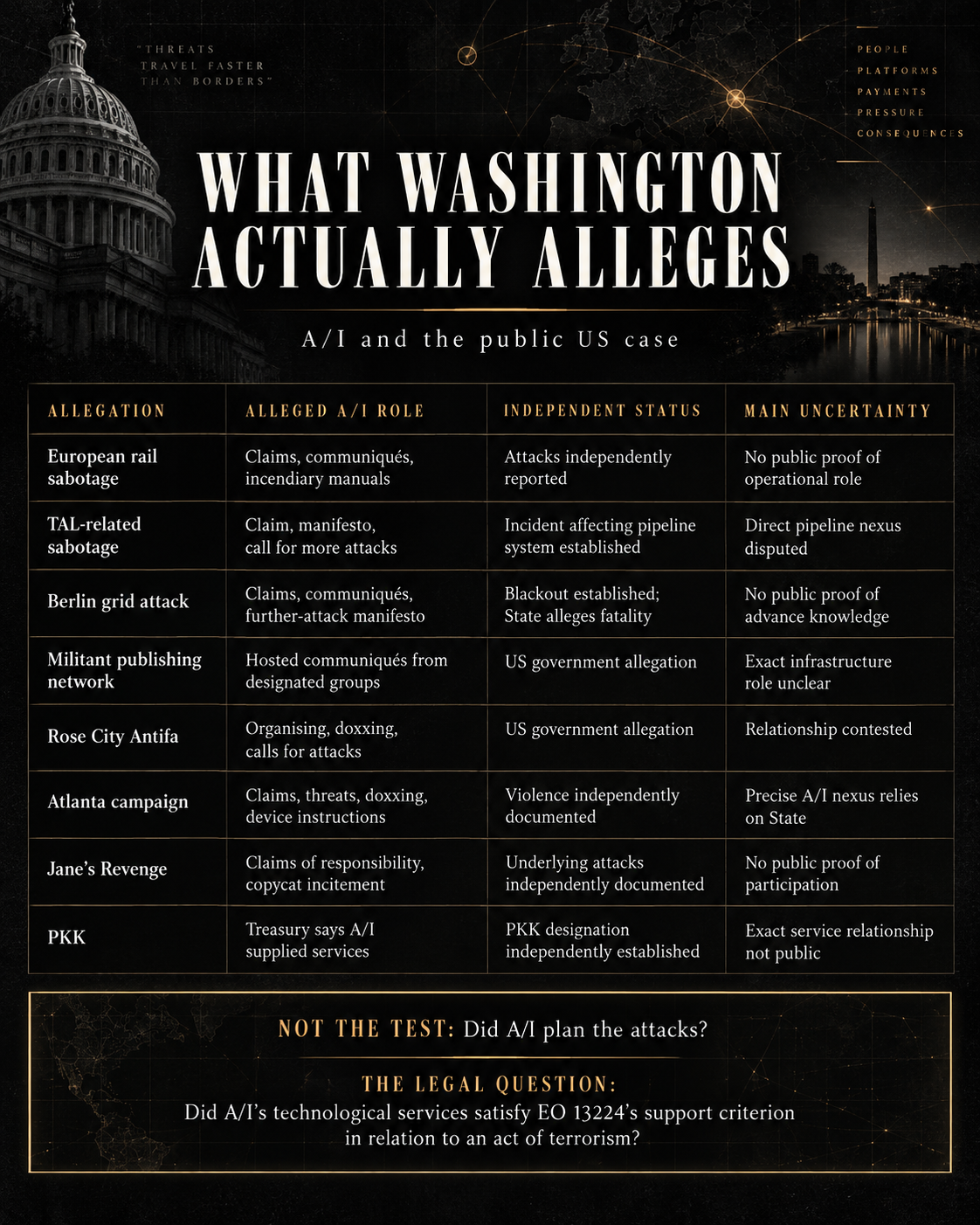
Graphic 01 — What Washington Actually Alleges: the public US case, the independently established facts, and the remaining uncertainty.
In an incident affecting the Transalpine Pipeline system, State alleges that an anarchist cell used A/I services to claim responsibility, to publish communiqués and to distribute a manifesto urging further attacks; and while State describes the event as sabotage of the pipeline itself, independent reporting indicates that the physical damage was in fact done to the electricity infrastructure supplying the system, a distinction that matters.
Turning to Germany, State points to a network associated with arson and sabotage against rail and energy infrastructure, citing in particular the January 2026 Berlin grid attack that cut electricity to roughly 45,000 households and, it states, resulted in a fatality; the network, it alleges, used A/I services to claim its attacks, to publish communiqués and to call for more. [State Department]
State alleges, too, that a militant media operation used A/I infrastructure to publish communiqués and calls to action tied to several US-designated organisations; that Rose City Antifa used it for organising, for doxxing and for calls to attack immigration personnel; that activists connected to the violent campaign against Atlanta’s police-training centre turned to A/I services for communiqués, doxxing, threats and instructions for building improvised incendiary and explosive devices; and that Jane’s Revenge used the infrastructure to publish responsibility claims and to incite copycat attacks. [State Department]
These claims should be neither softened nor enlarged. What State specifically describes, in several of the instances, is publishing infrastructure used before or after an act of violence, or infrastructure used to encourage further violence — conduct that can carry real legal significance, and yet remains analytically distinct from the claim that A/I helped to execute the attack itself.
The PKK allegation matters — but it is not the formal designation language
Treasury, for its part, says that A/I supplied services to ideologically aligned actors, the PKK among them. [US Treasury]
That is a consequential claim in its own right, because providing technological services to an organisation that is already blocked raises a different and comparatively straightforward sanctions question under the Global Terrorism Sanctions Regulations, which permit designation for material or technological support, goods or services provided not only to an act of terrorism but also to a person already blocked under the relevant provisions. [31 CFR 594.201]
The published A/I designation, however, does not rest on that limb at all, resting instead on the finding that A/I provided support, goods or services to or in support of an act of terrorism. [Federal Register]
Which act or acts supplied the decisive legal nexus? |
Treasury and State between them offer a great many facts from which a possible answer might be inferred, but the formal notice never identifies the particular act, and that is precisely the gap Crosswise cannot responsibly fill with speculation.
A/I was not an ordinary open-access platform
This is the point at which part of A/I’s own defence becomes awkward, because the collective plainly did not accept anyone who happened to open an account.
Its own documentation records that service requests were reviewed by hand, with applicants expected to explain their intended project and to show how it squared with A/I’s principles. [A/I service policy]
That makes it hard for A/I to reach for the strongest version of the neutral-platform defence, the plea that “we had no idea who our customers were,” because it had, by deliberate design, chosen to know something about them.
Even so, knowing a group’s political orientation and knowing that it intends to engage in conduct that satisfies the legal definition of terrorism remain two quite different factual propositions.
The legal issue therefore comes to rest somewhere between two convenient simplifications — that “they were just a hosting company,” on the one hand, and that “they hosted extremists, and therefore participated in terrorism,” on the other — neither of which will do.
Eleven days
The chronology that follows the designation is a good deal clearer than the evidentiary record beneath it, though the legal character of each step along the way turns out to be quite different from the last.
26 AUGUST — THE DESIGNATION. OFAC adds A/I to the SDN list, blocking any property and interests in property within US jurisdiction and generally prohibiting US persons from dealing with it, while the same entry carries an explicit secondary-sanctions risk for foreign financial institutions under section 1(b) of Executive Order 13224 as amended. This, in the plainest sense, is formal state power. [OFAC]
26 AUGUST — THE EXCEPTION. On the very same day, OFAC issues General License 36, authorising transactions otherwise prohibited under the Global Terrorism Sanctions Regulations where they are ordinarily incident and necessary to winding down dealings involving A/I, and allowing that wind-down to run until 12:01 a.m. EDT on 25 September. Any payment to A/I as a blocked person, however, must still go into a blocked account, so that the licence neither restored normal business nor, for that matter, required every relationship to vanish on the instant. [GL36]
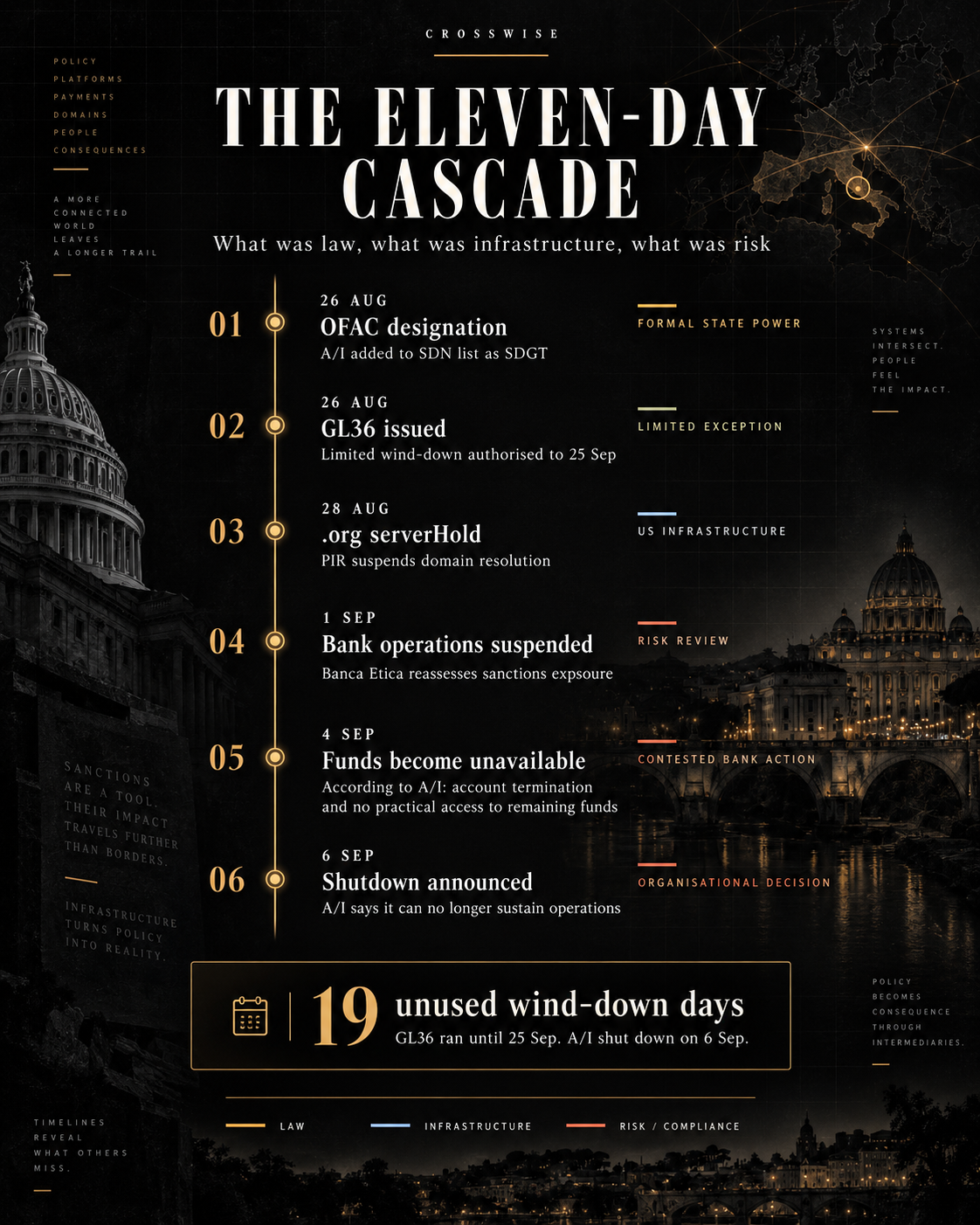
Graphic 02 — The Eleven-Day Cascade: what was law, what was infrastructure, and what was a private risk decision.
28 AUGUST — THE DOMAIN. autistici.org becomes unreachable after a registry-level serverHold imposed on the domain by Public Interest Registry, the US-based operator of the .org registry. The effect of a serverHold is to prevent ordinary DNS resolution, so that no server need be seized for users to lose the familiar route to it, and PIR later said it regarded the step as one required of it by US sanctions law.
1 SEPTEMBER — THE BANK SUSPENDS OPERATIONS. Banca Etica publicly explains that A/I had held an account with it since 2018, that the account had operated regularly and thrown up no particular anti-money-laundering concerns, and that it had remained classified at medium risk right up until the US designation. After the OFAC action, the bank says, it had no choice but to raise the customer’s risk rating and to suspend the account’s operations temporarily while it worked out what options were left to it. [Banca Etica]
The bank says it reached out to Italy’s Economy and Finance Ministry, to the banking associations ABI and Assopopolari, and to further technical opinions besides, because its concern went well past the single A/I account: a secondary-sanctions outcome that cut it off from American intermediaries could, it warned, compromise card services and extra-euro payments for roughly 130,000 customers and members, and might in the end threaten the bank’s own survival. That, it should be stressed, is Banca Etica’s own assessment, and not an OFAC order addressed to it. [Banca Etica]
4 SEPTEMBER — THE DECISIVE DISPUTE. A/I says that at a meeting on 4 September Banca Etica informed it that the bank would exercise its right to terminate the contract unilaterally, and that the donated funds still sitting in the account would not be available to the association. A/I called the decision illegitimate and said it intended to pursue every legal remedy open to it, but the point it pressed hardest was that the decision had left it unable to meet its administrative obligations, to pay its service providers or to go on delivering services at all. [A/I account]
Those claims come from A/I, and Crosswise has not identified any later Banca Etica statement that independently confirms every detail of the 4 September meeting — a qualification that genuinely matters. Yet if A/I’s account is accurate, then the loss of practical access to its own funds was no peripheral detail of the shutdown but one of its proximate causes.
6 SEPTEMBER — A/I STOPS. A/I announces that it will discontinue its services, the collective explaining that continued operation now risked legal and financial consequences not only for itself but for the users and others who interacted with it. It stopped fully nineteen days before OFAC’s wind-down licence was due to expire, which proves nothing about whether any provider had violated or unnecessarily exceeded GL36, but does show plainly enough that the practical effects of the designation had overtaken the theoretical duration of the authorised wind-down. [A/I closure]
The 19-day question
There is a useful number buried inside the chronology, for GL36 was set to expire on 25 September while A/I announced its shutdown on 6 September — a gap of nineteen days.
The licence permitted specified wind-down transactions throughout those remaining nineteen days, even as it required any payment to the blocked organisation to enter a blocked account and authorised nothing that fell outside its scope. [GL36]
The public evidence does not yet establish whether PIR, Banca Etica or the other service providers could lawfully have kept materially more functionality alive during that window, and so to brand their conduct over-compliance as settled fact would go too far — though to call it a question well worth examining goes no distance too far at all.
02 THE PERSPECTIVES
Washington's strongest case
The strongest argument for the designation begins from a fact that critics are sometimes tempted to minimise, which is that communications infrastructure can itself be operational infrastructure.
A network engaged in political violence needs far more than money and weapons; it needs secure communications, anonymous publishing, channels for recruitment, information about targets, instructions for carrying out its work, and some reliable mechanism for claiming its attacks and encouraging their repetition.
State alleges that A/I services performed several of exactly those functions, in some instances citing the distribution of incendiary-device instructions, of maps or other information about infrastructure, of doxxing material, and of explicit calls for further attacks. [State Department]
A/I, moreover, selected its users for ideological affinity rather than operating as an indiscriminate public utility, and under EO 13224 Washington was never required to prove that A/I’s administrators had chosen a target or personally helped to carry out an attack, since the regulation reaches, in express terms, technological support, goods or services provided to or in support of terrorism. [31 CFR 594.201]
Set against that legal framework, the government’s theory is a good deal stronger than the caricature that “they sanctioned a website because they disliked its politics.”
A/I's strongest case
A/I broadly rejects the US allegations, and the strongest argument in its favour is not the implausible one that violent people could never have used its services, but the sharper claim that providing privacy infrastructure and knowingly supporting a qualifying terrorist act are not necessarily the same thing.
Some of State’s strongest concrete examples involve the publication of responsibility claims after an attack had already happened, others turn on material encouraging violence still to come, and others again concern the distribution of manuals or target information — and each of those categories may carry a quite different factual and legal significance from the next.
The publicly available material tells us a great deal about what appeared on, or moved through, A/I-linked infrastructure, and a good deal less about what A/I’s administrators themselves knew of each item, when they knew it, what control they exercised over it, and which particular conduct OFAC finally relied upon in applying the “act of terrorism” criterion.
That missing specificity does nothing to invalidate the designation itself; what it does is limit what any outsider can independently conclude from the public record.
Banca Etica's dilemma
The Italian bank occupies perhaps the most revealing position of all, for its stated political judgment ran squarely against Washington’s action even as its risk judgment pulled it the other way.
Banca Etica said that it opposed what it took to be the misuse of counterterrorism instruments against political dissent, and yet it said, in the same breath, that its dependence on US financial intermediaries made the consequences of keeping an OFAC-listed customer potentially intolerable — for its other customers, and conceivably for the bank itself. [Banca Etica]
The value of retaining A/I was finite. The perceived value of retaining access to the wider financial network was much larger. |
03 EVIDENCE CHECK
CLAIM A/I was convicted of terrorism. VERDICT: FALSE There was no criminal conviction underlying the 26 August action. A/I was subjected to an administrative blocking designation under EO 13224 and placed on the SDN list as an SDGT. [Federal Register] |
CLAIM A/I was made a Foreign Terrorist Organization. VERDICT: FALSE FTO designation under the Immigration and Nationality Act is legally distinct from OFAC's Global Terrorism Sanctions Regulations and from the [SDGT] designation applied here. [31 CFR 594.201] |
CLAIM Washington had to prove A/I planned or knew about particular attacks in advance. VERDICT: FALSE That is not the test. The applicable regulation permits designation for material or technological support, goods or services to or in support of an act of terrorism, among other criteria. An earlier analytical approach placed too much weight on a criminal-conspiracy-style standard that the sanctions regime does not require. [31 CFR 594.201] |
CLAIM Washington's case consisted only of political association. VERDICT: FALSE The State Department published a detailed allegation set involving responsibility claims, militant communiqués, sabotage manuals, target information, doxxing and calls for additional attacks. [State Department] |
CLAIM The US public record identifies exactly which act of terrorism supplied OFAC's formal legal nexus. VERDICT: NOT CLEAR The Federal Register gives the legal criterion but does not identify a particular underlying act. State's fact sheet provides multiple possible candidates. Crosswise cannot determine from the published designation notice alone which was dispositive. [Federal Register] |
CLAIM A/I was simply a neutral internet utility. VERDICT: MISLEADING A/I explicitly selected users according to ideological compatibility. That materially distinguishes it from an indiscriminate commercial platform. It does not automatically establish knowledge of everything those users subsequently published or did. [A/I service policy] |
CLAIM US authorities ordered an Italian bank to close A/I's account. VERDICT: NOT ESTABLISHED Banca Etica describes its response as driven by the sanctions designation, secondary-sanctions exposure and dependence on American intermediaries. Crosswise found no published, A/I-specific US directive ordering Banca Etica to terminate the account. [Banca Etica] |
CLAIM Banca Etica unquestionably over-complied. VERDICT: NOT ESTABLISHED A/I argues that the bank's conduct was illegitimate. GL36 authorised certain wind-down activity until 25 September. But the licence also imposed significant limitations, and no definitive legal ruling establishing what Banca Etica could or could not lawfully have done has been identified. The issue remains disputed. [GL36] |
CTX THE SYSTEM BEHIND THE SANCTION
CONTEXT — NOT EVERY TOOL BELOW WAS USED AGAINST A/I
The events of these eleven days become far easier to understand when they are set inside the broader evolution of American financial-security policy, provided the distinctions are kept clear.
FinCEN did not sanction A/I, and Section 311 was never used against it; the operative instrument in this case was OFAC, acting under Executive Order 13224, and everything else that follows serves only to explain the larger system within which that instrument operates.
OFAC — sanction and block
US economic sanctions long predate the modern terrorism regime; Treasury traces OFAC’s institutional ancestor to Foreign Funds Control, established in 1940 after Nazi Germany invaded Norway to block assets and restrict transactions involving enemy and occupied territories.
OFAC itself came into being in 1950, in the wake of China’s entry into the Korean War. [OFAC history]
Its modern programmes allow the United States to block property and to restrict dealings with designated countries, entities and individuals wherever statutory or executive authority permits, and in this case OFAC was the operative institution throughout.
The Bank Secrecy Act — make finance visible
The Bank Secrecy Act dates to 1970, and it established the reporting and record-keeping requirements meant to leave the authorities a financial trail — at first through the reporting of large cash transactions and the preservation of identifying information — before later legislation expanded that architecture very substantially. [FinCEN history]
The underlying principle is a different one from sanctions altogether: where OFAC can restrict access, the Bank Secrecy Act works instead to make financial activity observable.
FinCEN — analyse the flows
FinCEN was created in 1990, as the United States developed a greater capacity to collect, analyse and disseminate financial intelligence, and it administers the BSA framework today while serving as the country’s Financial Intelligence Unit. [FinCEN]
FinCEN is therefore central to any understanding of how the United States polices illicit finance, even though it played no demonstrated role whatever in the designation of A/I.
2001 — access becomes more powerful
After September 11, the USA PATRIOT Act expanded the BSA and anti-money-laundering architecture, tightening in particular the requirements around foreign correspondent banking and terrorist finance, of which Section 311 is a useful example.
It allows Treasury to impose escalating special measures on the jurisdictions, institutions or transactions it deems of primary money-laundering concern, and at their strongest those measures can prohibit or condition the maintenance of US correspondent or payable-through accounts for foreign banks. [FinCEN PATRIOT Act]
Treasury itself is at pains to stress that Section 311 actions are distinct from OFAC designations; Section 311 helps explain the broader history of access-based financial leverage, but it was not the weapon brought to bear against A/I. [Treasury Section 311]
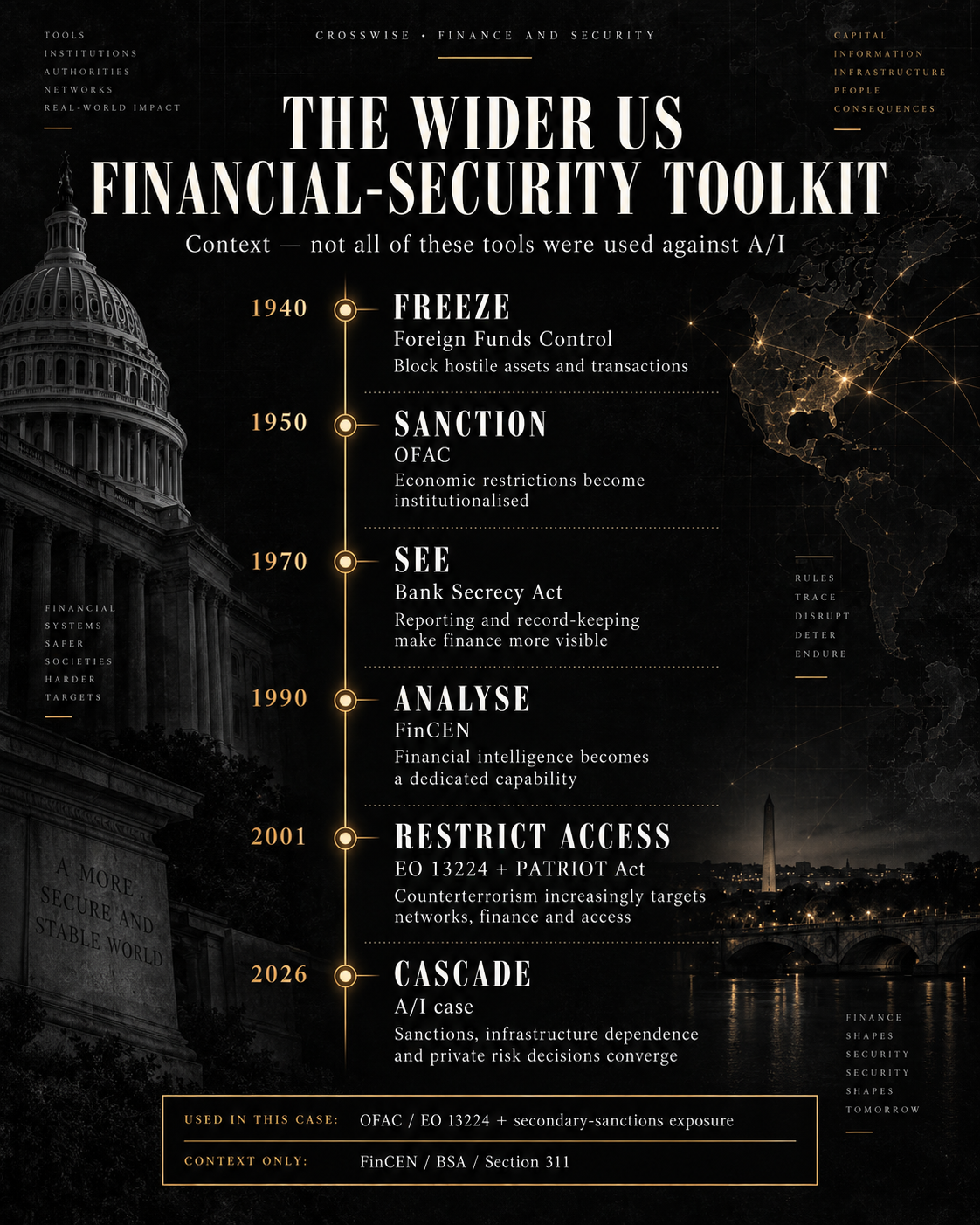
Graphic 03 — The wider US financial-security toolkit. Context matters, but only OFAC / EO 13224 and the resulting sanctions exposure operated directly in this case.
Why American power travels
America does not control the internet, nor does it control the whole of global banking, and by no means every international payment so much as touches the United States.
The more useful observation is a narrower one: that the international economy keeps running up against institutions and infrastructure over which American law does have jurisdiction, or through which access to American markets and financial services comes to matter enormously.
A foreign institution can therefore find itself caring a great deal about US sanctions even where Washington has issued it no direct command at all, and nowhere is this truer than in banking, where foreign banks maintain relationships with other institutions in order to settle transactions, to reach currencies and to provide international services — so that the loss of an important correspondent or intermediary relationship can carry consequences reaching far beyond any single customer.
A similar effect can make itself felt well outside banking, and in the A/I case it was the .org registry itself that carried the decisive US nexus.
The relevant question is not whether Washington governs everything. It is how often an international organisation eventually encounters something Washington can regulate — or something whose operator cannot afford to ignore Washington. |
That, in the end, is what infrastructural leverage looks like.
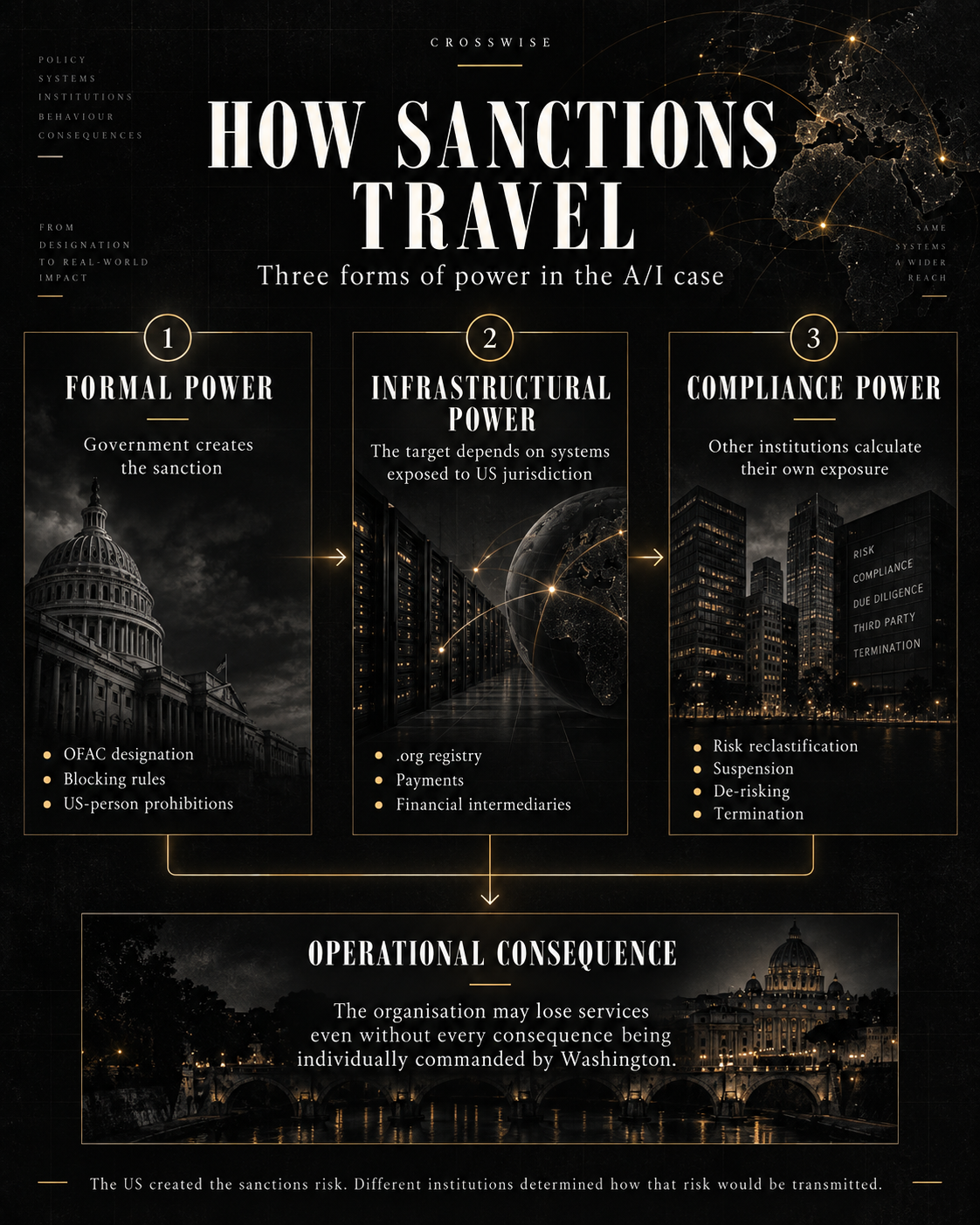
Graphic 04 — How Sanctions Travel: formal power, infrastructural power and compliance power can converge into operational consequence.
04 WHAT WE DON'T KNOW
What underlying evidentiary record did OFAC rely upon?
The publicly released materials are not the entire administrative file, and the US government may well hold evidence that materially strengthens the nexus between A/I and particular acts of terrorism — evidence that Crosswise, for its part, has not seen.
Which act of terrorism was decisive?
This is now the most important of the unresolved evidentiary questions: the formal notice applies the act-of-terrorism support criterion, and State supplies several possible factual chains, but the public notice never tells us which of them, or which combination of them, supplied the dispositive basis.
How independently verified are the individual A/I links?
The violent incidents themselves can often be established independently, which is not at all the same as independently corroborating the government’s precise account of how A/I services were used in each and every instance, and those claims need to stay labelled accordingly.
What exactly was the A/I–PKK relationship?
Treasury says that A/I provided services to the PKK, and the allegation is an important one, but Crosswise has not yet obtained any independent primary record establishing the exact service, account or organisational relationship being referred to.
Was the 4 September banking decision legally necessary?
A/I says it was not, while Banca Etica had already explained in public that it was seeking institutional guidance and feared for its wider operations, and all of this unfolded while GL36 remained in force; Crosswise, for now, has obtained no definitive Italian, European or American legal determination that resolves the dispute.
Will A/I's challenge actually reach a court?
A/I said it would pursue every available legal avenue over the banking decision, which amounts to a stated intention to challenge rather than any evidence, as yet, that proceedings have actually been filed. [A/I bank statement]
Did shutting A/I down eliminate the underlying networks?
The honest answer is that we do not know: digital communities can migrate, services can be mirrored, and users can move to other infrastructure, so that while the sanctions plainly disrupted A/I’s existing operation, that is a long way from demonstrating that the underlying extremist communications ecosystem has disappeared.
05 CROSSWISE ASSESSMENT
The easiest conclusions to reach about this case are, almost without exception, the least useful ones.
Autistici/Inventati was not merely some innocent commercial host, unlucky enough to find that bad people had opened accounts on its servers; its political identity was explicit, it chose its users by ideological affinity, and the US government has identified numerous instances in which, it says, A/I infrastructure was used to publish militant communiqués, to distribute tactical material, to expose personal information and to encourage further violence.
EO 13224 never required Washington to prove that A/I’s administrators had personally planned the attacks, and holding on to that distinction has been essential to assessing the case fairly.
The harder question is the one the public designation materials leave only partly resolved. OFAC formally concluded that A/I provided technological support, goods or services to or in support of an act of terrorism, and yet its formal notice never identifies the particular act, even as State’s accompanying case gathers together several very different forms of conduct — ranging from post-attack publication to alleged plotting and incitement.
The designation may very well be soundly founded; what the public record does not allow is for any outsider to reconstruct its decisive factual chain with the precision that saying so confidently would require.
What happened afterwards offers a different kind of evidence altogether, and here, at least, the mechanism is plainly visible.
American law created the sanctions exposure; a US-regulated registry acted upon it; an American payment provider reportedly restricted service; and an Italian bank that had publicly objected to the designation nevertheless concluded that keeping the relationship alive could place the services relied on by roughly 130,000 other customers and members at risk.
Then, according to A/I, the bank told it that its remaining funds would no longer be available, whereupon A/I said it could no longer pay its suppliers and announced its shutdown two days afterwards.
That sequence should not be described as Washington directly ordering an Italian organisation to close its doors; what it demonstrates is something subtler and, in its way, more consequential — that American legal power had altered the risk calculations of institutions well beyond American borders.
The distinction matters because private compliance decisions can at once amplify a sanction and make its ultimate consequences far harder to attribute. The government imposes the sanction; an infrastructure provider then decides what compliance requires of it; a bank weighs its correspondent relationships; a payments company measures its own exposure — and while each of those decisions may be perfectly rational on its own terms, taken together they can determine whether another organisation remains operational at all.
And that is why the history of OFAC, of FinCEN, of correspondent banking and of the wider American financial-security architecture matters here — not because they add up to some single omnipotent agency, which they plainly do not, but because, over decades, the United States has developed several distinct ways of making access to important systems conditional.
The A/I case is a particularly concentrated demonstration of what happens when legal power, infrastructure and private compliance all converge on the same point at the same moment.
Whether A/I deserved that treatment depends, in the end, on evidence that remains only partly visible to those outside the file; the mechanism by which it was undone, however, is a great deal harder to dispute.
Eleven days showed how quickly legal risk can become infrastructure risk — and infrastructure risk can become a question of organisational survival. |
RADAR CROSSWISE RADAR
JAMAICA — A reparations claim moves from politics toward law
Jamaica has formally petitioned King Charles III to refer three legal questions concerning slavery to the Judicial Committee of the Privy Council — whether enslavement in Jamaica was lawful under English law, whether it violated international law, and whether Britain consequently bears a present obligation to provide a remedy — and the Jamaican government says it wants answers to those questions in hand before deciding on its next step. [AP]
What we're watching: whether the King makes the referral and, if so, whether the JCPC treats the questions as legally justiciable rather than essentially political.
NORTH KOREA — Nuclear deterrence moves toward the sea
Kim Jong Un says that the newly commissioned Kang Kon, a destroyer of roughly 5,000 tons, will form part of North Korea’s nuclear response system, though the claim by itself establishes nothing about whether the ship currently carries deployed nuclear weapons. [Reuters]
What we're watching: evidence of an operational rather than declaratory sea-based nuclear capability.
GREENLAND — Europe puts €200 million behind its Arctic relationship
The European Commission has announced a €200 million Global Gateway package with Greenland for 2026–27, spanning connectivity, sustainable energy and critical raw materials. [European Commission]
What we're watching: how much of the package becomes concrete infrastructure and whether it materially changes the balance of European, American and other external investment in Greenland.
THE RECEIPTS
Research Ledger
Crosswise conducted two independent research passes, followed by a hostile red-team review and a final adjudication, and throughout the investigation it kept the following strands deliberately apart:
A/I's political character
the US government's allegations
the legal criterion actually used
independent evidence of the underlying attacks
the alleged use of A/I infrastructure
the consequences legally required by US sanctions
decisions made independently by infrastructure and financial providers
The repetition of a US government allegation across multiple news reports was never counted as independent corroboration, and wherever the underlying incident is independently established while the precise A/I nexus derives chiefly from State or Treasury, that distinction has been retained rather than quietly smoothed over.
How Crosswise Counts
11 days: 26 August designation to 6 September shutdown announcement.
19 unused wind-down days: 6 September through 25 September, when General License 36 was scheduled to expire.
Approximately 130,000 customers and members: Banca Etica's figure for the wider customer/member population it said could be affected if access to US-linked services were disrupted. This is not a Crosswise estimate. [Banca Etica]
16,000 mailboxes / 1,500 websites / 5,500 mailing lists / 10,000 blogs: figures cited in contemporary US reporting around the designation. These are retained as approximate infrastructure counts rather than independently audited Crosswise figures.
Primary & Official Records
1. US Treasury — Treasury Takes Action Against Violent Far-Left Terrorist Networks, 26 August 2026 — Sets out Treasury's allegations, the PKK claim and sanctions basis. Open source
2. OFAC — Counter Terrorism Designations, 26 August 2026 — Confirms the [SDGT] entry, secondary-sanctions notation and issuance of GL36. Open source
3. Federal Register — Notice of OFAC Sanctions Action — Provides the formal designation criterion applied specifically to A/I. Open source
4. OFAC — General License 36 — Provides the 25 September wind-down deadline and conditions. Open source
5. US Department of State — Designation of Autistici/Inventati as a Specially Designated Global Terrorist — Provides the detailed allegation set concerning rail sabotage, TAL, Germany, militant publications, Rose City Antifa, Atlanta and Jane's Revenge. Open source
6. Banca Etica — statement of 1 September 2026 — Provides its AML history with A/I, suspension decision, consultations and assessment of secondary-sanctions risk. Open source
7. Autistici/Inventati — statement on the 4 September bank decision — Provides A/I's account of the bank decision and its intended legal response. Open source
8. Autistici/Inventati — closure statement — Confirms the decision to discontinue services and its stated reasons. Open source
Specialist / Data Sources
1. OFAC institutional history — Foreign Funds Control, 1940; OFAC, 1950. Open source
2. FinCEN BSA history — BSA, 1970; development of reporting architecture; FinCEN, 1990. Open source
3. FinCEN USA PATRIOT Act material — Section 311 and foreign correspondent banking. Open source
4. Treasury Section 311 explainer — Confirms Section 311 is legally distinct from OFAC designations. Open source
Independent & Regional Reporting
Independent and Italian reporting was used principally to test the dates, the consequences of the shutdown, the banking developments, the payment-provider reports and the underlying sabotage incidents, and wherever a primary document existed it superseded the syndicated or secondary accounts in the final evidentiary chain.
Key Claims Crosswise Triangulated
1. A/I was designated as an SDGT on 26 August 2026. CONFIRMED. [OFAC]
2. A/I was not designated as an FTO and was not criminally convicted through this action. CONFIRMED. [Legal framework]
3. The formal designation used the “support to or in support of an act of terrorism” criterion. CONFIRMED. [Federal Register]
4. State published specific allegations concerning A/I's use by violent actors. CONFIRMED AS US GOVERNMENT ALLEGATIONS. [State Department]
5. Treasury says A/I provided services to the PKK. CONFIRMED AS A TREASURY ALLEGATION; precise service relationship not independently established by Crosswise. [US Treasury]
6. GL36 permitted qualifying wind-down activity through 25 September. CONFIRMED. [General License 36]
7. Banca Etica says A/I's account had not generated prior AML concerns. CONFIRMED. [Banca Etica]
8. Banca Etica feared sanctions consequences could affect approximately 130,000 other customers and members. CONFIRMED AS THE BANK'S RISK ASSESSMENT. [Banca Etica]
9. A/I says the 4 September banking decision deprived it of practical access to its funds and prevented it paying providers. CONFIRMED AS A/I'S ACCOUNT; not yet independently confirmed in full by Banca Etica. [A/I]
10. A/I announced its shutdown on 6 September. CONFIRMED. [A/I]
11. The public record does not identify the specific underlying act or acts OFAC treated as dispositive for A/I's formal designation. CONFIRMED FROM THE PUBLISHED NOTICE; the non-public administrative record may contain additional specificity. [Federal Register]
What We Could Not Obtain
Crosswise was unable to obtain the complete OFAC administrative evidentiary record; any classified or otherwise non-public intelligence underlying the designation; independent primary evidence establishing the precise A/I–PKK service relationship; a definitive identification of the particular act or acts of terrorism underlying the formal designation; an authoritative legal determination of how GL36 applied to PIR’s or Banca Etica’s precise circumstances; a Banca Etica statement independently confirming every detail A/I attributes to the 4 September meeting; a primary PayPal statement; or any evidence that the shutdown eliminated, rather than merely displaced, the affected digital networks.
Those uncertainties are retained rather than resolved by inference.
Radar Sources
Jamaica: Associated Press and Jamaican government material. [AP]
North Korea: Reuters and KCNA reporting as described by Reuters. [Reuters]
Greenland: European Commission / Global Gateway. [European Commission]
Found Something We Missed?
Crosswise investigations remain open after publication. If you have a primary document, correction, contradictory source or evidence that materially changes this analysis, contact editor@readcrosswise.com.
We distinguish corrections from disagreements. Material factual errors are corrected. Substantive new evidence is incorporated into the record.