
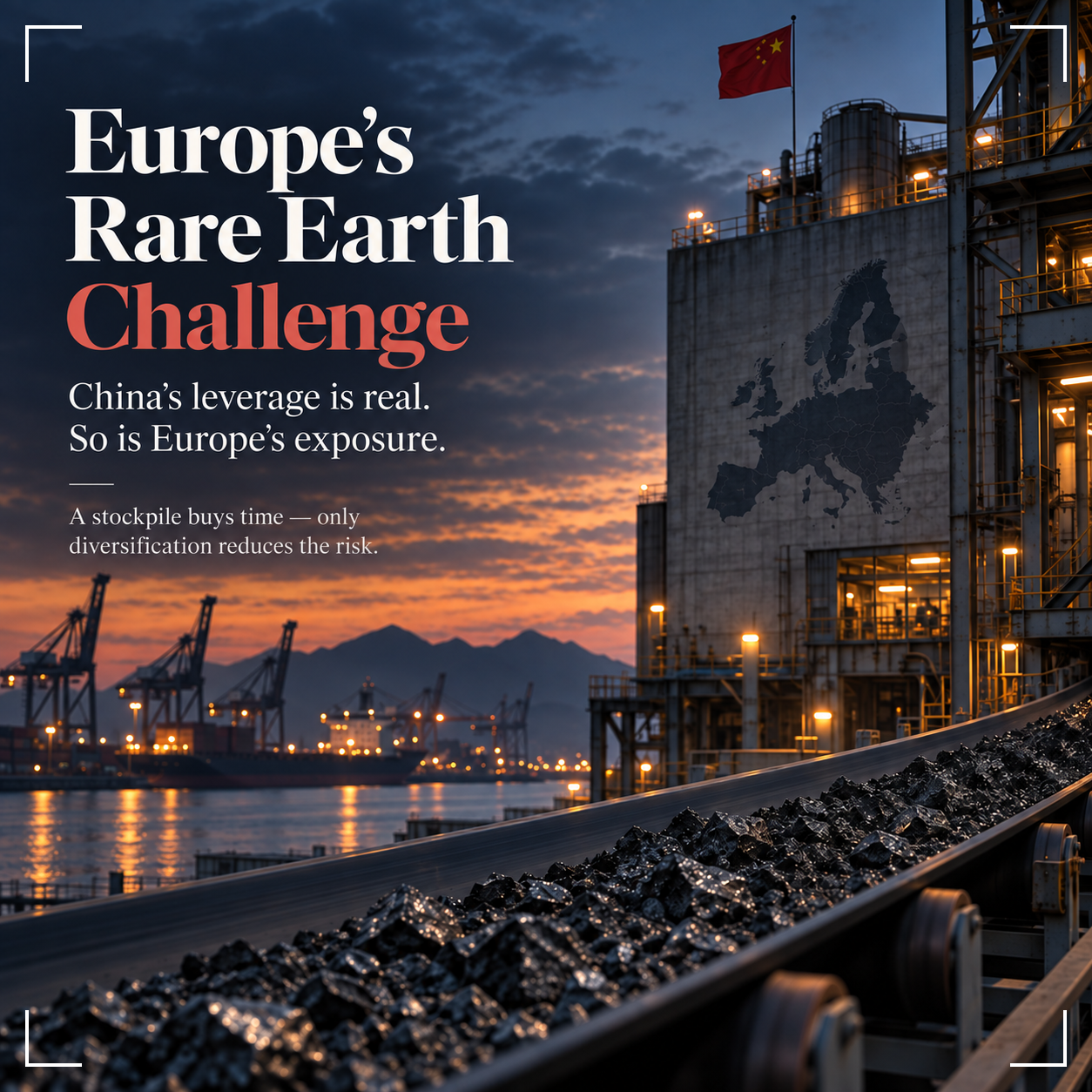
Europe has identified the minerals, projects and dependencies it considers strategically dangerous. Twenty-three designated projects are now demanding more support. But the harder question is not whether Europe should spend more. It is which dependencies are genuinely intolerable - and how much insurance against them is worth buying.
60% China share of mining for Nd, Pr, Dy, Tb | 91% China share of refining | 94% China share of sintered magnets | 60 EU CRMA Strategic Projects |
Why This Story
Europe knows, with unusual precision, where many of its critical-material vulnerabilities lie: it has legislated targets for mining, processing and recycling, identified 60 projects intended to improve the security of supply, and built the financing mechanisms, faster permitting procedures and foreign partnerships meant to deliver them.
And yet, in August, the developers behind 23 of those 60 Strategic Projects issued an “Urgent Call to Action”, warning about financing, market access, permitting and the mounting pressure on projects nearing a final investment decision. That is not, in itself, evidence that 23 projects are failing; the signatories were making an industry case for more support, and the precise number in genuine liquidity trouble remains unclear. One project director told Reuters that several had already been “put on ice”, though that too is an attributed industry claim rather than a verified, project-by-project failure count. The European Commission, for its part, says it has assembled a framework capable of mobilising around €1.7 billion for Strategic Projects.
So this is not quite the familiar tale of Brussels identifying a strategic problem and then forgetting to pay for it; the truth is more awkward than that. The Critical Raw Materials Act can declare that a given mine, refinery or processing plant would make Europe safer, but it cannot make that plant profitable — and the gap between strategic value and commercial value is fast becoming one of the most consequential industrial-policy problems Europe faces.
Rare earths show why. For the four principal magnet rare earths — neodymium, praseodymium, dysprosium and terbium — China accounted in 2024 for roughly 60% of mined production, 91% of refined output and 94% of sintered permanent-magnet production, so that the vulnerability arises not because China owns almost every deposit but because it dominates almost everything that happens once the material leaves the ground.
That imbalance has bred an increasingly familiar warning — that China could switch off Western industry, or even Western defence production, simply by withholding rare earths. There is truth inside the argument and there is also exaggeration, because a prolonged, universal embargo would impose heavy costs on China itself, punish its own customers, encourage substitution and accelerate the very alternative supply chains that Beijing’s dominance currently suppresses. None of which makes the dependency harmless: China may never need to close the tap for good, only to keep the ability to tighten it at politically useful moments.
The question for Europe, then, is not whether it should attempt complete mineral autarky, which it plainly cannot, but whether it can build enough inventory, processing, alternative supply and industrial redundancy that Chinese coercion becomes an inconvenience rather than a disablement — something that takes money, and, harder still, a decision about precisely what deserves to be insured.
Research Summary
The EU’s Critical Raw Materials Act sets a series of 2030 benchmarks — domestic extraction equivalent to at least 10% of annual strategic-material consumption, 40% of processing and 25% of recycling — and under it the Commission has since designated 47 Strategic Projects inside the EU and a further 13 beyond its borders.
Strategic designation carries real advantages, since it can speed permitting, raise a project’s visibility, ease coordination and open the door to financing channels; what it does not carry is any entitlement to EU money. The European Court of Auditors has said as much explicitly, noting that the CRMA contains no automatic financing for Strategic Projects and that financial viability is not even a prerequisite for the designation in the first place. That distinction matters more than it may appear, because a project can be strategically desirable without ever being commercially bankable.
A project, in other words, can answer “Would Europe be safer if this existed?” with an emphatic yes and, in the same breath, answer “Will private investors earn an acceptable risk-adjusted return by building it?” with an equally firm no. Those are two different questions, and the danger lies in pretending they are one.
FIGURE 01 • THE RARE-EARTH EXPOSURE
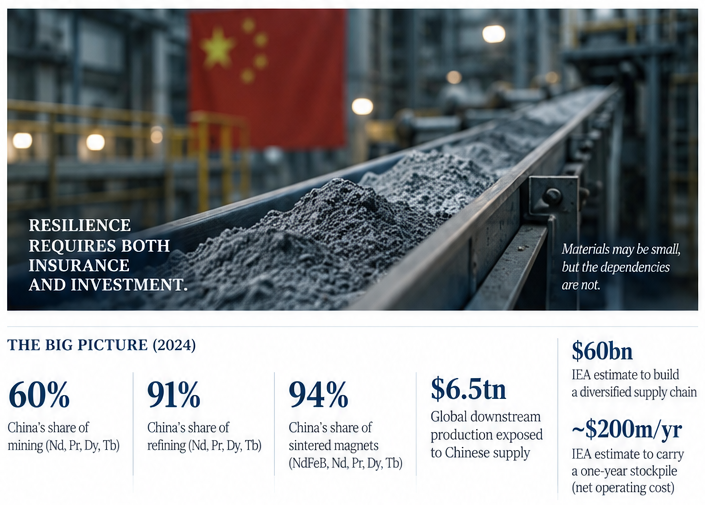
The strategic risk is concentrated downstream: China’s share rises sharply from mining to refining and magnet manufacture. The $6.5tn figure is economic activity exposed to disruption, not a forecast of losses. Sources: IEA, 2026.
01 What We Know
The 23-project letter is a warning, not a failure census
The August appeal is politically important, but it is not an objective health check on all 60 Strategic Projects. Its signatories have a direct commercial interest in cheaper capital, guaranteed markets and public participation, so their claims have to be read as advocacy as much as evidence: the letter establishes real dissatisfaction with the speed and scale of financing, market-access support and permitting, yet it does not establish that every signatory is in financial distress, that Brussels caused the difficulties, or that every project deserves to be rescued.
To dismiss it as mere lobbying, though, would err just as badly in the other direction, because the European Court of Auditors had already identified many of the same structural weaknesses on its own account: fragmented financing instruments, an uncertain link between public spending and actual supply, financing bottlenecks, high project risk and implementation timelines that make the EU’s 2030 targets look harder by the month. The letter does not prove that Europe’s financing system is failing; what it does is show industry running into problems already visible elsewhere in the European institutional record.
Viridian does not have one clean cause
Viridian Lithium had planned a lithium refinery of roughly €295 million at Lauterbourg, in France, and it carried the Strategic Project designation; in March 2026 the company nonetheless entered judicial liquidation, having failed to assemble the financing it needed to proceed, and the cause of that failure is genuinely contested.
The company’s former chief commercial officer, Luc Pez, told Reuters that insufficient European participation had contributed directly to the collapse, arguing that private investors had been waiting for Europe to commit and that Strategic Project status had raised expectations which never translated into real support. Yet the project also faced a deteriorating market: lithium prices had fallen dramatically from their earlier highs, European EV growth had slowed against expectations, financing conditions had tightened, and the proposed refinery faced direct cost competition from established Chinese capacity.
Both explanations can be true at once. Weak economics can leave investors unwilling to move, and a comparatively small public commitment can still be the marginal signal those same investors are waiting for — which is why Viridian proves neither that Brussels killed a viable refinery nor that the refinery simply deserved to die. It poses, instead, the question this whole story keeps returning to: when a strategically valuable asset is commercially marginal, should government step in and change the economics?
Europe has a project-pipeline problem before construction even starts
The financing challenge, in fact, begins long before any refinery or mine reaches a final investment decision. An EIB-commissioned study published in July put current EU mineral-exploration spending at roughly €200 million a year, and calculated that it would need to climb to about €2 billion a year, sustained for five years, to generate the pipeline of projects Europe’s extraction targets require — a near-tenfold increase.
This matters because mining is a brutal funnel: thousands of geological prospects are explored, a tiny fraction mature into advanced projects, and a smaller fraction still ever become operating mines. Europe cannot solve a long-term supply problem simply by designating more Strategic Projects at the narrow end of that funnel; it needs a pipeline of prospects wide enough at the top to yield enough successes at the bottom.
02 The Perspectives
Perspective A: strategic dependence cannot be left entirely to market prices
The market has no automatic mechanism for pricing a national-security externality. A manufacturer choosing between two magnets will normally decide on price, specification, quality and reliability; it will not, as a rule, price in the geopolitical consequences of an adversarial state dominating the processing ecosystem five years hence.
China’s rare-earth position illustrates the problem exactly. Chinese dominance climbs sharply as the material moves downstream — from roughly 60% of mining to about 91% of refining and 94% of sintered permanent magnets — on the back of scale, integrated supply chains, specialist equipment, process expertise, infrastructure, trained labour and an enormous domestic manufacturing base, all of which add up to a real and durable cost advantage. Cheap Chinese material is therefore no artificial distortion; it is a genuine competitive advantage that happens to carry strategic consequences.
And there lies the trap: if thousands of companies each make the individually rational choice and buy the cheapest qualifying input, the collective result can be precisely the dependency their governments regard as strategically dangerous.
Perspective B: strategic policy can easily become a machine for preserving bad projects
The opposite risk is every bit as real. Once a government labels an asset “strategic”, its owners acquire a powerful argument for public support — and the label tends to stick regardless of merit. A mine can have poor geology and still be strategic; a refinery can carry excessive operating costs and still be strategic; a technology can fail and still be strategic; commodity prices can collapse and still leave management blaming insufficient government help.
That is why the European Court of Auditors’ finding — that financial viability is not required for Strategic Project designation — matters so enormously: strategic status cannot be allowed to become a guarantee against failure. Insulate every designated project from commodity-price risk and Europe will, in time, manufacture a fleet of expensive industrial zombies; the real challenge is to pick out the limited number of nodes whose strategic value genuinely exceeds their commercial disadvantage, which calls for discrimination rather than blanket subsidy.
03 Evidence Check
CLAIM: “China controls 95% of rare earths.”
VERDICT: MISLEADING
Everything depends on which part of the supply chain is being measured. For the four magnet rare earths — Nd, Pr, Dy and Tb — China accounted in 2024 for roughly 60% of mining, 91% of refining and 94% of sintered permanent-magnet manufacturing, so the 94% figure is entirely real; what it describes, however, is magnet production, not ownership of 94% of the world’s deposits or mines.
That distinction matters because it locates the real vulnerability. The critical asset is not the ore body but the accumulated ecosystem around it — the separation plants, the metallurgy, the specialist equipment, the process knowledge, the trained personnel, the magnet manufacturing and the downstream customers needed to turn ore into a high-performance component — which makes the chokepoint industrial at least as much as geological.
CLAIM: “China could immediately shut down Western military assets.”
VERDICT: OVERSTATED
China can certainly disrupt production, and it has already shown as much: after Beijing introduced controls on several heavy rare earths in April 2025, exports fell sharply, and carmakers outside China ran short of magnets, with some cutting output or halting lines altogether until licences were eventually issued.
But the magnets already installed inside an operational fighter aircraft, a submarine or a radar do not vanish the moment exports stop; the more defensible military vulnerability lies further back, in the production and replenishment chain that keeps such systems flying and fighting:
· New production
· Replacement parts
· Repairs
· Actuators and electric motors
· Precision-guided munitions
· The ability to replenish inventories during a prolonged conflict
A production chokepoint of that kind is a serious matter — but it is a different thing entirely from reaching across the world to switch off an existing fleet.
CLAIM: “China would never use the chokepoint because it would hurt itself.”
VERDICT: TOO REASSURING
Economic self-harm constrains Chinese coercion; it does not abolish it. The IEA estimates that full implementation of China’s expanded rare-earth controls could leave around $6.5 trillion of downstream production outside China exposed — a measure of the economic activity at risk, not a forecast that $6.5 trillion would simply be destroyed.
Much of the immediate pain would fall on China’s own customers, and China would incur costs of its own through lost sales, damaged downstream trade, retaliation and the acceleration of substitution — but those costs need not arrive all at once, nor need they be politically symmetrical. A government can be willing to absorb diffuse, dispersed losses if its target suffers concentrated, time-sensitive disruption in a strategically sensitive sector; economic interdependence raises the price of coercion without ever making coercion irrational in every circumstance.
CLAIM: “China can selectively starve Western defence manufacturers.”
VERDICT: PLAUSIBLE IN INTENT; UNCERTAIN IN EXECUTION
The U.S. Department of Defense estimates that its own rare-earth demand amounts to less than 0.1% of global consumption, a tiny share that can be read in two opposite ways: either military requirements are relatively easy for Western governments to secure, or denying military-related supply would cost China very little — provided Beijing could identify the ultimate military users with any accuracy.
China is explicitly trying to build that capability, its export-control architecture increasingly distinguishing civilian trade from military users, military end uses and transactions where the end user cannot be satisfactorily verified. That proves regulatory intent rather than perfect enforcement, because magnets and intermediate products can pass through distributors, motor manufacturers, electronics suppliers and third-country assemblers, and tracing every gram through such tangled supply chains is far harder than drafting the rule that forbids it; how well those mechanisms can actually prevent diversion and leakage remains an open question.
CLAIM: “Japan proved dependence can easily be broken.”
VERDICT: HALF TRUE
Japan is routinely cited as proof that rare-earth coercion backfires. After the 2010 confrontation with Beijing, Tokyo invested in alternative sourcing, recycling, material efficiency, redesign and non-Chinese producers such as Lynas, and China’s share of Japanese rare-earth imports duly fell from around 85% in 2009 to 58% by 2020.
That is meaningful diversification, and it is also a lesson in how stubbornly the dependency clings: a wealthy, technologically sophisticated state spent the better part of a decade reducing its exposure and still drew a majority of its rare earths from China. Japan therefore proves two things at once — that adaptation works, and that adaptation takes years — and it is the second of those, far more than the first, that should govern any serious thinking about strategic inventories.
CLAIM: “A ~$200 million stockpile can solve the problem instead of building alternative supply.”
VERDICT: FALSE
The IEA estimates that building sufficiently diversified non-Chinese magnet rare-earth supply chains would take roughly $60 billion of investment over the coming decade, and, quite separately, that the net annual operating cost of holding a strategic inventory equivalent to about a year of exposed non-Chinese magnet rare-earth imports would run to some $200 million. These are not competing solutions but complementary ones: the stockpile buys time, while the industrial investment decides what happens once that time runs out.
Nor is $200 million the purchase price of the inventory; it is the estimated annual net cost of maintaining it. Governments would still have to acquire the oxides, metals, alloys and magnets themselves, finance the holding, decide what form to stockpile, rotate the material as technical requirements shift, and do all of it without distorting a market China still dominates. The logic is best read as an equation — an inventory to survive the disruption window, plus selective industrial capacity to reduce what happens once that inventory is consumed. Strip out the second term and a stockpile merely postpones dependency; strip out the first and the new capacity may arrive too late.
FIGURE 02 • BUFFER + BUILD
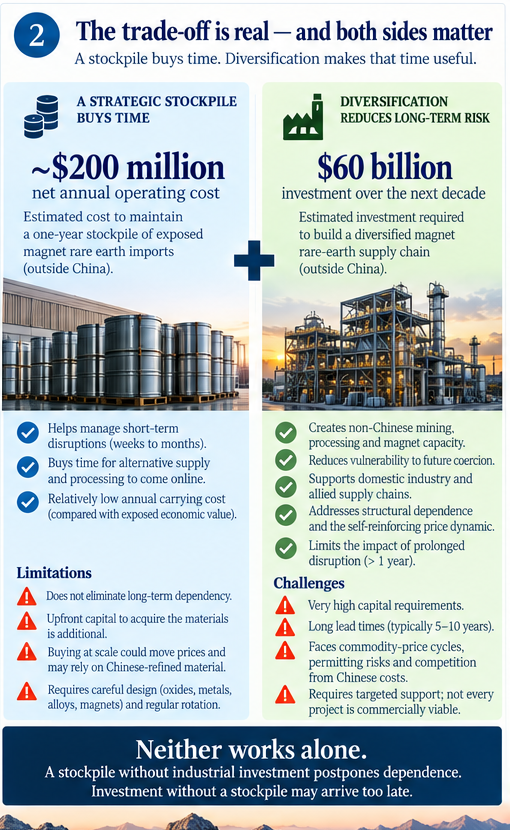
A strategic inventory and diversified industrial capacity solve different parts of the same problem. The ~$200m figure is the estimated net annual operating cost of a one-year buffer; it is not the upfront cost of acquiring the inventory. Source: IEA, 2026.
04 What We Don’t Know
Which of the 60 projects actually deserve support?
The August appeal cannot answer that question, and neither can Strategic Project designation. What Europe needs is project-level discrimination — judgement grounded in geology, position on the global cost curve, technical maturity, capital intensity, permitting risk, the availability of alternative suppliers, downstream importance and the economic consequence of failure. The relevant test is not “Is this project strategic?” but “Is this project one of the least-cost ways to insure a genuinely dangerous supply-chain node?” — and those are very different questions.
What would a serious European strategic inventory really cost?
The IEA gives an estimated annual net operating cost; it does not claim that Europe could assemble a complete strategic inventory for $200 million. Governments would need significant upfront capital to buy the material in the first place, and the design of the stockpile would matter every bit as much as its size, because a reserve of rare-earth oxide may do nothing to relieve a shortage of the particular qualified magnet a defence contractor actually needs. A pile of raw material is not automatically a usable industrial buffer; the inventory has to be built around specific supply-chain failure modes rather than headline tonnage.
How accurately can China police end use?
Beijing clearly intends to separate civilian trade from military, but its ability to do so through the tangle of international supply chains is a great deal less certain — and that gap may ultimately decide whether Chinese coercion can stay narrowly selective or whether effective enforcement would demand controls broad enough to inflict meaningful costs on China’s own civilian exporters and customers as well.
How long would diversification actually take during a crisis?
Japan’s experience is a warning against assuming that a one-year buffer amounts to a one-year solution, because industrial qualification, specialist equipment, permitting, construction and customer certification all take time of their own. The real value of stockpiling therefore depends on having diversification projects already under way before any crisis begins: a stockpile is only a bridge, and a bridge is worth building only if something is rising to meet it at the far end.
05 Crosswise Assessment
Europe does not face a binary choice between dependence and autarky; it faces a sequencing problem. The task is first to survive the shock and then to make the next shock less powerful — and while a strategic inventory can address the first half of that task, only selective industrial policy can address the second.
That reframing changes how the Chinese rare-earth threat ought to be understood. The most dramatic version of it — Beijing permanently embargoes the West and effortlessly shuts down its military-industrial base — is implausibly simple, since a comprehensive embargo would impose costs on Chinese producers and exporters, encourage substitution, justify enormous Western subsidies and hasten the construction of the very competitors China would least wish to see. None of which makes the chokepoint imaginary.
China may, in truth, extract more leverage from disruption that is limited, selective and reversible than from outright permanent denial. A licence can be delayed, an end user rejected, a shipment made to wait on fresh certification, an export-control category quietly widened; and a government in the middle of a military or diplomatic crisis can suddenly find that several of its alternative supply chains remain unfinished. Much of the coercive value lies precisely in that uncertainty.
Yet the West’s vulnerability is not fixed in the nature of things; it is, increasingly, a matter of industrial-policy choice. China has accumulated its advantages not merely from resources but from scale, equipment, expertise, vertical integration, downstream manufacturing and decades of industrial learning — advantages that lower costs, which benefits Western consumers even as it makes non-Chinese projects harder to finance.
The result is a self-reinforcing loop that Europe has not yet found a way to break:
· Chinese scale supports low prices.
· Low prices weaken competing projects.
· Weak competition preserves Chinese scale.
· Persistent concentration preserves geopolitical leverage.
A stockpile cannot break that loop; it can only buy Europe the time in which to break it.
The United States has chosen one unusually explicit method. Its 2025 agreement with MP Materials combined a $400 million preferred-equity investment, a $150 million loan, a ten-year price floor of $110/kg for NdPr and a ten-year magnet-offtake arrangement — and it is the price floor that matters most, since it effectively shifts part of the downside risk of low rare-earth prices from the producer onto the state. That does not, of itself, make the policy efficient: a price floor can preserve a strategically essential producer, and it can just as easily preserve an inefficient one.
That is exactly why Europe should not copy the intervention indiscriminately across all 60 Strategic Projects, but should instead identify the narrowest set of industrial capabilities that matter out of all proportion to their size:
· Rare-earth separation
· Metallisation and alloy production
· High-performance magnet manufacturing
· Selected heavy-rare-earth feedstock
· Recycling
· Qualified defence inventories
· Particular lithium, graphite or nickel-processing nodes where concentration creates similar systemic exposure
With those in hand, Europe can then layer several kinds of resilience on top of one another:
· Strategic inventory for short shocks
· Multiple external suppliers for geographic diversification
· Domestic or allied processing for the most critical stages
· Long-term offtake or price support where private markets cannot price the security benefit
· Ordinary market discipline everywhere else
FIGURE 03 • A STRATEGIC-RESILIENCE FRAMEWORK
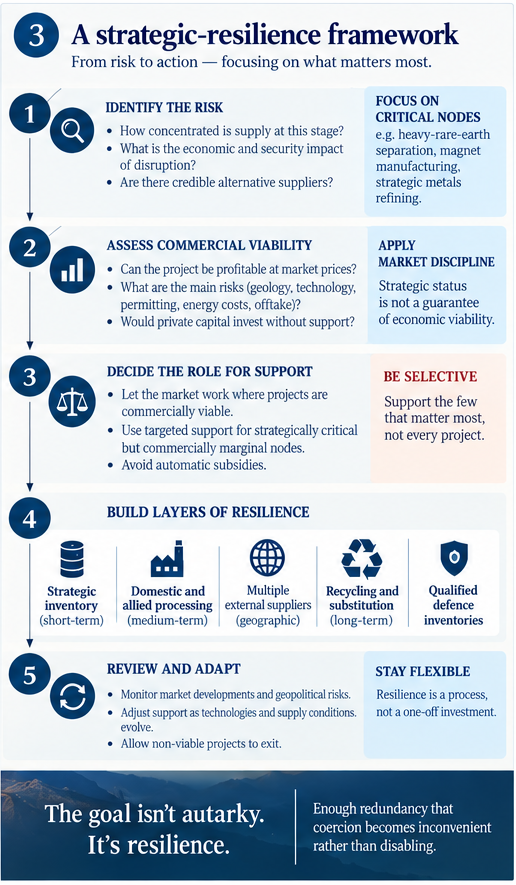
The policy test is not whether a project carries a strategic label, but whether it protects a genuinely critical node at an acceptable cost. Market discipline remains part of the framework; support is targeted, not automatic.
This is harder than simply funding mines, and it is also more rational than trying to reproduce every Chinese industrial advantage inside Europe — and it offers a far better answer to the rare-earth doomsday narrative than fatalism ever could. China cannot painlessly shut down the Western economy for ever; but that, in the end, is the wrong test.
The right test is whether Beijing can manufacture enough temporary scarcity, in sufficiently important sectors and at sufficiently sensitive moments, to alter Western behaviour — and today the honest answer is probably yes. The further question is whether Europe can materially reduce that leverage, and the answer to that is also yes, but only if the buffer and the build are pursued together rather than one at the expense of the other.
The August warning from those 23 Strategic Projects therefore matters for a reason more subtle than its signatories themselves suggest. It is not proof that Brussels must fund them; it is evidence that Europe has reached the point at which merely identifying its dependencies is no longer enough, and the next stage will require putting an explicit price on resilience.
Some projects should fail, some should be allowed to fail, and some may need to survive even when ordinary market economics insist they should not — and the serious policy challenge is telling the three apart. Europe has mapped its chokepoints; it has still not fully priced the escape.
Crosswise Radar
MMG / BRAZIL
EU regulators are preparing antitrust objections to the proposed acquisition, by Chinese-controlled MMG, of Anglo American’s Brazilian nickel operations. The immediate question is one of competition policy, yet the case is a neat illustration of how ownership of mineral capacity is coming to intersect, ever more tightly, with Europe’s wider economic-security concerns.
SOLVAY / LA ROCHELLE
Solvay is in discussions over a potential partnership involving its rare-earth activities and its La Rochelle processing facility. It would be wrong to present this as proof that private capital has solved Europe’s downstream problem, since discussions are a long way from a closed transaction, but it does show investors beginning to examine strategic processing capacity rather than leaving the sector wholly to governments.
EXPLORATION
The EIB estimates that Europe needs roughly ten times its current exploration expenditure over the next five years, a reminder that all the talk of downstream resilience ultimately rests on a far larger pipeline upstream.
JAPAN
Japan remains the most useful natural experiment available, its experience demonstrating both that dependence on China can indeed be reduced and that the reduction is measured in years rather than months.
The Receipts
Reuters — 8 September 2026
The August appeal associated with 23 EU Strategic Projects; the Commission’s €1.7 billion financing-framework claim; Luc Pez’s account of Viridian; and the attributed claim that other projects had already been put on ice.
European Court of Auditors — Special Report 04/2026
Findings on financing, legal and administrative bottlenecks; fragmented EU funding; Strategic Project designation; project viability; and implementation risk.
International Energy Agency — Rare Earth Elements, 2026
China’s 60% mining, 91% refining and 94% sintered-magnet shares for Nd, Pr, Dy and Tb; the estimated ~$60 billion diversification requirement; and the approximate ~$200 million annual net operating cost of a one-year strategic buffer.
International Energy Agency — Global Critical Minerals Outlook 2026
Analysis of Chinese export controls and the scale of downstream economic activity exposed to supply disruption.
European Investment Bank — July 2026 exploration study
Estimate that EU exploration expenditure needs to rise from approximately €0.2 billion to around €2 billion annually for five years.
U.S. Government Accountability Office
U.S. Department of Defense estimate that its rare-earth requirements account for less than 0.1% of global demand.
Japan Ministry of Economy, Trade and Industry
China’s share of Japanese rare-earth imports falling from approximately 85% in 2009 to 58% in 2020 following sustained diversification efforts.
Chinese Ministry of Commerce — 2026 export-control measures
Evidence of explicit attempts to distinguish military users and military end uses from civilian trade.
MP Materials / U.S. Department of Defense — 2025
Preferred-equity investment, loan, ten-year $110/kg NdPr price floor and long-term magnet-offtake structure used to support domestic U.S. supply.
CROSSWISE VERDICT
China’s rare-earth advantage is real, but it is not an effortless economic kill switch. Europe does not need autarky. It needs enough inventory to absorb a short shock, enough alternative processing and production to survive a long one, and enough discipline to subsidise only those industrial nodes whose strategic value genuinely exceeds their commercial weakness. A stockpile without industrial investment postpones dependence. Industrial investment without a stockpile may arrive too late. |