
Indonesia is deepening defence-industrial cooperation with Beijing while China already dominates important parts of its trade and industrial economy. Yet Jakarta is simultaneously expanding security relationships with Australia, the United States, Japan and other partners. The evidence does not show an Indonesian pivot to China. It shows a more complicated strategy: accepting different dependencies from competing powers in an attempt to prevent any one of them becoming decisive.
CROSSWISE RESEARCH
38 source items materially used · 23 underlying evidentiary chains · 16 primary/official records · 10 key claims deliberately triangulated
Research cut-off: 22 August 2026
VIEW THE RECEIPTS ↓
WHY THIS STORY
Indonesia and China have just agreed to deepen their defence relationship.
Among the most consequential elements is a proposal to establish a joint munitions-production facility in Indonesia, with the Indonesian side describing possible Chinese technology transfer and an intended operational start around 2027.
That would move China further into an area directly connected to Indonesian national security.
The obvious interpretation is:
Indonesia is moving closer to Beijing.
But that interpretation encounters an immediate problem.
Indonesia is simultaneously expanding defence cooperation with Australia, maintaining large-scale military engagement with the United States, deepening maritime and technology cooperation with Japan, buying major combat systems from European and Asian suppliers, and continuing to reject the legal basis of Chinese maritime claims affecting Indonesia’s exclusive economic zone.
It also became a full member of BRICS in January 2025.
Jakarta is therefore moving closer to several competing centres of power at once.
Crosswise chose this story because the useful question is not simply:
Whose side is Indonesia on?
It is:
Can Indonesia preserve strategic autonomy by spreading its dependencies across competing powers — even as parts of its economy become increasingly concentrated on China?
We tested that question against trade, investment, nickel, arms procurement, exercises, defence agreements, maritime disputes and actual cases in which Indonesian and Chinese interests have collided.
01 — WHAT WE KNOW
China is becoming a more important Indonesian defence partner
The latest Indonesia–China agreement is substantive.
The two governments have agreed to deepen defence cooperation and pursue a joint munitions-production facility in Indonesia.
The Indonesian side has described possible technology transfer from China, with the facility expected to begin operating around 2027 if the project proceeds as intended.
That is potentially important.
Domestic munitions production can create long-term relationships involving:
- manufacturing equipment;
- technical standards;
- specialist materials;
- intellectual property;
- software;
- licensing;
- training;
- maintenance;
- and component supply.
But much of the detail required to judge the project's strategic effect is not yet public.
Crosswise could not verify the final:
- ownership structure;
- Chinese industrial participants;
- Indonesian industrial participants beyond the broad state-sector involvement;
- financing arrangements;
- specific weapons categories;
- component sourcing;
- licensing terms;
- intellectual-property arrangements;
- or guaranteed technology-transfer package.
The agreement therefore establishes growing defence-industrial cooperation.
It does not yet establish Indonesian military dependence on China.
China is already economically central to Indonesia
The trade relationship is much more mature.
Indonesia imported approximately $87.4 billion of goods from China in 2025.
That represented approximately:
36.2% of all Indonesian goods imports.
China was also Indonesia’s largest major non-oil export market.
That concentration matters.
More than one-third of Indonesian goods imports came from a single country.
But concentration is not automatically dependence.
To establish strategic dependence we also need to know:
- how replaceable Chinese goods and capital are;
- how long substitution would take;
- what the switching costs would be;
- whether Beijing can deliberately exploit the relationship;
- and whether Jakarta actually changes policy when Chinese pressure is applied.
That produces a much more complicated picture.
Nickel is where the relationship becomes structurally important
Indonesia has become one of the most important countries in the global nickel industry.
Chinese companies, finance and industrial technology have been central to that transformation.
Chinese involvement extends through:
- smelting;
- refining;
- industrial parks;
- battery materials;
- stainless steel;
- processing technology;
- financing;
- and commodity offtake.
That creates substantial Chinese leverage.
But Indonesia also owns something China needs: extraordinarily large nickel resources and production capacity.
The important question is therefore not simply:
Who owns the ore?
It is:
Who can replace whom, at what cost and over what period?
That is harder to answer.
Indonesia can impose costs on Chinese processors by changing quotas, taxes, pricing or regulation.
China can impose costs on Indonesia because much of the processing ecosystem, investment capital and industrial technology cannot necessarily be replaced quickly.
Both sides therefore possess leverage.
Crosswise cannot presently establish with confidence which side is less vulnerable to disruption.
The safest description is:
mutual but uneven interdependence.
The $50 billion dispute gives us a real-world test
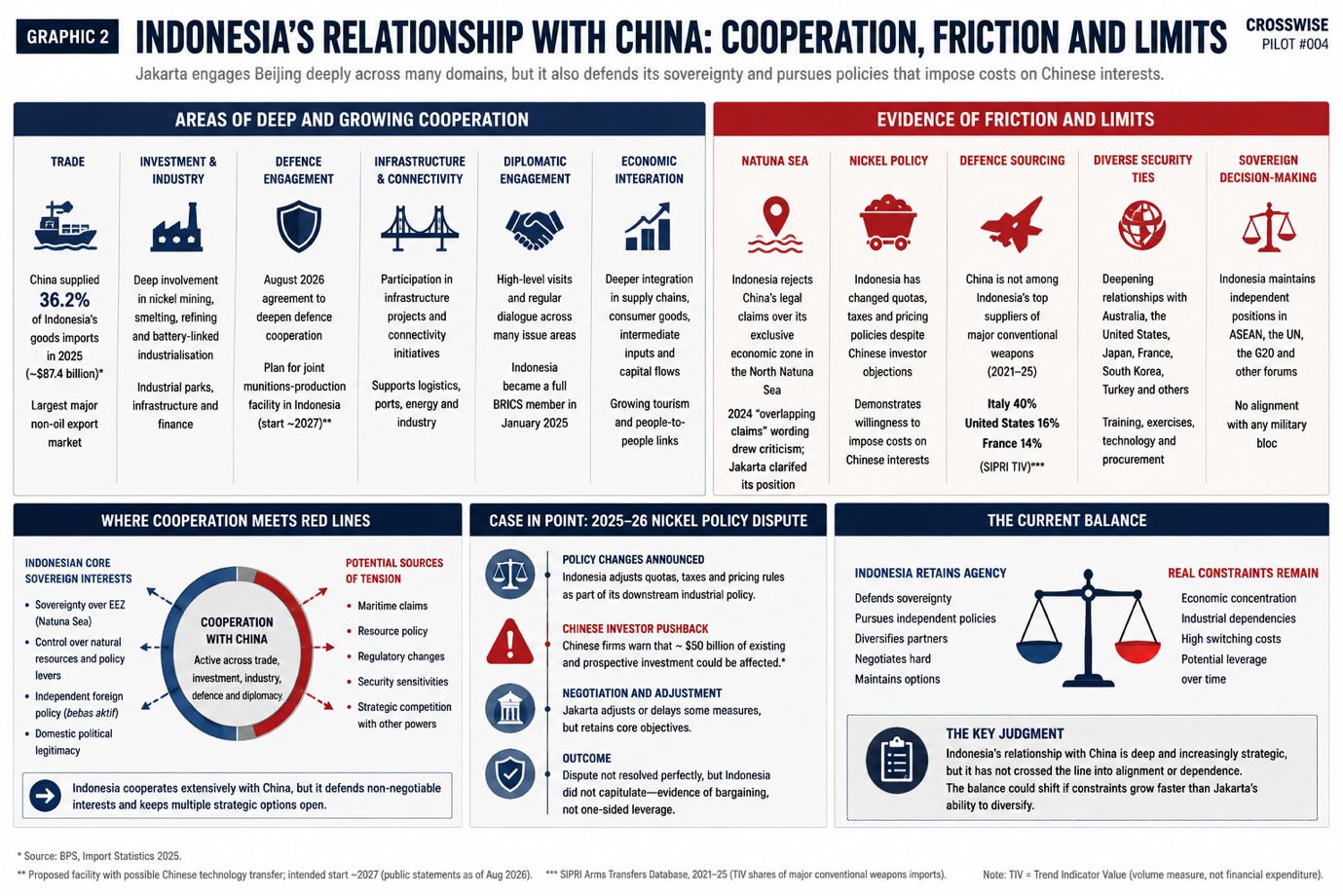
Chinese businesses have warned that approximately $50 billion in existing and prospective investment could be affected by changes in Indonesian nickel policy.
The figure itself should be treated carefully.
It is a reported estimate of Chinese investment exposure, including prospective capital, rather than an independently audited stock of realised investment.
The dispute nonetheless matters.
Chinese firms objected to changes involving:
- production quotas;
- taxation;
- pricing;
- and regulatory conditions.
Jakarta did not simply abandon its downstream industrial-policy objectives.
Some measures were adjusted or delayed.
Others remained.
That makes the episode evidence of bargaining, not evidence that one side can dictate terms to the other.
It weakens two simplistic claims at once:
“Indonesia is too dependent on China to resist.”
and
“Indonesia can easily dictate terms because China needs its nickel.”
Neither is established.
Security dependence exists too — but it is distributed differently
A major weakness in analysing Indonesia is to treat dependence on China as inherently dangerous while describing dependence on Western or other partners as “autonomy.”
That would be wrong.
Indonesia also relies on external partners for:
- combat aircraft;
- submarines;
- military education;
- spare parts;
- software;
- weapons integration;
- training;
- doctrine;
- maintenance;
- intelligence relationships;
- and defence technology.
France, South Korea, Turkey, the United States, Australia and Japan can all create their own forms of dependency.
The difference is structural.
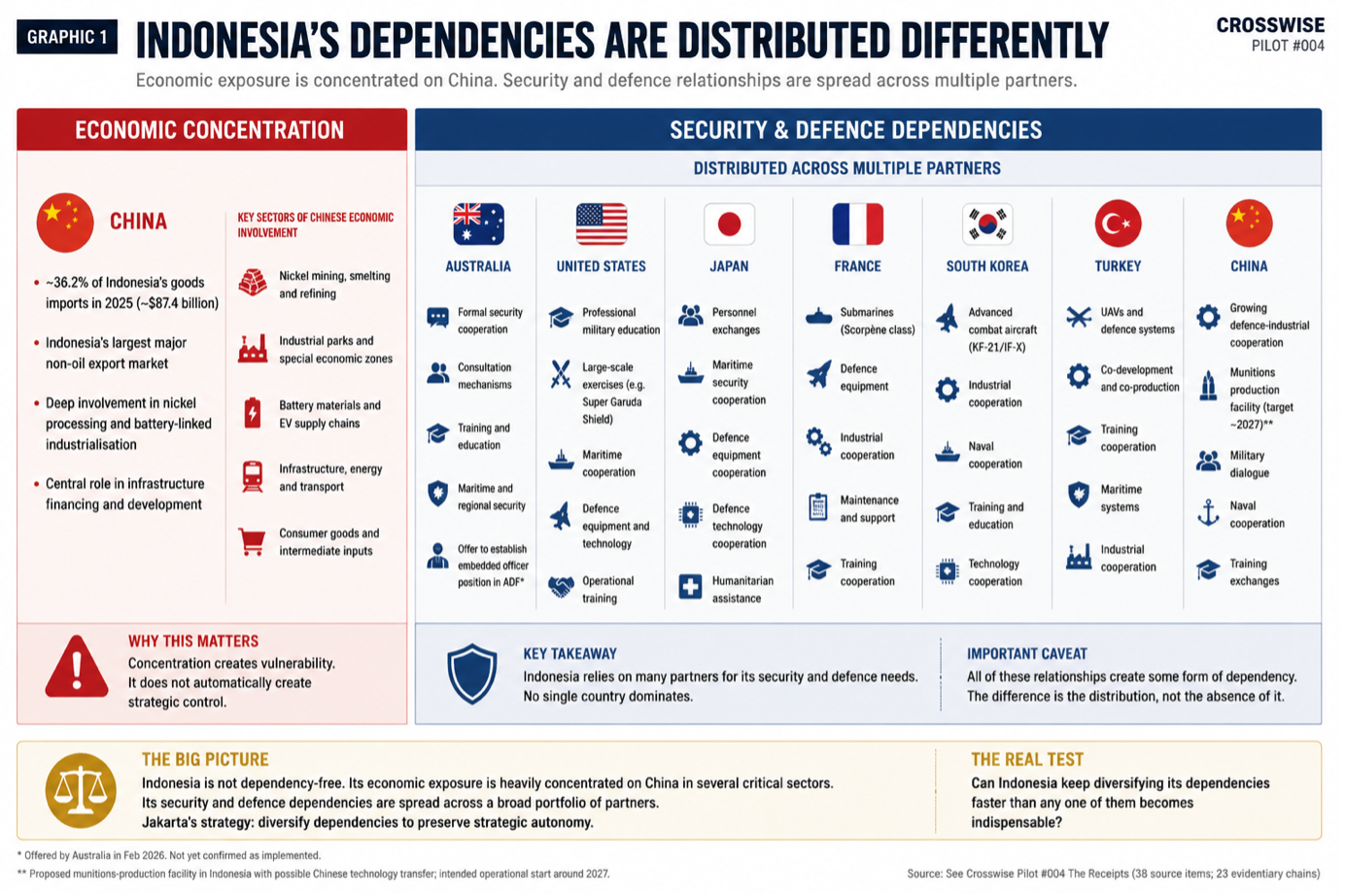
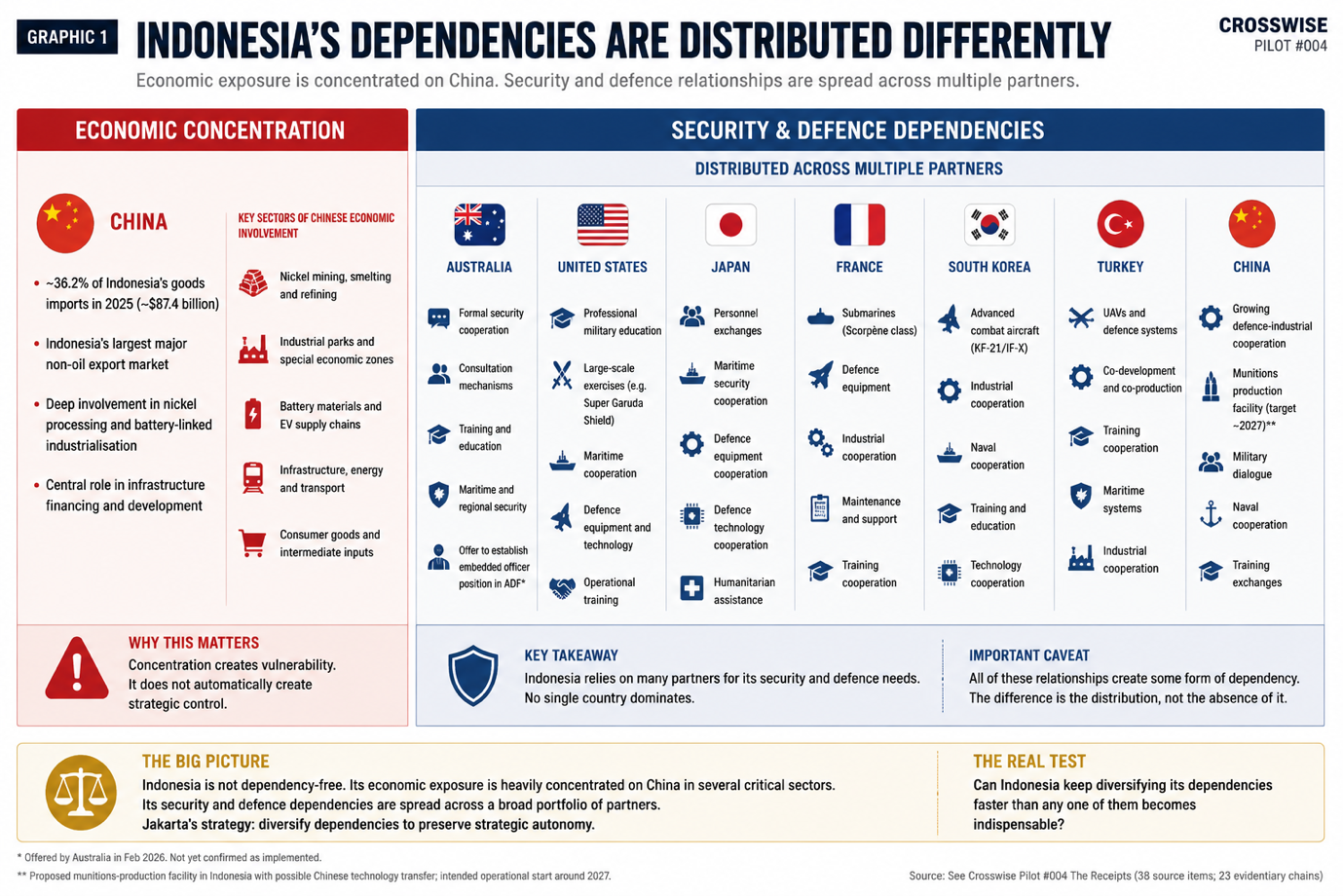
Indonesia’s economic exposure to China is highly concentrated.
Its security and defence dependencies are spread across a wider portfolio of partners.
That does not make those defence dependencies benign.
It makes them less concentrated.
FIGURE 1 — INDONESIA’S DEPENDENCIES ARE DISTRIBUTED DIFFERENTLY
ECONOMIC CONCENTRATION
China
- ~36.2% of Indonesian goods imports in 2025
- largest major non-oil export market
- deep role in nickel processing and battery-linked industry
SECURITY / DEFENCE DEPENDENCIES
Australia
- formal security cooperation
- consultation mechanisms
- training and institutional integration
United States
- military education
- exercises
- operational training
- equipment
Japan
- maritime security
- defence technology
- equipment cooperation
France / South Korea / Turkey
- major platforms
- industrial cooperation
- co-development
China
- growing defence-industrial cooperation
- limited current role in major conventional-arms supply
TAKEAWAY
Indonesia is not dependency-free. Its security dependencies are distributed across several partners; parts of its economic exposure are much more concentrated on China.
China is not Indonesia’s dominant supplier of major conventional weapons
Indonesia’s procurement pattern matters because major weapons systems can generate long-term dependence through:
- maintenance;
- ammunition;
- training;
- upgrades;
- software;
- integration;
- and spare parts.
SIPRI data for 2021–2025 identify Indonesia’s three largest suppliers of major conventional arms as:
Italy — 40%
United States — 16%
France — 14%
China does not appear among the top three.
An important caveat:
SIPRI’s measure tracks the volume of major conventional arms transfers.
It does not measure total defence expenditure.
And it does not capture smaller munitions in the same way as aircraft, warships or other major systems.
So the evidence supports:
China is not currently a dominant supplier of Indonesia’s major conventional weapons.
It does not support:
China is unimportant to Indonesia’s defence supply.
The proposed munitions facility could begin changing that picture at another layer of the defence-industrial system.
Australia is institutionally important — but this is not an alliance
Indonesia and Australia signed a new Treaty on Common Security in February 2026.
The agreement deepens an already substantial bilateral relationship.
It provides mechanisms for consultation and further cooperation when the two countries face adverse security circumstances.
But it should not be described as a mutual-defence alliance.
Indonesia has deliberately avoided that kind of commitment.
Australia has also proposed deeper practical integration, including expanded training arrangements and an offer to create a senior embedded position for an Indonesian military officer within the Australian Defence Force.
Those initiatives are significant.
But proposed or offered arrangements should not be treated as already implemented.
The evidence therefore supports a narrower conclusion:
Australia currently has a more institutionally developed security relationship with Indonesia than China does.
That relationship creates dependencies of its own.
It is also one component of Indonesia’s wider effort to avoid relying on a single partner.
The United States remains a major operational partner
Indonesia participates in Super Garuda Shield, a large multinational exercise involving thousands of personnel and multiple partner countries.
Its activities have included:
- combined-arms training;
- live fire;
- amphibious activity;
- maritime operations;
- air operations;
- and other complex military activity.
But Super Garuda Shield is multinational, not simply a bilateral US–Indonesia exercise.
It should therefore not be used alone to prove bilateral alignment with Washington.
The stronger evidence is cumulative:
Indonesia also has substantial bilateral relationships with the United States involving:
- professional military education;
- officer training;
- equipment;
- maritime cooperation;
- institutional engagement;
- and operational training.
That combination is currently deeper than Indonesia’s military relationship with China.
Japan is expanding its role as well
Indonesia and Japan signed a new Defence Cooperation Arrangement in May 2026.
It covers areas including:
- personnel exchanges;
- joint training;
- maritime security;
- humanitarian assistance;
- defence equipment;
- and defence technology.
The two sides are also discussing deeper naval cooperation, including potential equipment transfers and the maintenance, sustainment and training relationships that would accompany them.
Again, Jakarta is not replacing one strategic relationship with another.
It is accumulating them.
BRICS complicates any simple “Western partner” narrative
Indonesia became a full member of BRICS in January 2025.
China and Russia are central members of that grouping.
That fact can reasonably be interpreted as evidence of Indonesia moving further into institutions associated with the non-Western international order.
But Jakarta itself framed BRICS membership differently.
Indonesia presented the decision as part of:
- Global South cooperation;
- greater representation for developing countries;
- economic diversification;
- and a more inclusive international system.
And BRICS membership occurred alongside — not instead of — deeper relationships with Australia, Japan, the United States and others.
The episode therefore fits the wider pattern:
Indonesia is joining institutions across competing geopolitical spheres rather than choosing one institutional camp.
That strengthens the multi-alignment interpretation.
It also demonstrates why “non-aligned” should not be mistaken for “uninvolved.”
Natuna shows where cooperation reaches its limit
Indonesia and China also disagree over maritime rights.
China’s expansive South China Sea claims overlap waters where Indonesia asserts rights under the UN Convention on the Law of the Sea around the North Natuna Sea.
Indonesia has repeatedly maintained that it does not recognise a Chinese legal claim over its exclusive economic zone.
But the record is not perfectly clean.
A controversial 2024 joint statement referred to “overlapping claims.”
That language generated criticism because Indonesia had historically insisted there was no legal overlap to negotiate.
Jakarta subsequently clarified that the statement did not represent recognition of China’s expansive maritime claims or a surrender of Indonesian sovereign rights.
The episode is therefore evidence of two things simultaneously.
First:
Indonesia has not formally accepted Beijing’s maritime legal position.
Second:
The political language around the dispute can soften or become ambiguous as the wider bilateral relationship deepens.
That ambiguity deserves watching.
02 — THE PERSPECTIVES
There is no useful Left-versus-Right division here.
The disagreement concerns how strategic alignment actually develops, whether economic concentration translates into political leverage, and whether Indonesia’s diversification strategy is genuinely sustainable.
THE CHINA-TILT CASE
The strongest argument that Indonesia is moving towards Beijing does not require a formal alliance.
It begins with structural economics.
China is:
- Indonesia’s dominant source of imports;
- its largest major export market;
- deeply embedded in nickel processing;
- central to parts of battery and EV industrialisation;
- a major infrastructure partner;
- a BRICS partner;
- and now an expanding defence-industrial partner.
Under this interpretation, the important question is not whether Jakarta signs a treaty with Beijing.
Economic alignment can precede strategic alignment.
The proposed munitions facility matters because it takes China further into an area linked directly to Indonesian national security.
The deeper argument is:
Indonesia may be building Western and regional security relationships precisely because its economic centre of gravity is already becoming too China-heavy.
If so, security diversification is not evidence that the economic tilt does not exist.
It is a response to it.
Strongest evidence
The depth and concentration of China’s role in Indonesian trade and strategic industry.
Weakness
Indonesia continues behaving in ways inconsistent with established Chinese strategic control.
THE MULTI-ALIGNMENT CASE
The strongest counterargument is behavioural.
Indonesia works with China.
It also:
- trains with the United States;
- builds security institutions with Australia;
- cooperates with Japan;
- buys French weapons;
- develops technology with South Korea and Turkey;
- joins BRICS;
- remains active in ASEAN;
- and protects its maritime claims against China.
This is not equidistance.
Nor is it neutrality in the passive sense.
It is active portfolio management.
Indonesia’s traditional bebas aktif — free and active — doctrine is therefore evolving into something that can usefully be described as:
multi-alignment in pursuit of autonomy.
The purpose is not to avoid relationships.
It is to avoid exclusivity.
THE ECONOMIC-CAPTURE CASE
A third interpretation argues that security diversification may eventually become irrelevant if economic dependencies become sufficiently difficult to substitute.
Factories, supply chains and industrial ecosystems are sticky.
They create:
- sunk capital;
- employment;
- technology dependence;
- intermediate-goods dependence;
- infrastructure;
- commercial constituencies;
- and political costs.
A state can therefore remain formally non-aligned while its practical ability to oppose an economic partner becomes progressively constrained.
The critical question is:
Could Indonesia afford a major political rupture with China without undermining its own industrialisation strategy?
Crosswise cannot answer that confidently.
That is precisely why the economic concentration deserves attention.
THE WESTERN-DEPENDENCY COUNTERARGUMENT
The same logic must be applied in the other direction.
Indonesia also accepts dependency on Western and other security partners.
A French submarine programme can create dependence on:
- maintenance;
- training;
- parts;
- software;
- weapons;
- and technical support.
US professional military education can create institutional and doctrinal influence.
Australian training and interoperability can deepen operational relationships.
South Korean or Turkish co-production can create industrial dependencies.
If China-linked dependence raises questions about autonomy, these should too.
The relevant difference is not:
China = dependence
West = autonomy
It is:
How concentrated is the dependency, how replaceable is the partner, and what coercive leverage does the relationship create?
That is the standard Crosswise applies to all of them.
THE AUTONOMY-BY-DIVERSIFICATION CASE
Indonesia may deliberately accept multiple dependencies because eliminating external dependency altogether is unrealistic.
Few states can independently produce:
- combat aircraft;
- submarines;
- missiles;
- advanced electronics;
- battery technology;
- industrial machinery;
- and every critical intermediate input.
Indonesia’s strategy may therefore be to prevent concentration rather than dependence itself.
Obtain:
- submarines from France;
- aerospace cooperation from South Korea;
- co-development from Turkey;
- training from the United States;
- security cooperation with Australia;
- maritime capability from Japan;
- industrial scale and capital from China;
- and munitions technology from Beijing if useful.
Under that model:
diversification of dependencies becomes the mechanism of autonomy.
The weakness is obvious.
If one relationship becomes too difficult to replace, the strategy begins to fail.
03 — EVIDENCE CHECK
CLAIM: “Indonesia is pivoting into China’s strategic camp.”
CROSSWISE: NOT SUPPORTED
Indonesia’s relationship with China is becoming deeper.
But its wider strategic behaviour is inconsistent with a conventional pivot.
Jakarta is simultaneously strengthening security and defence relationships across multiple competing partners.
It also continues to reject the legal basis of Chinese maritime claims affecting its EEZ.
The evidence therefore supports greater China engagement, not bloc alignment.
CLAIM: “Indonesia remains non-aligned.”
CROSSWISE: SUPPORTED — WITH QUALIFICATION
Indonesia is not part of a China- or US-led alliance structure.
But “non-aligned” can imply distance from competing powers.
That is not what Jakarta is doing.
It is deliberately engaging many of them.
A better description of the observable behaviour is:
multi-alignment in pursuit of strategic autonomy.
That is an analytical description, not a replacement for Indonesia’s own bebas aktif doctrine.
CLAIM: “Indonesia’s BRICS membership proves it is moving towards China and Russia.”
CROSSWISE: NOT ESTABLISHED
BRICS membership is relevant.
China and Russia are major powers within the grouping.
But Indonesia joined BRICS while simultaneously expanding cooperation with Australia, Japan, the United States and others.
The membership is therefore consistent with both:
- greater engagement with non-Western institutions;
- and Indonesia’s broader strategy of institutional diversification.
By itself, BRICS membership does not establish alignment.
CLAIM: “China is becoming Indonesia’s dominant military partner.”
CROSSWISE: NOT SUPPORTED
China’s defence role is growing.
The proposed munitions facility matters.
But Indonesia’s deeper operational, procurement and institutional relationships remain distributed elsewhere.
SIPRI’s 2021–25 data show that China is not among Indonesia’s three largest suppliers of major conventional arms.
That statistic does not capture every munitions relationship.
It does establish that China does not currently dominate Indonesia’s high-end conventional procurement.
CLAIM: “The Chinese munitions facility will create military dependence.”
CROSSWISE: NOT ESTABLISHED
The project could have opposite effects.
Domestic production could:
- increase local capability;
- reduce imported finished-munition dependence;
- build skills;
- and strengthen Indonesian industrial autonomy.
But if production relies on Chinese-controlled:
- components;
- software;
- licences;
- specialist materials;
- or technical support,
it could create a new form of dependency.
The contractual evidence needed to decide between those outcomes is not public.
CLAIM: “Indonesia is economically dependent on China.”
CROSSWISE: OVERSTATED
China is economically central.
Its approximately 36.2% share of Indonesian goods imports establishes substantial concentration.
Chinese involvement in strategically important industrial ecosystems increases the vulnerability.
But strategic dependence requires more than concentration.
It requires understanding:
- substitutability;
- switching costs;
- coercive leverage;
- and actual policy consequences.
The evidence supports significant dependence risk in particular sectors.
It does not support describing the entire Indonesian economy as subordinate to Beijing.
CLAIM: “China has already converted its economic weight into strategic control over Jakarta.”
CROSSWISE: NOT ESTABLISHED
Crosswise has not found compelling evidence of Beijing successfully forcing a major Indonesian strategic-policy reversal through economic coercion.
Indonesia continues to:
- maintain substantial security relationships with competing powers;
- defend its maritime legal position;
- and pursue industrial policies opposed by Chinese investors.
That does not prove Chinese leverage is weak.
It means strategic control has not been demonstrated.
CLAIM: “The nickel dispute proves Indonesia can resist China.”
CROSSWISE: PARTLY SUPPORTED
Jakarta has been willing to pursue policies that impose significant costs on Chinese investors.
That demonstrates agency.
But some measures have been adjusted or delayed.
The episode therefore does not prove Chinese pressure is ineffective.
It shows that the relationship involves negotiation and reciprocal leverage.
CLAIM: “Indonesia’s nickel gives Jakarta the stronger hand.”
CROSSWISE: NOT ESTABLISHED
Indonesia controls extraordinary mineral resources.
China possesses major advantages in:
- processing technology;
- capital;
- industrial integration;
- and offtake.
Crosswise cannot presently establish which side could replace the other more easily.
The relationship contains leverage on both sides.
The balance remains unresolved.
CLAIM: “Western security relationships increase Indonesian autonomy while Chinese relationships create dependency.”
CROSSWISE: FALSE AS A GENERAL RULE
All external relationships can create dependency.
The relevant questions are:
- concentration;
- substitutability;
- switching cost;
- coercive capacity;
- and actual policy constraint.
Indonesia’s strategy appears to depend on distributing those dependencies.
The risk arises when one becomes substantially more difficult to replace than the others.
CLAIM: “Indonesia’s security dependencies are more diversified than its economic exposure to China.”
CROSSWISE: SUPPORTED — WITH QUALIFICATION
Indonesia’s security and defence relationships are spread across numerous partners.
Its trade and several strategic industrial relationships are substantially more China-concentrated.
But these are different domains and cannot be reduced to a single comparable score.
The finding is therefore descriptive:
Indonesia has greater partner breadth in security than in several economically critical China-linked relationships.
It is not proof that the security side is intrinsically safer or easier to substitute.
CLAIM: “South China Sea tensions prevent deep Indonesia–China cooperation.”
CROSSWISE: FALSE
Indonesia demonstrates that disagreement and cooperation can coexist.
Jakarta can reject Beijing’s legal position while expanding:
- trade;
- investment;
- diplomatic engagement;
- military dialogue;
- and industrial cooperation.
But the 2024 “overlapping claims” controversy shows that closer relations can produce rhetorical ambiguity even when Indonesia subsequently reasserts its legal position.
04 — WHAT WE DON’T KNOW
1. What the China-linked munitions facility will actually look like
The public agreement is not sufficiently detailed to establish:
- ownership;
- financing;
- final participants;
- IP;
- component sourcing;
- software dependence;
- product mix;
- licensing;
- or supply continuity.
Those details could materially alter the assessment.
2. Whether Chinese defence technology increases or reduces Indonesian dependence
Domestic assembly is not automatically sovereignty.
A locally produced weapon can still depend on foreign:
- electronics;
- software;
- materials;
- licences;
- maintenance;
- and technical assistance.
The opposite is also true.
A genuine transfer of know-how and production capability can reduce dependence.
We do not yet know which model will apply.
3. Which side has greater leverage in nickel
Indonesia has the resource.
Chinese firms possess substantial processing capital, technology and market integration.
The decisive issue is substitutability.
Crosswise could not establish:
- how quickly China could replace Indonesian nickel;
- how quickly Indonesia could replace Chinese processing capability;
- or the relative economic cost of each scenario.
That prevents us from confidently calling the relationship asymmetric in either direction.
4. How concentrated Chinese ownership of processing actually is
Chinese involvement is plainly extensive.
But published estimates vary because they measure different things:
- equity ownership;
- joint ventures;
- financing;
- capacity;
- production;
- technology;
- or offtake.
Crosswise therefore does not publish a single “China controls X%” figure.
5. How expensive economic diversification would be
Indonesia could theoretically expand partnerships with:
- Japan;
- South Korea;
- Europe;
- the United States;
- and domestic firms.
But theoretical substitutes are not the same as economically viable substitutes.
We do not know what replacing major elements of Chinese:
- capital;
- machinery;
- technology;
- intermediate goods;
- or export demand
would cost.
6. How much Western and other defence relationships constrain Indonesian choices
The same uncertainty applies to security relationships.
Crosswise cannot quantify the cost to Indonesia of losing:
- US military education and cooperation;
- French platform support;
- Australian security cooperation;
- Korean co-development;
- Japanese maritime support;
- or Turkish defence-industrial relationships.
Those are dependencies too.
7. Whether Chinese economic pressure has already caused major policy changes
Influence is difficult to prove causally.
Lobbying and economic pressure are observable.
A strategic policy reversal because of that pressure is harder to establish.
Crosswise has not found a sufficiently clean case to conclude that Chinese economic leverage has already overridden Indonesian strategic preferences.
8. Whether Prabowo represents continuity or acceleration
President Prabowo Subianto has intensified engagement across several directions:
- China;
- BRICS;
- Australia;
- the United States;
- Japan;
- and other partners.
That is consistent with Indonesia’s long-standing free-and-active doctrine.
It may also represent a more transactional and ambitious version of it.
We do not yet have enough longitudinal evidence to determine whether this becomes a durable structural shift.
9. Whether multi-alignment survives a real great-power crisis
The strategy works while relationships can be compartmentalised.
A major confrontation over:
- Taiwan;
- the South China Sea;
- or a broader US–China military crisis
could force decisions that peacetime diplomacy does not.
Indonesia has not yet faced that test under current conditions.
05 — CROSSWISE ASSESSMENT
Indonesia is moving closer to China.
But it is also moving closer to several of China’s strategic competitors.
That is the key fact the conventional alignment framework struggles to capture.
The latest defence agreement matters.
Chinese involvement in Indonesian munitions production could create a durable defence-industrial relationship.
China is already enormously important to Indonesia economically.
Approximately 36.2% of Indonesian goods imports came from China in 2025.
Chinese firms and capital are deeply embedded in nickel and battery-linked industrialisation.
Indonesia also joined BRICS in 2025.
Taken in isolation, those developments could support a compelling story of gradual Indonesian movement towards Beijing.
But Indonesia’s behaviour elsewhere complicates it.
Jakarta maintains substantial operational and institutional defence relationships with the United States and Australia.
Japan is deepening its defence role.
France, South Korea and Turkey remain important suppliers and industrial partners.
China is not currently dominant in Indonesia’s major conventional-arms procurement.
And Indonesia continues to defend a maritime legal position Beijing rejects.
This is not a country avoiding dependency.
It is a country diversifying dependency.
That distinction is important.
Indonesia cannot independently produce or replace everything it needs.
It therefore accepts different forms of external reliance:
- industrial capital from one partner;
- military technology from another;
- training from another;
- maritime capability from another;
- markets from another.
The strategic objective appears to be preventing any single relationship from becoming sufficiently dominant to dictate Indonesian choices.
The problem is that not all dependencies are equally distributed.
Security relationships are spread widely.
Some economic relationships are substantially more concentrated on China.
That concentration could eventually matter more than the number of defence partners Jakarta possesses.
Factories and industrial ecosystems can be harder to replace than diplomatic agreements.
Supply chains can generate switching costs that persist for years.
And if Chinese capital and technology become increasingly indispensable to Indonesia’s industrial strategy, the cost of exercising political autonomy could rise even without any formal shift in alignment.
Crosswise does not find compelling evidence that this has already happened.
Indonesia still demonstrates meaningful agency.
It pursues policies Chinese investors oppose.
It retains deep relationships with rival powers.
It continues asserting its maritime rights.
But the vulnerability is real.
And it suggests the wrong question has dominated much of the discussion.
The question is not:
Will Indonesia choose China or the West?
It is:
Can Indonesia keep diversifying its dependencies faster than any one of them becomes indispensable?
CROSSWISE ASSESSMENT
Indonesia is not moving into China’s strategic orbit. It is practising a more ambitious form of multi-alignment: deliberately accepting different dependencies from competing powers in order to preserve strategic room for manoeuvre.
That strategy is clearest in defence, where Indonesian partnerships are widely distributed.
The economic picture is more concentrated. China’s importance to imports, nickel and industrial development creates genuine autonomy risk that may be harder to diversify quickly.
Indonesia’s BRICS membership reinforces the pattern rather than resolving it: Jakarta is expanding its presence in non-Western institutions while simultaneously deepening security relationships with US-aligned partners.
Crosswise therefore finds no evidence of a conventional China pivot.
It does find a more subtle long-term test:
Indonesia’s autonomy will depend on whether it can continue diversifying its dependencies before any one relationship becomes too costly to replace.
CROSSWISE CONFIDENCE
No conventional China pivot: HIGH
Indonesia’s current defence, procurement, maritime and diplomatic behaviour is inconsistent with conventional bloc alignment towards Beijing.
Multi-alignment as the best current description: MODERATE
The observable behaviour strongly supports diversification across competing powers.
But “multi-alignment” is an analytical description rather than Indonesia’s formal doctrinal terminology, and future direction under Prabowo remains developing.
China’s economic concentration creates genuine autonomy risk: MODERATE–HIGH
The trade concentration and depth of Chinese involvement in strategic industry are well established.
The extent to which those relationships are substitutable remains less certain.
Indonesia’s security dependencies are more distributed than its economic exposure to China: MODERATE
This is supported descriptively.
But the two domains involve different kinds of dependency and cannot be reduced to a common metric.
China has already converted economic weight into strategic control: LOW–MODERATE
The mechanism is plausible.
The evidence of demonstrated coercive control over major Indonesian strategic decisions is weak.
Indonesia retains meaningful bargaining autonomy: MODERATE
Jakarta’s behaviour supports this conclusion, but the unresolved balance of leverage in nickel and other strategic sectors prevents higher confidence.
Chinese defence-industrial cooperation will create military dependence: LOW / UNRESOLVED
The proposed facility is not yet operational and its critical technological and contractual terms are unavailable.
WHAT WOULD CHANGE OUR ASSESSMENT?
China becomes a major supplier of Indonesia’s core combat systems.
Large-scale procurement of Chinese fighters, submarines, major surface combatants or integrated air-defence systems would materially change the defence-dependency picture.
The munitions relationship becomes technologically indispensable.
Evidence that important Indonesian weapons production could not continue without Chinese-controlled components, software, licences or support would strengthen the China-dependency case.
PLA–TNI interoperability deepens dramatically.
Recurring large combined-arms exercises, integrated command relationships, intelligence sharing or sophisticated joint operational planning would be qualitatively different from current cooperation.
Indonesia materially softens its Natuna position under Chinese pressure.
A clear change in legal or operational treatment of Indonesia’s EEZ attributable to Beijing would be powerful evidence that economic leverage is translating into strategic constraint.
Australia, US or Japan relationships stagnate while Chinese defence ties accelerate.
The current multi-alignment assessment depends on simultaneous diversification.
A sustained directional shift would weaken it.
Chinese economic coercion produces a documented Indonesian strategic reversal.
A clear case in which Jakarta abandons a major policy because Beijing credibly threatens trade, investment or industrial access would materially alter the assessment.
Indonesia diversifies nickel and battery investment successfully.
Large alternative investments from Japan, Korea, Europe, the United States or Indonesian firms that materially reduce switching costs would weaken the China-concentration risk.
A major US–China crisis forces Jakarta to choose.
Indonesia’s strategy has not yet faced its hardest test.
Its behaviour during a Taiwan or severe South China Sea confrontation would reveal considerably more about alignment than peacetime diplomatic language.
CROSSWISE RADAR
US · CHINA TRADE
Washington’s China trade debate is moving beyond incremental tariffs.
The consequences of potentially ending normal US trade treatment for Chinese goods are receiving growing scrutiny.
Why it matters: moving Chinese imports into substantially higher tariff categories could shift production and trade through third countries rather than simply returning manufacturing to the United States.
What to watch: whether the economic debate focuses on reshoring, consumer prices or trade diversion through Mexico, Vietnam, India and other intermediaries.
IRAN · SANCTIONS
The next sanctions test is enforcement, not announcement.
Washington is preparing tougher economic pressure on Iran and the commercial networks that sustain Iranian trade.
Why it matters: the practical effect will depend on whether third-country banks, trading hubs and intermediary jurisdictions actually restrict activity.
What to watch: China, Turkey, Gulf commercial hubs and other jurisdictions through which sanctioned trade can be rerouted.
ARCTIC SHIPPING
China’s new Arctic container service is now becoming testable.
Sea Legend’s first seasonal China–Europe sailings are under way.
Why it matters: realised transit times, actual cargo loads and return-leg utilisation will begin showing whether the new corridor examined in Pilot #003 has a sustainable commercial model.
What to watch: cancellations, schedule reliability, load factors and whether subsequent seasons expand beyond the initial eight sailings.
GLOBAL BONDS
High long-term borrowing costs remain a warning without constituting a crisis.
Long-duration sovereign yields remain elevated across several developed markets.
Why it matters: governments can face progressively tighter fiscal constraints even when auctions clear normally and investors continue lending.
What to watch: auction demand, term premiums, inflation expectations and whether the US begins materially decoupling from other developed sovereign markets.
THE RECEIPTS
Research cut-off: 22 August 2026
RESEARCH LEDGER
38 source items materially used in the lead investigation
23 underlying evidentiary chains after source-dependency review
16 primary / official records
9 specialist defence, economic and industrial-data sources
13 independent and regional reporting items
10 key claims deliberately triangulated
9 material uncertainties explicitly retained
Categories overlap and should not be mechanically added together.
“Source item” counts material actually used in the investigation.
“Evidentiary chain” attempts to remove apparent corroboration when several reports ultimately derive from the same:
- government statement;
- dataset;
- corporate warning;
- official agreement;
- or original investigation.
The principal quantitative conclusions rely on a substantially smaller number of core chains than the raw source count.
HOW CROSSWISE COUNTS
Crosswise does not treat repetition as corroboration.
If five publications repeat an Indonesian government announcement about the proposed munitions facility, that remains fundamentally one Indonesian-government evidentiary chain.
If several outlets repeat a Chinese investor estimate that $50 billion of investment is at risk, the repetition does not independently verify the $50 billion.
The same principle applies to:
- BPS trade statistics;
- SIPRI arms-transfer data;
- Australian treaty material;
- Japanese defence documentation;
- BRICS membership;
- and exercise figures.
Crosswise distinguishes:
what a government announced
from
what has actually been implemented.
It also distinguishes:
economic concentration
from
strategic dependence.
And it applies that dependency test to Chinese, Western and other relationships alike.
PRIMARY & OFFICIAL RECORDS
1. Indonesian Ministry of Defence — August 2026 Indonesia–China Defence Engagement
Used to establish the expansion of bilateral defence cooperation and the proposed domestic munitions-production initiative.
Limitation: public material does not disclose sufficient contractual and technical detail to determine the final dependency structure.
2. Chinese Ministry of Foreign Affairs / Ministry of National Defense — Indonesia Engagement
Used for Beijing’s official account of the relationship and planned defence cooperation.
Limitation: political descriptions of the relationship do not themselves establish Indonesian alignment.
3. Statistics Indonesia — BPS, Foreign Trade Statistics: Imports 2025
Used for:
approximately $87.4bn of imports from China
and
approximately 36.2% share of total Indonesian goods imports.
Role: primary trade evidence.
4. Statistics Indonesia — Export and Trade Releases
Used for China’s position as Indonesia’s largest major non-oil export market.
Role: primary trade evidence.
5. Indonesian Ministry of Investment / BKPM — H1 2026 Investment Realisation
Used for total investment and the significance of mainland Chinese and Hong Kong investment flows.
Limitation: Crosswise did not verify a sufficiently clean combined China+Hong Kong figure and therefore does not publish one.
6. Australian Government — Australia–Indonesia Treaty on Common Security
Used for:
- treaty structure;
- consultation provisions;
- implementation requirements;
- and the formal scope of the relationship.
Limitation: the treaty is not a mutual-defence alliance and should not be described as one.
7. Australian Government / DFAT — Indonesia Country and Defence Relationship Material
Used for Australia’s offer to establish a senior embedded position for an Indonesian officer and related practical cooperation.
Limitation: an offered future posting is not an already implemented arrangement.
8. Indonesian Ministry of Defence — Australia Cooperation
Used to cross-check Jakarta’s description of the bilateral relationship.
9. Japanese Ministry of Defense — Indonesia–Japan Defence Cooperation Arrangement, May 2026
Used for:
- personnel exchanges;
- training;
- maritime security;
- defence equipment;
- and defence-technology cooperation.
10. Japanese Ministry of Defense — June 2026 Ministerial Record
Used for subsequent equipment, maintenance, sustainment and maritime-cooperation discussions.
11. US Department of Defense — Super Garuda Shield
Used for the size, scope and complexity of the multinational exercise.
Limitation: multinational participation should not be treated as equivalent to purely bilateral US–Indonesia interoperability.
12. Indonesian Ministry of Defence — US Defence Cooperation
Used for bilateral training, military education, equipment and operational engagement.
13. SIPRI — Trends in International Arms Transfers 2025
Used for Indonesia’s three largest suppliers of major conventional arms in 2021–25:
Italy 40%
United States 16%
France 14%
Limitation: SIPRI’s Trend Indicator Value measures the volume of major weapons transfers, not financial expenditure or the total defence-supply relationship.
14. Indonesian Ministry of Foreign Affairs — Natuna / South China Sea Position
Used for Indonesia’s legal position and clarification following the controversial 2024 “overlapping claims” language.
15. Indonesian Ministry of Foreign Affairs — BRICS Membership
Used to establish Indonesia’s entry as a full BRICS member in January 2025 and Jakarta’s official explanation of the decision.
16. Indonesian Mining / Nickel Regulatory Records
Used for changes to domestic nickel policy and Indonesia’s continuing downstream-industrial strategy.
SPECIALIST / DATA SOURCES
17. SIPRI Arms Transfers Database
Used to test whether China has become a dominant Indonesian supplier of major conventional weapons.
Current evidence says it has not.
18. IISS — Indonesia’s Defence Partnership Portfolio
Used to examine the breadth and depth of Indonesia’s defence relationships and distinguish agreement volume from operational integration.
19. UNIDO — Indonesian Industrial Development / Nickel Downstreaming
Used for industrialisation, Chinese capital and the structure of Indonesia’s processing strategy.
20. Critical-Minerals / Energy-Finance Research
Used to evaluate Chinese investment, processing and offtake exposure in Indonesian nickel.
Limitation: available estimates use differing methodologies.
Crosswise therefore does not publish a single Chinese ownership percentage.
21. Defence-Industry Specialist Research
Used to compare Indonesian technology-transfer and co-production relationships involving:
- China;
- France;
- South Korea;
- Turkey;
- and other partners.
22. Trade and Supply-Chain Research
Used to evaluate:
- concentration;
- switching costs;
- industrial dependency;
- and the difference between trade exposure and coercive leverage.
23. ASEAN / Indonesian Foreign-Policy Research
Used to contextualise bebas aktif, strategic autonomy and contemporary multi-alignment.
24. Maritime-Security Research
Used for the North Natuna Sea, Indonesian maritime enforcement and Sino-Indonesian legal disagreement.
25. Investment / Critical-Minerals Data
Used to stress-test Chinese exposure and the reported $50 billion nickel-investment figure.
INDEPENDENT & REGIONAL REPORTING
26. Associated Press — Indonesia–China August 2026 Engagement
Used for the broader context of defence and economic cooperation.
Dependency note: core agreement details ultimately derive partly from official statements.
27. Reuters — Indonesia–China Security and Economic Dialogue
Used to cross-check the defence-industrial initiative and the scope of bilateral cooperation.
28. Financial Times — Chinese Nickel Investment Warning
Used for the reported approximately $50bn existing/prospective investment exposure at issue in the nickel dispute.
Classification: reported investor/industry claim, not independently audited realised investment.
29. Reuters — Chinese Firms and Indonesia’s Nickel Regulation
Used to establish:
- Chinese objections;
- quota and pricing disputes;
- taxation concerns;
- and Jakarta’s response.
30. Reuters — Indonesia’s South China Sea Clarification
Used to cross-check Jakarta’s denial that the 2024 joint statement constituted recognition of China’s expansive maritime claim.
31. Reuters — Indonesia–China Naval Activity
Used for the Indonesian Navy’s description of recent bilateral activity as a passing exercise rather than a more integrated combat exercise.
32. Indonesian Independent / Regional Reporting
Used to assess domestic interpretations of:
- the China agreement;
- economic dependency;
- Prabowo’s foreign policy;
- and national strategic autonomy.
33. Australian Independent Reporting
Used to test claims surrounding the common-security treaty and the actual depth of bilateral defence integration.
34. Japanese / Asian Regional Reporting
Used to evaluate Japan’s growing maritime and defence-technology relationship with Jakarta.
35. Nikkei Asia / Regional Economic Reporting
Used to assess Indonesia’s attempts to diversify foreign investment and industrial relationships beyond China.
36. Independent BRICS / Indonesian Foreign-Policy Reporting
Used to test competing interpretations of Indonesia’s accession:
- China/Russia alignment;
- Global South diversification;
- or multi-alignment.
37. Independent Defence Reporting
Used to compare Indonesian procurement, training and co-development across multiple foreign partners.
38. Independent Critical-Minerals Reporting
Used to examine Chinese industrial leverage, Indonesia’s regulatory response and the limits of both sides’ bargaining power.
THE TEN KEY CLAIMS CROSSWISE TRIANGULATED
1. Indonesia is deepening defence cooperation with China.
Tested against Indonesian and Chinese official records and independent reporting.
Finding: supported.
2. The new munitions initiative does not yet establish Chinese military dependence.
Tested against the public agreement, available industrial evidence and the absence of contractual detail.
Finding: dependence remains unresolved.
3. China is economically central to Indonesia.
Tested against BPS trade data and industrial evidence.
Finding: strongly supported.
4. Economic centrality is not the same thing as strategic control.
Tested against:
- Natuna policy;
- nickel regulation;
- diversified security ties;
- procurement;
- and documented policy behaviour.
Finding: strategic control is not established.
5. Indonesia’s security dependencies are distributed across multiple partners.
Tested against Australia, US, Japan, France, South Korea, Turkey and China relationships.
Finding: supported descriptively, with the qualification that partner breadth does not by itself establish substitutability.
6. Western and other security relationships create dependencies too.
Tested through platform support, training, maintenance, technology and institutional relationships.
Finding: supported.
Crosswise therefore does not treat China-linked dependence as uniquely problematic by definition.
7. China does not currently dominate Indonesian major conventional-arms supply.
Tested against SIPRI 2021–25 data.
Finding: strongly supported within SIPRI’s major-conventional-arms category.
8. Indonesia’s BRICS membership is consistent with broader institutional diversification.
Tested against Indonesia’s simultaneous BRICS accession and continued expansion of US-, Australian- and Japanese-linked cooperation.
Finding: plausible and supported by behaviour, but interpretation remains analytical.
9. Nickel creates leverage for both China and Indonesia.
Tested against Indonesian resource dominance, Chinese processing/investment exposure and the 2026 regulatory dispute.
Finding: supported.
Which side has the lower vulnerability remains unresolved.
10. Multi-alignment currently explains Indonesian behaviour better than a conventional China pivot.
Tested across:
- trade;
- defence;
- procurement;
- BRICS;
- maritime policy;
- investment;
- military exercises;
- and industrial cooperation.
Finding: supported with MODERATE confidence, not certainty.
WHAT WE COULD NOT OBTAIN
Crosswise was unable to obtain:
the final ownership structure of the proposed Indonesia–China munitions facility;
binding contracts governing the facility;
a definitive list of Chinese and Indonesian industrial participants;
the final product range;
detailed technology-transfer commitments;
intellectual-property arrangements;
licensing terms;
component sourcing;
software dependencies;
reliable evidence showing whether production could continue during a political rupture with China;
a clean, methodologically defensible percentage for Chinese ownership of Indonesian nickel-processing capacity;
a reliable calculation showing how quickly Indonesia could replace Chinese processing investment and technology;
a reliable calculation showing how quickly China could replace Indonesian nickel supply;
a definitive measure of the relative bargaining advantage between Beijing and Jakarta in the nickel ecosystem;
a clean causal case proving that Chinese economic pressure has already forced a major Indonesian strategic-policy reversal;
a comprehensive measure allowing Chinese, American, Australian, Japanese, French, Korean and Turkish dependencies to be compared on one common scale;
or
evidence capable of determining whether Indonesia’s multi-alignment strategy would survive an acute US–China military confrontation.
Those limitations are reflected in the confidence judgements.
RADAR SOURCES
US · CHINA TRADE
US International Trade Commission
Used for the investigation into the economic consequences of changing normal US tariff treatment for Chinese goods.
Independent economic reporting
Used for the potential implications for:
- reshoring;
- prices;
- supply-chain diversion;
- and third-country production.
IRAN · SANCTIONS
US government / Treasury material
Used for the latest sanctions escalation and intended enforcement targets.
Independent international reporting
Used to assess the role of intermediary jurisdictions, financial institutions and trade networks.
ARCTIC SHIPPING
Sea Legend / maritime reporting
Used for current scheduled service activity.
CHNL / specialist Arctic shipping analysis
Used for the wider commercial and seasonal context.
GLOBAL BONDS
US Treasury / Federal Reserve / sovereign-market data
Used for current long-duration yield conditions.
Independent financial reporting
Used for international context and market interpretation.
FOUND SOMETHING WE MISSED?
Crosswise welcomes evidence that challenges its conclusions.
If you possess a primary document, dataset or other material evidence that could materially alter this analysis:
Material factual errors will be corrected transparently rather than silently amended.
CROSSWISE
The facts. The perspectives. The evidence. The unknowns. Our assessment.
One consequential story each weekday. Read crosswise.