
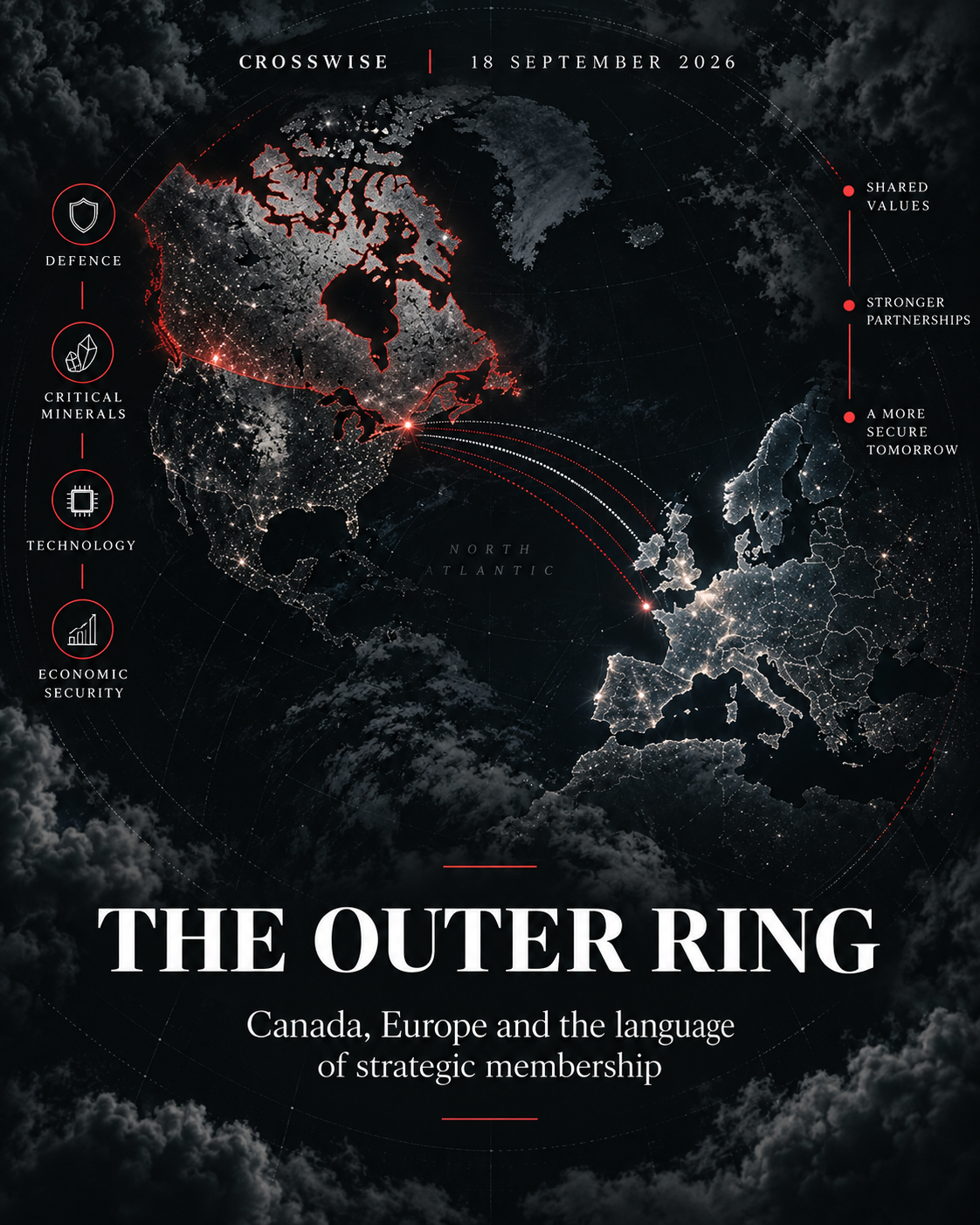
Europe’s strategic outer ring already exists. What changed this week was the name.
Brussels wants Canada to become the EU’s first “associate member”, although no such status exists anywhere in the treaties. The substance is older and a good deal more concrete than the label, since Canada already trades with the Union, sits inside its security architecture and has access to its defence-procurement system. The real question is what expectations the word “member” creates when representation, obligation and political membership do not travel with it.
Why This Story
Canada is not joining the European Union, and more importantly the European Union does not yet know what an “associate member” actually is. None of which makes Ursula von der Leyen’s proposal meaningless; it makes the choice of words the most interesting part of it.
In her State of the Union address on 16 September, von der Leyen said the EU should move from CETA to an “Alliance for the Future” with Canada — a common prosperity and economic-security space spanning intelligent manufacturing, defence-industrial integration, the Arctic, energy, critical minerals, batteries, AI, quantum, cyber and economic security — before proposing “opening the door for Canada to be the first associate member of the EU.”
Much of that substance already exists in pieces. Canada has CETA and a Security and Defence Partnership with the Union; Canadian firms can already participate, under agreed conditions, in SAFE, the EU’s defence-procurement instrument, where Canada is the first non-European country to do so; and the EU already maintains differentiated strategic relationships with states ranging from Norway and the United Kingdom to Japan, South Korea and Australia. The novelty is therefore not that Brussels has discovered cooperation beyond its borders. It is that the President of the Commission has attached the vocabulary of membership to a country that cannot enter through the Union’s existing Article 49 accession route, and has done so before defining what the word would confer.
That creates a deceptively simple governance question, because a partner cooperates while a member belongs. Once the EU begins using the language of membership for countries with no representation in the institutions that make EU law, it will eventually have to explain which rights, obligations and forms of influence distinguish the new category from an ordinary strategic partnership.
The issue reaches well beyond Canada. Europe is preparing for enlargement, debating the future of unanimity and qualified-majority voting, building new defence instruments and expanding strategic partnerships outside the Union all at once — each development rational on its own terms, and together raising a harder question: how far can strategic integration extend beyond the political Union before the boundary between partnership and membership has to become more explicit rather than less?
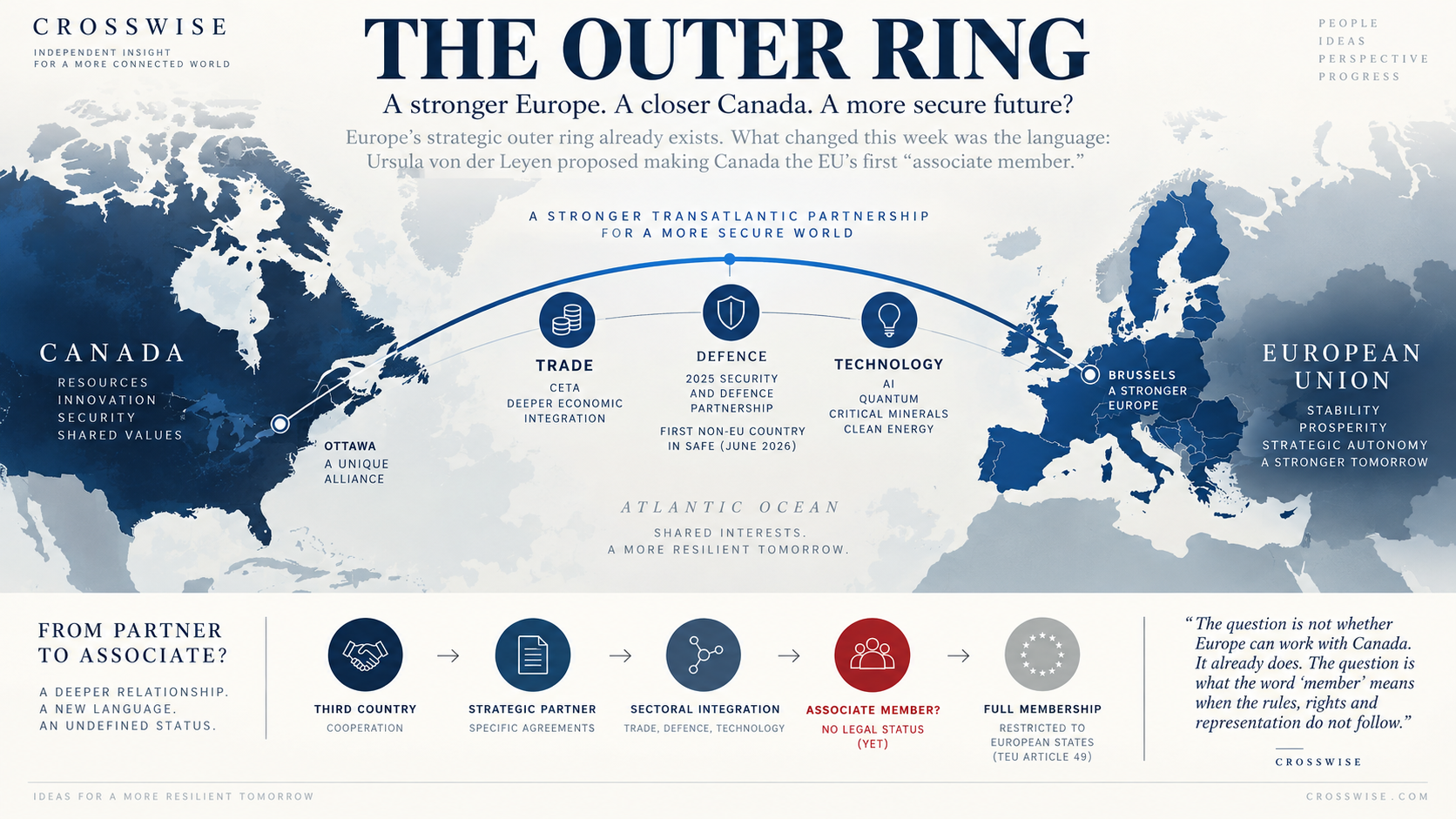
Graphic 01 — The existing transatlantic relationship and the undefined step from strategic partner to “associate member”.
Research Summary
Von der Leyen’s proposal is real, but it is not yet EU policy in the constitutional sense. The Commission President used the term “associate member” in the State of the Union address, and Reuters subsequently reported that the concept had not been worked through with member states and that EU diplomats were unclear what the status would mean.
Canadian Prime Minister Mark Carney welcomed a much deeper relationship while keeping his emphasis on practical cooperation. In Strasbourg he called for stronger Canada-EU alignment on critical minerals, AI, defence, energy and digital trade, without constructing any legal doctrine of Canadian EU membership; Ottawa has consistently spoken of a “unique alliance” rather than ordinary accession.
The treaty position is considerably clearer than the politics. Article 49 TEU reserves ordinary membership to a “European State”, Article 217 TFEU permits deep association agreements with third countries, and Articles 216-218 permit international agreements more broadly. Canada’s existing SAFE access was concluded under Article 212 TFEU as economic, financial and technical cooperation with third countries — evidence that substantial integration can be built sector by sector without inventing a new membership status.
The strongest available interpretation is therefore a modest one: Europe already has an outer perimeter of differentiated partnerships, and von der Leyen may be trying to give part of that functional reality a new political name. Whether the name ever acquires institutional substance remains unknown.
01 — What We Know
The proposal is political, not yet constitutional
Von der Leyen explicitly proposed that Canada become the EU’s first “associate member”, and the Commission’s own list of 2026 initiatives repeats the proposal alongside an “Alliance for the Future” built around a common prosperity and economic-security space, a technology alliance and integrated defence-industrial bases.
No provision of the TEU or TFEU currently creates a status called “associate member”, so there is no existing bundle of voting rights, budget obligations, judicial jurisdiction or institutional representation attached to the phrase. That does not make the term legally unusable as political branding: the EU could describe a future association, or a package of agreements, as “associate membership” without touching the treaties, provided the arrangement granted no rights the treaties reserve to actual members.
Canada is already more than a trade partner
CETA has supplied the economic base of the relationship since provisional application began in 2017, and the 2025 Security and Defence Partnership then created a structured framework covering crisis management, defence-industrial cooperation, hybrid threats, military mobility, cyber, maritime security, space security and economic security.
SAFE adds a concrete defence-industrial dimension, with Canada the first non-European participant and the agreement allowing Canadian legal entities and Canadian-origin products to take part under defined procurement conditions. Canada paid an initial €2.5 million administrative contribution and a €7.5 million participation instalment, with further contributions linked to Canadian content in SAFE-supported contracts.
This is significant access, and it is not participation in EU political decision-making — which is precisely why the new language is analytically interesting, since meaningful integration is already occurring without membership.
02 — The Word “Member” Is Doing the Work
Had von der Leyen proposed a “deeper strategic partnership”, the announcement would have sat comfortably inside existing EU practice, since the Union already builds bespoke relationships with non-members through trade agreements, association agreements, programme participation, security partnerships and defence instruments.
The word “member” changes the expectation, because membership normally binds three things together: participation, obligation and representation. A state accepts rules and financial commitments because it also participates, however imperfectly, in the institutions that make those rules.
An “associate member” could sever that link. Canada might gain privileged access to programmes, procurement, consultation or strategic coordination while remaining outside the Council, the European Council and the European Parliament, which may prove entirely workable — though if regulatory alignment deepens, the question of influence without representation becomes progressively harder to avoid.
That is not yet a Canadian grievance. It is a design problem the proposal would eventually have to solve, and its size depends on scope: the more modest and sectoral the arrangement remains, the smaller the difficulty, while the more it comes to resemble participation in areas Brussels describes as European sovereignty, the more consequential it becomes.
03 — The Legal Routes Are Less Dramatic Than the Rhetoric
Article 49: full membership
Article 49 TEU allows any “European State” respecting the Union’s values to apply for membership, with admission requiring unanimous agreement in the Council, the consent of the European Parliament and ratification by every member state. Canada does not meet the ordinary geographic criterion under the treaties as they stand.
Article 217: association
Article 217 TFEU lets the EU conclude association agreements with third countries involving reciprocal rights and obligations, common action and special procedures. Such an agreement can be extensive, and under Article 218(8) it requires unanimity in the Council. It is one possible legal vehicle for a future Canada framework, though no public evidence shows that Brussels has selected it.
Article 212 and sectoral agreements
The Canada SAFE agreement demonstrates another route entirely, having been concluded by the Council under Article 212 TFEU rather than Article 217 — which matters, because it shows that strategically important integration can be constructed through narrow, sector-specific legal bases without inventing any grand constitutional category.
The correct legal conclusion is therefore not that “associate membership” requires treaty change, since the label itself may not. Treaty change would become relevant only if Canada were offered rights belonging to member states inside the Union’s institutions.
04 — The Outer Ring Already Exists
Canada is not the first non-European democracy to hold a structured strategic relationship with the EU. Security and Defence Partnerships exist with states including the United Kingdom, Japan, South Korea and Australia; Norway sits inside a far deeper EEA relationship; Ukraine is simultaneously an association partner and an accession candidate; and Switzerland operates through a bespoke model of its own.
The Union is therefore already a network of different legal distances from the centre, in which full membership is only one form of integration and market access, programme participation, defence cooperation, regulatory alignment and political consultation can be distributed in almost any combination.
Canada’s genuine novelty is narrower than the headlines suggest: it is the first non-European SAFE participant, and the first state to which a Commission President has publicly offered the language of “associate membership”. The outer ring existed long before the name did.
05 — What “Associate Member” Could Mean
Because the term carries no treaty definition, almost every substantive question remains open. A future arrangement could amount to little more than a political umbrella over CETA, SAFE and the Security and Defence Partnership, or it could become a structured status with new consultation bodies, programme access and reciprocal obligations.
The design choices are what matter. Would Canada contribute to specific EU funds? Would it be expected to align with sanctions or export controls? Would Canadian firms receive broader industrial preferences? Would dispute settlement remain conventional treaty arbitration, or would EU law and the Court of Justice acquire a role? Would Ottawa receive observer or consultation rights before rules affecting shared programmes were adopted? None of those outcomes follows automatically from the phrase, and the risk in treating a label as an institution is that analysis quietly fills an undefined status with rights and obligations Brussels has never proposed.
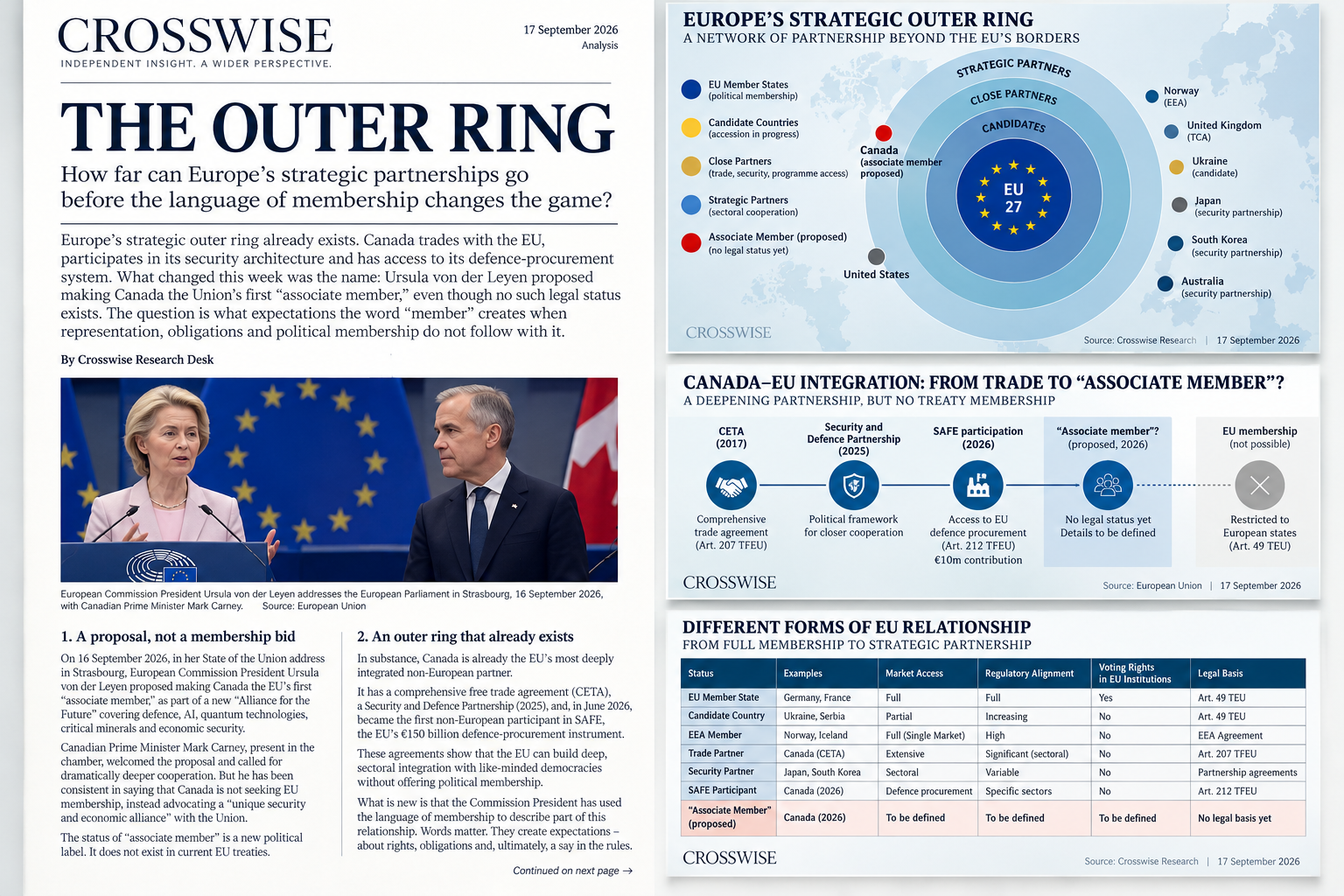
Graphic 02 — Canada’s route from CETA to defence-procurement access shows how deep integration can grow without becoming political membership.
06 — The Core Still Matters
The Canada proposal arrives while the EU is already debating how its own centre should work, and that context matters without needing to be overstated. Most ordinary EU legislation is adopted by qualified majority; unanimity survives in several of the areas most relevant to geopolitical action, including much of the Common Foreign and Security Policy, enlargement, own resources, the long-term budget and parts of taxation. Both the Commission and the Parliament have argued that future enlargement should be accompanied by internal reform and, in some fields, wider use of qualified-majority voting.
One reading is that adding external layers before settling those internal questions simply compounds the complexity. Another is that external strategic integration relieves pressure on the political core, letting Europe acquire Canadian minerals, industrial capacity, technology and defence cooperation without adding another Commissioner, another parliamentary delegation or another national veto inside the Union.
The Canada case therefore settles nothing in the federalism debate. What it exposes is a sequencing problem: how much external strategic architecture can be layered around the Union before the relationship between participation, obligation and influence requires clearer rules?
07 — The Counterargument: Networked Europe May Be the Point
The strongest case for von der Leyen’s proposal is that the EU does not need every strategically aligned democracy to become a member, and that a twenty-first-century geopolitical bloc may require a smaller political core surrounded by wider networks of defence, resources, technology and infrastructure.
Canada fits that model unusually well, offering critical minerals, uranium, energy, Arctic geography, advanced research, defence production and a closely aligned political relationship, while showing no appetite whatever for ordinary accession. Europe gains scale, Canada gains access and diversification, and neither side has to recreate the political obligations of membership.
On this reading, differentiated integration is no institutional failure but the very mechanism that allows the EU to operate beyond its borders without pretending that every partner belongs inside its constitutional order. The weakness of the model is not complexity in itself; it is ambiguity about status. Should the practical relationship remain a collection of sectoral agreements, “associate member” may add nothing beyond symbolism — but should the label start generating expectations of privileged consultation, representation or solidarity, the Union will eventually have to convert rhetoric into rules.
08 — The American Reaction
President Donald Trump has threatened additional tariffs should the proposed Canada-EU relationship develop in ways Washington regards as harmful to US interests. Carney has responded by stressing Canada’s sovereign right to choose its international partnerships, while the Commission says the initiative is not directed against any third country.
The reaction matters because it reveals the geopolitical significance of diversification even before “associate membership” has acquired any legal content at all. Canada and Europe are not necessarily building an anti-American bloc; they are increasing the number of strategic options available to themselves across defence, energy, technology and trade — and that alone can alter bargaining power inside the transatlantic triangle even if the new label never becomes an institution.
09 — Evidence Check
Claim | Crosswise assessment |
Von der Leyen proposed Canada as the first EU “associate member” | VERIFIED — Commission primary material |
“Associate member” is a defined EU treaty status | FALSE |
Canada has applied for ordinary EU membership | FALSE |
Article 49 ordinary membership is open to European states | VERIFIED |
Article 217 can support deep third-country association | VERIFIED |
Any use of the words “associate member” requires treaty change | FALSE |
Voting rights inside EU member institutions could be granted without major legal change | NOT SUPPORTED |
Canada participates in SAFE | VERIFIED |
Canada is the first non-European SAFE participant | VERIFIED |
SAFE makes Canada an EU rule-taker generally | FALSE / NOT ESTABLISHED |
The EU already has an outer network of differentiated partners | VERIFIED AS INSTITUTIONAL DESCRIPTION |
The “associate member” label will acquire substantive rights | UNKNOWN |
The model would weaken the EU | ANALYTICAL HYPOTHESIS |
The model could strengthen EU strategic scale without enlarging membership | ANALYTICAL HYPOTHESIS |
10 — What We Don’t Know
· What “associate member” would mean in legal terms.
· Whether the Commission envisages one overarching agreement or a bundle of sectoral instruments.
· Whether an Article 217 association will ever be proposed.
· What rights Canada would receive beyond existing CETA, SAFE and security arrangements.
· What obligations Canada would accept in return.
· Whether Canada would contribute to additional EU programmes or funds.
· Whether regulatory alignment would extend to sanctions, export controls, AI or other economic-security rules.
· Whether Canada would receive formal consultation or observer rights in any new joint bodies.
· Whether member states support the “associate member” vocabulary.
· Whether Canada itself ultimately wants that label rather than simply deeper cooperation.
· Whether the category would be available to other strategic partners.
· Whether the proposal survives US pressure or changes in European and Canadian politics.
· Whether the word “member” ultimately proves to be constitutional innovation — or simply an applause line attached to agreements that already existed.
11 — Crosswise Assessment
The easiest version of this story is that Canada might somehow join the European Union, and it will not — not through the treaties as they stand, and not through anything currently proposed.
The more interesting development is linguistic. Europe already possesses an outer perimeter of differentiated strategic relationships, in which trade, defence procurement, security dialogues and programme participation allow states to sit at varying distances from the political core, and Canada is moving deeper into that architecture without moving any closer to ordinary membership. What von der Leyen has done is put the word “member” on part of that existing reality.
That may yet prove inconsequential, with Brussels packaging existing arrangements under a more ambitious political label while rights and decision-making remain substantially unchanged. Or the label may begin to generate expectations of its own. A state described as an associate member may reasonably ask whether it should be consulted before rules affecting joint programmes are made; other partners may ask why they do not enjoy comparable status; candidate countries may seek reassurance that association is not being confused with accession; and member states may demand clarity about which forms of solidarity extend outward and which remain exclusive to the Union.
There is, though, a way to tell which of those futures is arriving, and it lies in the legal base rather than the rhetoric. The distance between a slogan and a status is measured in treaty articles. Should Brussels pursue a genuine Article 217 association, it must carry unanimity in the Council under Article 218(8), which means twenty-seven governments would have to agree what the word means — and that requirement alone would force the definition the speech avoided. Should it instead continue building through narrow sectoral bases in the manner of SAFE under Article 212, the integration may deepen considerably while “associate member” remains decorative. The choice of legal instrument, in other words, is the tell, and it will be visible long before any new institution is.
The second consequence is comparative, and it arrives whether or not the label ever acquires content. An undefined status is cheap to offer once and expensive to withhold thereafter, because the moment one non-European state is called an associate member, every other partner in the outer ring acquires a reference point. Norway and Switzerland have spent decades in intricate, undefined proximity to the Union without the vocabulary of belonging; the United Kingdom, Japan, South Korea and Australia hold partnerships of their own. Each may now ask what distinguishes their position from Canada’s, and Brussels will have to answer either by extending the category or by explaining why it stops where it does. Neither answer is free.
The sharpest undefined edge, however, is not voice but solidarity. The outer ring works precisely because its obligations are explicit and narrow: a procurement agreement specifies what each side owes the other, and a security partnership describes the cooperation it covers. The vocabulary of membership imports something far more diffuse, since belonging implies mutual support whose boundaries nobody has drawn. That ambiguity costs nothing in ordinary times and becomes acute in a crisis, when the question is not who may attend a meeting but what an associate member is entitled to expect — and from whom.
Membership is normally a compact between voice and obligation, and partners can accept narrower bargains precisely because the limits are explicit. An undefined “associate member” sits between those categories. Should the term remain symbolic, little changes; should it become substantive, Brussels will have to answer the questions the speech left open — who gets a voice, who accepts the rules, who pays, who receives solidarity, and what, after all that, still distinguishes the outer ring from the Union itself.
“The question is not whether Europe can work with Canada. It already does. The question is what the word ‘member’ means when the rules, rights and representation do not follow.” |
RADAR
Russia sanctions — coercion through third countries
The US House has passed a bill authorising tariffs of up to 100% on major buyers of Russian energy, including India and China. The immediate target is Russia, though much of the leverage would fall on third-country trade, and India has warned that the measure could damage bilateral relations.
Federal Reserve — tightening returns
The Fed raised the federal-funds target range by 25 basis points to 3.75–4.00%, its first increase in three years, citing still-elevated inflation. The market question now shifts from the decision itself to whether this becomes the start of a new tightening cycle.
Semiconductors — Nexperia turns to India
The Dutch chipmaker Nexperia has formed a strategic partnership with Tata Electronics for production and packaging in India, following its break with the Chinese parent Wingtech — another instance of supply-chain diversification becoming industrial geography.
THE RECEIPTS
Research Ledger
This edition was built through two independent research passes, followed by legal verification and a hostile red-team review, and the red-team materially narrowed the thesis. An earlier formulation treated von der Leyen’s proposal as evidence that the EU was creating a new strategic outer ring; the evidence showed instead that the outer ring largely predates the speech, since CETA, the Security and Defence Partnership, SAFE and other differentiated relationships already provide substantive integration without membership.
The final thesis therefore concentrates on what is genuinely new: the Commission President’s decision to apply the language of membership to an undefined non-member relationship. The research also corrected three overstatements — that “associate membership” automatically requires treaty change, that SAFE participation amounts to political integration rather than procurement access, and that deeper Canada-EU cooperation would automatically make Canada a general EU regulatory rule-taker.
Primary and high-authority sources
· European Commission — 2026 State of the Union address
· European Commission — Main initiatives 2026
· Reuters — Canada and EU should ally; associate-member proposal
· Council of the EU — SAFE agreement with Canada
· EUR-Lex — EU–Canada SAFE agreement
· Council of the EU — EU–Canada Security and Defence Partnership
· EUR-Lex — Treaty provisions including Articles 216–218 TFEU
· Reuters — US House passes Russia sanctions bill
· Federal Reserve — FOMC statement, 16 September 2026
What We Did Not Obtain
· A Commission legal proposal defining “associate member”.
· An agreed member-state position on the concept.
· A Canadian request for a legal status called associate membership.
· A draft Article 217 association agreement with Canada.
· Evidence of voting rights, institutional representation or CJEU jurisdiction being proposed for Canada.
· Evidence that other strategic partners have formally requested the same status.