
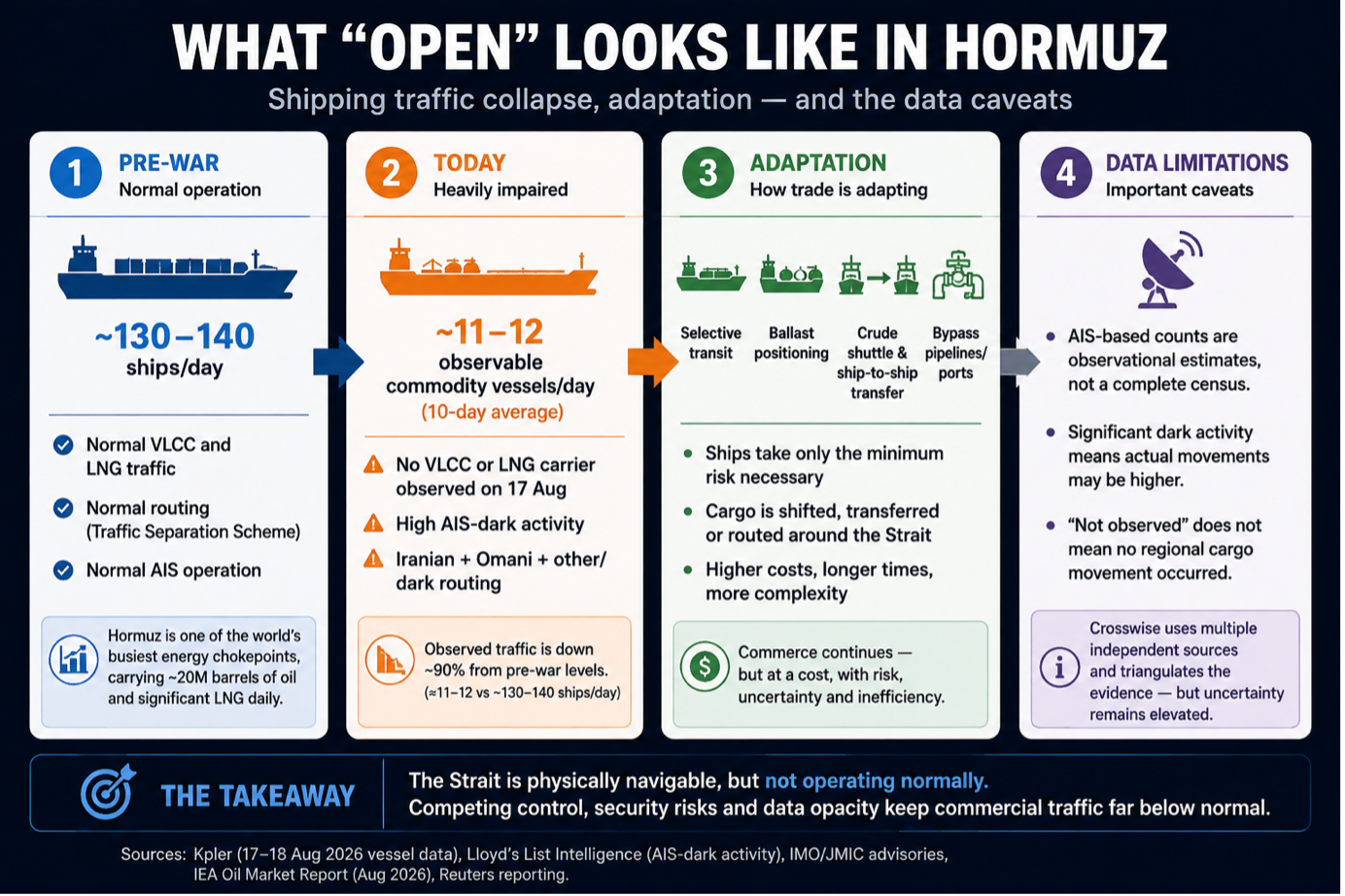
Ships are still moving through Hormuz. Normal commerce isn't. The deeper dispute is no longer simply whether the Strait is open, but what rules govern passage, who gets to enforce them—and whether commercial shipping can operate between competing systems of coercion.
19 August 2026 · ~12 minute read
CROSSWISE RESEARCH
31 source items materially used · 22 underlying evidentiary chains · 14 primary/official records · 8 key claims deliberately triangulated
Research cut-off: 19 August 2026
VIEW THE RECEIPTS ↓
WHY THIS STORY
Hormuz sits at the intersection of global energy security, military escalation, international trade and maritime law. Before the war, roughly one-fifth of global oil and LNG shipments passed through the Strait; today, Washington and Tehran offer sharply different accounts of whether it is even open, while vessel-tracking data show something more complicated than either description.
That combination of global consequence, contested interpretation and evidence we can actually test made Hormuz today's Crosswise lead.
01 — WHAT WE KNOW
President Donald Trump says the Strait of Hormuz is open. Tehran says it remains closed until Washington fulfils commitments Iran says it made under June's interim agreement.
Neither description adequately captures what is happening on the water.
Ships can physically transit Hormuz. Some do so every day. But commercial activity remains dramatically below normal conditions; vessels face attack, interception and insurance risk; the United States maintains a blockade against Iranian maritime commerce; and Iran has developed its own system for controlling routes and seeking payment from vessels using the Strait.
The most accurate starting point is therefore:
Hormuz is physically passable but commercially abnormal.
How much shipping is actually moving?
Before the war, more than 130 ships of all types could transit Hormuz in an ordinary day, according to shipping data cited by Reuters. Recent Kpler observations, by contrast, have put commodity-vessel crossings in the single digits to low teens, with a recent 10-day average around 11.
Those figures are deliberately not presented as a precise percentage decline.
The pre-war figure covers total vessel traffic; the current Kpler series refers to observable commodity vessels. They illustrate the extraordinary scale of disruption, but they are not identical statistical populations.
There is another problem with counting ships: not every vessel wants to be counted.
AIS—the Automatic Identification System vessels normally use to broadcast identity and position—is frequently switched off or manipulated in the current security environment. Lloyd's List Intelligence found that during one July sample almost 70% of observed tanker transits were operating dark.
Observed movements are therefore a minimum observable picture, not a complete census.
FIGURE 1 — WHAT “OPEN” LOOKS LIKE IN HORMUZ
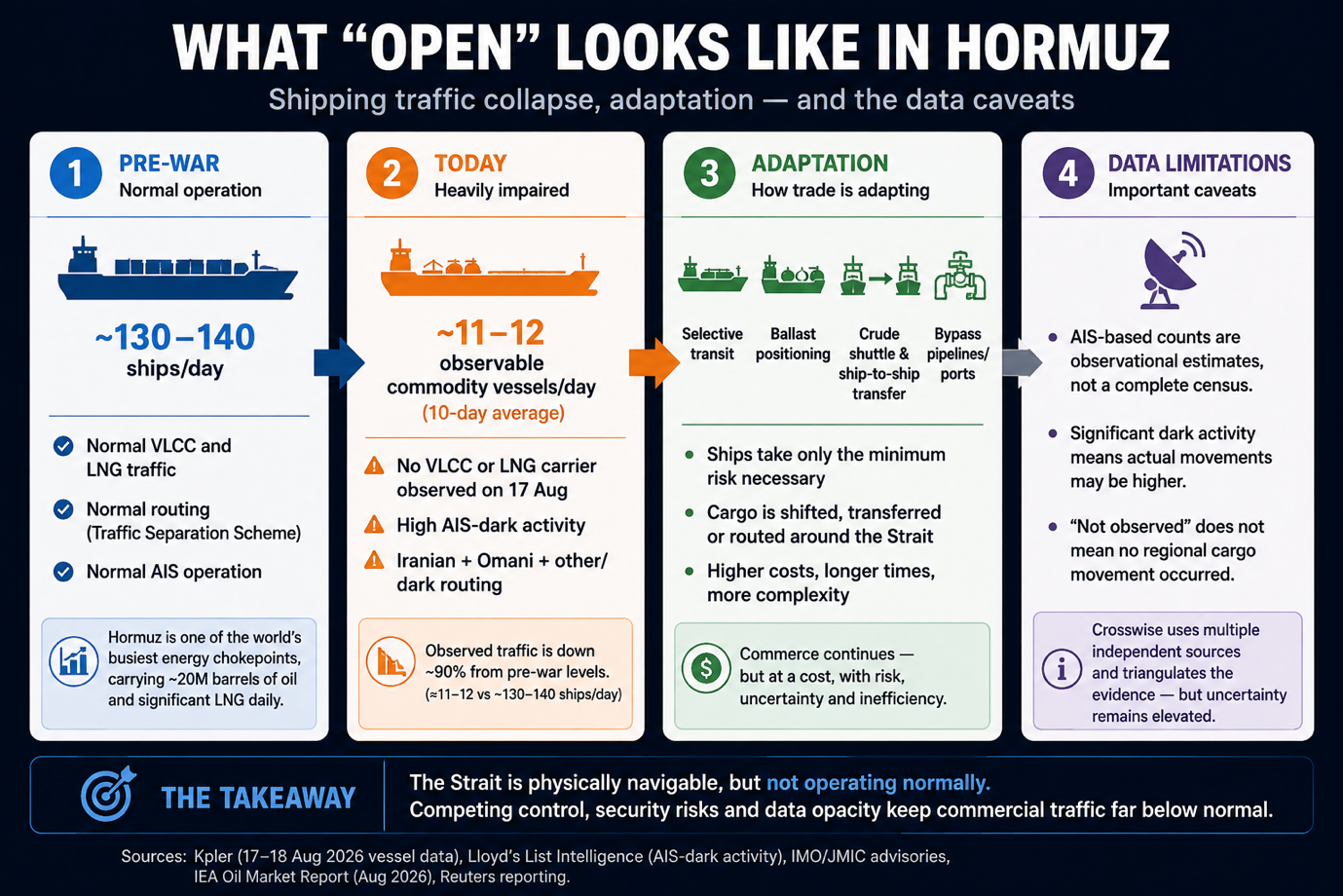
PRE-WAR: More than 130 total ship transits/day
RECENT CONDITIONS: Single-digit to low-teens observed commodity-vessel crossings/day
IMPORTANT: Different vessel categories; this is not a like-for-like percentage comparison. AIS-dark activity means actual physical movements may be higher.
What kinds of ships are still crossing?
A useful snapshot came on 17 August.
Kpler observed six commodity vessels crossing Hormuz that day.
Three travelled into the Gulf:
- one very large gas carrier;
- one medium-range fuel tanker;
- one intermediate-range tanker.
Three travelled out:
- one medium LPG carrier;
- one Panamax bulk carrier;
- one Panamax-sized fuel tanker.
The named inbound VLGC, Xavia, was travelling in ballast—effectively empty.
Most strikingly, Kpler observed no VLCC crude supertanker and no LNG carrier crossing on that particular day.
That was a snapshot, not a permanent condition.
On 18 August, Kpler again recorded only six commodity-vessel crossings, but this time one VLCC did enter from the Omani side, alongside two other tankers. The mix can therefore change substantially from one day to the next even while the overall level remains severely depressed.
That distinction matters.
“No VLCC observed on 17 August” does not mean crude exports had ceased completely. It means that the vessel mix on one observed day bore little resemblance to normal large-scale Hormuz energy trade.
FIGURE 2 — WHO IS STILL CROSSING HORMUZ?
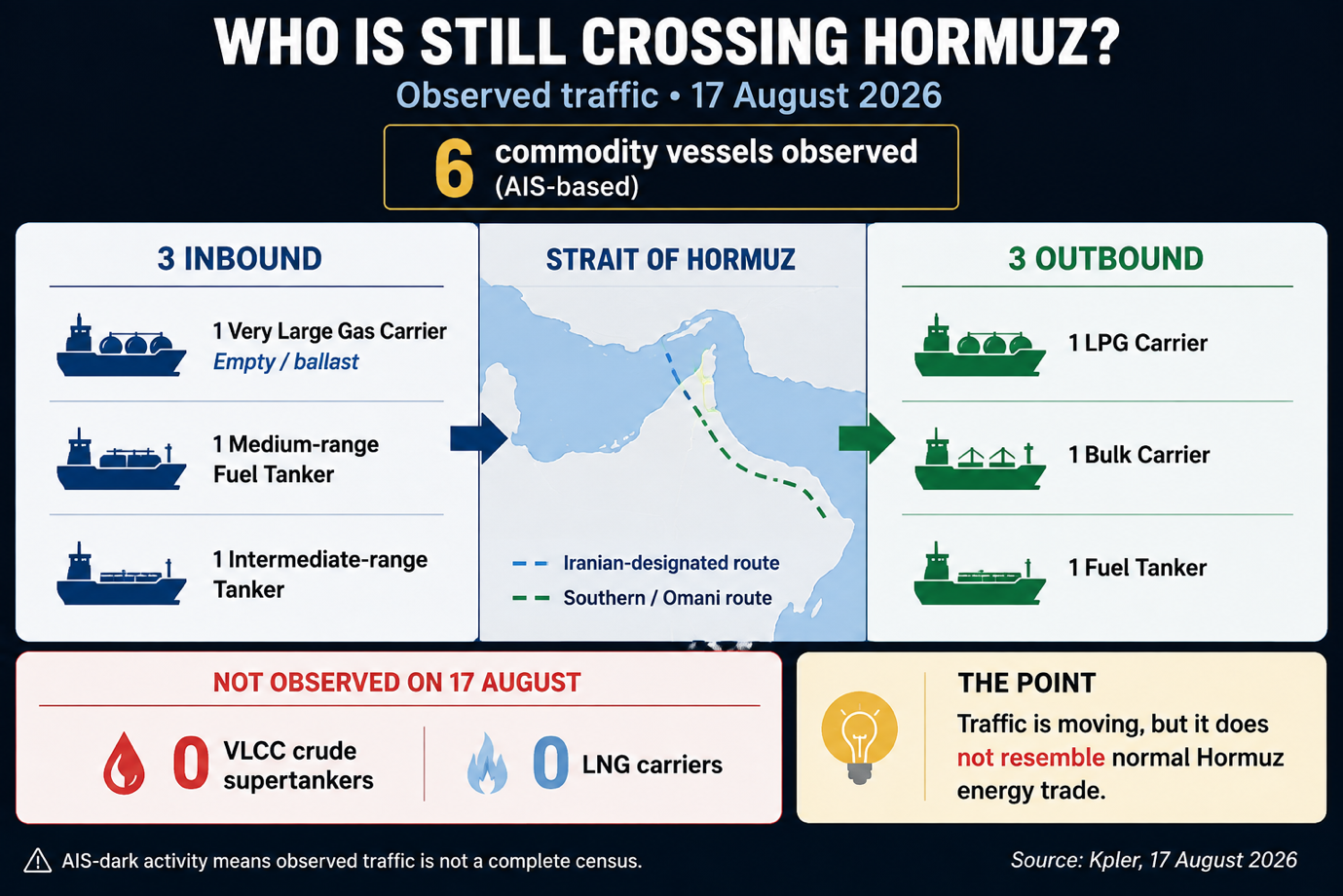
Snapshot: six observed commodity vessels · 17 August 2026.
Trade is adapting rather than returning to normal
The market is not simply waiting for the Strait to reopen.
Saudi Arabia and other Gulf producers have expanded workarounds. Saudi crude has again been loaded at terminals inside Hormuz, while some cargoes are transferred ship-to-ship outside the Strait for onward transport. China's major state shipping companies have also shifted tankers away from Hormuz and are increasingly relying on offshore transfers and alternative loading arrangements rather than exposing their own fleets to the chokepoint.
Lloyd's List Intelligence has documented similar behaviour: selective transits, crude shuttling, ship-to-ship transfers, dark operations and greater use of tonnage prepared to accept risks that mainstream operators will not.
Saudi Arabia and the UAE also possess pipeline and terminal capacity that can bypass Hormuz altogether.
These measures reduce the economic damage.
They are evidence of adaptation to dysfunction, not evidence that commercial normality has returned.
The part we initially missed: Iran already built a Strait authority
The dispute over future control of Hormuz did not begin with the latest Iran-Oman negotiations.
On 27 May, the US Treasury sanctioned an Iranian entity called the Persian Gulf Strait Authority, or PGSA.
Treasury describes the PGSA as a government agency created to collect payments from commercial vessels, obtain vessel information and coordinate with the IRGC Navy over an Iranian-designated transit route. It alleges that money collected by the authority supports the IRGC.
That is Washington's characterisation and should be treated as such.
But its existence is important regardless of whether every US allegation about its purpose is accepted.
By late May, the confrontation was already about more than mines and military attacks: Iran was attempting to build an institutional architecture around passage through Hormuz.
That substantially strengthens the American concern that Tehran is seeking something more durable than emergency wartime routing.
It also changes how the June agreement should be understood.
When the publicly available MoU said Iran would use its “best efforts” to provide safe commercial passage without charge for 60 days, that provision existed against a background in which Washington was already accusing Tehran of constructing a fee-and-permission system. The published MoU also explicitly contemplated subsequent Iran-Oman discussions over future administration and maritime services.
The June agreement briefly worked
This is another important part of the chronology.
The publicly available text of the Islamabad MoU required Washington to begin removing its naval blockade immediately and fully terminate it within 30 days. Iran undertook to use its best efforts to restore safe commercial passage without charge for 60 days while technical obstacles and mines were addressed.
Washington initially implemented part of the deal.
On 22 June, the US Treasury issued General License X, authorising transactions involving Iranian crude oil, petrochemicals and petroleum products through 21 August.
Oman and Iran also moved forward.
On 23 June, they jointly reaffirmed their commitment to safe passage in accordance with international law and established a process to discuss future navigation administration and maritime services.
On 24 June, Oman—working with the IMO—made a temporary corridor available to vessels and publicly said freedom of navigation should be ensured without transit fees.
And shipping responded.
Reuters, using Vortexa and other shipping data, found that Iran's oil exports rose by more than 70% to roughly 640,000 barrels per day as the US blockade eased. Ninety-eight tankers crossed Hormuz between 22 and 28 June—around 14 per day, the highest rate recorded since the conflict began.
The June framework therefore wasn't merely diplomatic theatre.
For a short period, it changed commercial behaviour.
Then the arrangement unravelled
The deterioration began before Washington's eventual reimposition of full economic and naval pressure.
On 25 June, Iran was publicly demanding that vessels use Iran-designated routes and coordinate with Iranian authorities.
CENTCOM says that on the same day an Iranian one-way attack drone struck the Singapore-flagged Ever Lovely while it was leaving Hormuz along the Omani coast. US forces struck Iranian missile, drone and coastal-radar facilities the following day.
On 27 June, CENTCOM said another Iranian drone was launched towards the Panama-flagged tanker Kiko, prompting further US strikes. This remains Washington's official account, but it demonstrates that the military breakdown had begun well before 7 July.
On 7 July, renewed Iranian attacks on commercial vessels were followed by substantial US retaliation. That same day Treasury revoked General License X and replaced it with a wind-down authorisation.
The US blockade was subsequently restored.
The evidence therefore supports two propositions simultaneously:
Washington later departed materially from commitments it made in June.
And:
The public chronology does not support a simple story in which Washington alone initiated the breakdown.
The dispute then shifted towards governance
Oman attempted to bridge the gap.
In late July, Muscat proposed a regionally managed Hormuz mechanism, backed by Gulf states, under which shipping companies could make voluntary contributions towards navigational, environmental and other maritime services.
Iran rejected the model.
Tehran argued that it needed control over the entire inbound route and part of the outbound route rather than an equal or broad regional-management structure.
The disagreement became even more concrete in August.
A senior Iranian official told Reuters that Tehran was seeking payments worth 5–7% of cargo value. Oman was discussing a figure around 3%, while Washington insisted there should be no transit fee at all. Gulf negotiators were also pressing for any payments to be voluntary.
For the shipping industry, this creates a practical trap.
The PGSA is under US sanctions. Shipping-industry sources told Reuters that paying Iran could therefore create sanctions exposure, while insurance provisions can also make compliance with such fees commercially impossible.
In other words, a vessel could theoretically satisfy Tehran and still become uninsurable or sanction-exposed elsewhere.
Washington has flirted with fees too
There is an important complication.
The idea of monetising access to Hormuz has not been confined to Iran.
On 13 July, President Trump proposed charging 20% of cargo value for ships using the Strait while the United States controlled security there. The IMO publicly opposed charging ships simply to pass through an international strait.
Trump abandoned the proposal the following day in favour of seeking trade and investment arrangements with Gulf states.
The episode was brief.
But it matters analytically because it demonstrates that both sides have, at different moments, attempted to translate coercive control into economic leverage.
Their systems are not identical.
Iran is seeking a more durable institutional role in navigation and payment.
The US proposal was short-lived and withdrawn.
But neither side's conduct fits neatly into a simple “free navigation versus tolls” narrative.
02 — THE PERSPECTIVES
There is no meaningful Left-versus-Right framework for Hormuz.
The relevant perspectives concern sovereignty, navigation, military power, commercial risk and energy security.
WASHINGTON
The strongest American case is now substantially clearer.
Hormuz is one of the world's most important international shipping corridors. Tehran has not merely threatened to interfere with it; the United States says Iran has created a formal body—the PGSA—to collect vessel information, impose charges and require compliance with Iranian routing.
Iran has also used military force against commercial shipping during the conflict.
From Washington's perspective, allowing that system to harden into accepted practice would mean converting international navigation into passage conditional on Iranian consent and payment.
That concern is supported by Iran's rejection of Oman's regional-management proposal and Tehran's demand for much greater control over inbound and outbound traffic.
But the American position is not free of contradiction.
Washington itself imposes a naval blockade on Iran-linked maritime commerce, intercepts vessels and has used military force to enforce that blockade.
Trump also briefly proposed his own 20% Hormuz cargo charge.
The strongest American argument is therefore not that Washington exercises no coercive maritime power.
It is that the coercion it exercises is intended to prevent Iran from institutionalising unilateral control over international transit.
Whether that distinction is legally and politically sufficient is a separate question.
TEHRAN
Iran's strongest case begins with geography and the June agreement.
Iran is one of the two states bordering the narrowest parts of the Strait.
The June MoU explicitly contemplated discussions between Iran and Oman concerning future administration and maritime services.
Washington also promised significant measures of its own: blockade removal, temporary petroleum relief and no additional escalation while negotiations continued. Some of those commitments were subsequently reversed.
Iran can therefore credibly argue that Washington cannot treat Iranian commitments as permanent while abandoning its own.
Tehran also disputes the legal framework Washington invokes.
Iran signed but has never ratified UNCLOS. In its declaration upon signature, Tehran specifically argued that some rights created by the convention—including transit passage through international straits—were contractual rights belonging to states parties rather than automatically binding customary law.
The weakness in Iran's position is that Tehran's claimed security interests have increasingly become demands for substantial operational authority and compulsory payment.
The PGSA, route requirements, rejection of regional management and proposed 5–7% cargo charges make it increasingly difficult to characterise Iran's position as merely protecting safe navigation.
OMAN AND THE GULF STATES
Oman remains the most plausible diplomatic bridge—but it is not currently a solution waiting to be implemented.
Muscat is a UNCLOS party and repeatedly frames its position around international law, freedom of navigation and the legitimate rights of the two coastal states.
Its late-July proposal attempted to create a broader regional structure rather than granting Iran unilateral control.
Iran rejected it.
That matters.
The real question is therefore no longer whether Iran and Oman can cooperate in principle. They already do.
It is whether Tehran will accept a system in which:
- Gulf states participate in oversight;
- routing is not determined exclusively by Iran;
- inspections are regionally supervised;
- and payments are voluntary or clearly connected to legitimate maritime services.
So far, the answer has been no.
For Saudi Arabia, the UAE and other Gulf exporters, the interest is straightforward: they need predictable access to world markets without either permanent Iranian control or endless US-Iran military confrontation.
SHIPPING AND INSURANCE
For commercial shipping, the sovereignty argument eventually reduces to a practical calculation:
Can we transit safely, legally and with valid insurance?
A theoretically open waterway is not commercially useful if:
- the vessel may be attacked;
- one military power may intercept it;
- another may demand routing information or payment;
- paying the demanded fee may trigger sanctions;
- and the insurer may then withdraw cover.
Shipping-industry sources have described the emerging fee arrangements as commercially unworkable for precisely those reasons.
That explains why traffic remains low even when individual ships are physically capable of crossing.
ENERGY IMPORTERS
China, India, Japan, South Korea and European economies have a different priority.
They need predictable energy throughput.
The June agreement demonstrated how quickly oil exports could rise when political and security risk fell.
The renewed fighting demonstrated how quickly that recovery could reverse.
For these countries, the relevant measure of whether Hormuz is “open” is therefore not a presidential statement or legal theory.
It is:
How many barrels and cargoes are reliably getting through, at what price, and with what risk?
03 — EVIDENCE CHECK
CLAIM: “The Strait of Hormuz is open.”
CROSSWISE: MISLEADING WITHOUT QUALIFICATION
Ships can physically transit.
Some do so every day.
But commercial traffic remains far below normal conditions; risk remains extraordinary; alternative routes, dark AIS operations and ship-to-ship transfers are being used to work around the disruption.
The most accurate formulation is:
Hormuz is physically passable but commercially abnormal.
CLAIM: “Iran closed Hormuz.”
CROSSWISE: PARTLY SUPPORTED, BUT TOO SIMPLE
Iran has imposed routing requirements, sought compulsory payments and used or threatened military force against commercial shipping.
Those actions are central to the disruption.
But the United States simultaneously maintains a blockade against Iranian maritime commerce and has itself used military force against vessels and Iranian facilities.
There is therefore more than one coercive maritime regime operating around the Strait.
CLAIM: “Iran is only proposing a future toll.”
CROSSWISE: FALSE / MISLEADING
The US Treasury sanctioned the Persian Gulf Strait Authority on 27 May and says it was already created to collect payments and vessel information associated with Hormuz transit.
Whatever one thinks of Washington's description of that system, the payment-and-permission architecture is not merely hypothetical.
The subsequent 5–7% Iranian demand represents an evolution of an existing governance project rather than an entirely new idea.
CLAIM: “America broke the June agreement.”
CROSSWISE: LATER US NON-PERFORMANCE IS ESTABLISHED. SOLE OR FIRST RESPONSIBILITY IS NOT.
Washington initially implemented meaningful elements of the arrangement.
Iranian petroleum exports increased after blockade easing; tanker traffic recovered; and Treasury formally authorised Iranian oil transactions.
The arrangement subsequently deteriorated amid renewed Iranian routing enforcement and attacks on commercial vessels.
Washington then retaliated, revoked petroleum relief and restored its blockade.
The evidence supports the proposition that the United States later departed materially from the agreement.
It does not support reducing the collapse to unilateral US betrayal.
CLAIM: “US and Iranian coercion are equivalent.”
CROSSWISE: NOT SUPPORTED
Both sides exercise coercive maritime power.
But their systems differ in structure.
Iran is attempting to establish a more durable role in routing, permission, administration and payment through the Strait.
Washington is using blockade, interdiction and military power to constrain Iran and resist that governance model.
The US briefly proposed a substantial passage fee of its own, but abandoned it within a day.
So:
There are competing coercive systems—but they are not necessarily equivalent coercive systems.
CLAIM: “International law clearly gives every vessel an uncontested right of transit passage through Hormuz.”
CROSSWISE: TOO SIMPLE
UNCLOS establishes a transit-passage regime for international straits.
But the legal posture around Hormuz is unusually awkward.
Iran signed UNCLOS but did not ratify it, and its formal declaration upon signature argued that transit passage was among the convention-created rights that should belong to treaty parties rather than automatically to non-parties.
The United States has also not ratified UNCLOS, but successive US administrations have taken the opposite view: that the convention's traditional navigation provisions largely reflect customary international law and therefore bind states regardless of treaty status.
Oman, by contrast, is an UNCLOS party and consistently invokes international law and freedom of navigation.
Crosswise therefore does not claim to resolve this legal dispute.
What can be said confidently is that the legal question is more contested than simply quoting UNCLOS Article 38 and declaring the matter settled.
CLAIM: “Oman offers an obvious solution.”
CROSSWISE: NOT CURRENTLY SUPPORTED
Oman offers the most credible negotiating mechanism.
That is different.
Muscat has already presented a regionally backed model involving joint management and voluntary contributions.
Iran rejected it because Tehran wanted substantially greater control of the routes.
Oman is therefore best understood as the principal negotiating arena, not as an agreed off-ramp.
04 — WHAT WE DON'T KNOW
1. The authenticated final MoU
The publicly available 17 June text is detailed and independently corroborated, but the American Presidency Project labels its version a draft.
Crosswise has not obtained an authenticated signed final instrument.
2. The final Iran-Oman arrangement
No definitive public agreement exists containing settled provisions on:
- routing;
- fees;
- inspections;
- enforcement;
- military vessels;
- or the role of other Gulf states.
Current figures such as Iran's 5–7% and Oman's approximately 3% remain negotiating positions reported by sources, not final policy.
3. The complete legal position
Iran and the United States disagree fundamentally over the customary-law status of UNCLOS transit passage.
Crosswise has established those positions but has not attempted to substitute itself for an international maritime court.
4. Attribution for every attack
Some incidents are strongly attributed.
Others involve projectiles, drones or mines whose origin has not been independently established.
Each attack must therefore be treated individually.
5. How much dark traffic exists
AIS-dark activity means no public vessel-tracking dataset can provide a perfect census.
The scale of observed disruption is clear.
The exact number of physical movements is not.
6. What Washington and Tehran actually want
Public positions may not reflect private negotiating thresholds.
We cannot establish whether either side would ultimately accept a compromise that it currently rejects publicly.
7. Whether Iran's governance ambitions are permanent
The evidence strongly suggests Tehran wants a substantially greater institutional role in post-war Hormuz management.
It remains uncertain how much of that position represents an enduring strategic objective and how much is wartime bargaining leverage.
05 — CROSSWISE ASSESSMENT
The phrase “Hormuz is open” now obscures more than it explains.
The Strait is physically navigable.
It is not operating as a normal commercial waterway.
And the reason is no longer simply that Iran has put mines in the water or that Washington has imposed a blockade.
The conflict has evolved into a struggle over how Hormuz should be governed after the war.
Iran is attempting to translate geography, coastal-state rights and military leverage into greater operational authority over navigation.
The Persian Gulf Strait Authority, Iranian routing requirements, demands for substantial cargo-linked payments and Tehran's rejection of Oman's regional-management proposal all point in the same direction:
Iran is seeking a more durable role in determining the conditions of passage through Hormuz.
Washington is trying to prevent that outcome.
But Washington is not doing so from a position of maritime neutrality.
It maintains a blockade against Iran-linked shipping, intercepts vessels and uses military force to enforce its policy.
President Trump even briefly proposed monetising American control of the Strait through a 20% cargo charge before abandoning the idea.
Hormuz is therefore operating under competing but structurally different coercive systems.
The distinction matters.
Iran's system increasingly concerns the long-term governance of passage itself: who must register, where ships travel, what authority supervises them and potentially what they pay.
The American system is principally designed to constrain Iran economically and militarily and to prevent Tehran from institutionalising that model.
Those are not identical forms of coercion.
But neither permits a convincing description of the current environment as ordinary freedom of navigation.
Commercial shipping is behaving accordingly.
Shipowners do not need a philosophical answer to who is right.
They need to know:
Can the vessel enter?
Will it be attacked?
Will another military stop it?
Will paying one authority trigger sanctions from another?
Will insurance remain valid?
Until those questions have predictable answers, normal traffic will not return simply because either government announces that Hormuz is open.
Oman remains crucial—but our initial view of its role was too optimistic.
Muscat has already attempted to reconcile the competing systems through a broader Gulf-backed management proposal.
Iran rejected it.
The most important unresolved question is therefore no longer:
Can Iran and Oman design a system together?
They can.
It is:
How much operational control is Iran prepared to surrender, and can any payment-and-management structure be reconciled with international navigation rights, US sanctions and commercial insurance?
Until that happens, Hormuz will remain physically passable while commercially abnormal.
CROSSWISE CONFIDENCE
Physical/commercial diagnosis: HIGH
Multiple independent datasets and reporting chains establish severe disruption, limited traffic, dark operations, alternative routing and commercial adaptation.
Governance trajectory: MODERATE
The evidence strongly supports the conclusion that Iran is seeking a larger institutional role in Hormuz. But the final Iran-Oman framework does not exist, negotiating positions may change, and the post-war legal settlement remains unresolved.
WHAT WOULD CHANGE OUR ASSESSMENT?
Iran accepts a regional or genuinely joint navigation framework rather than insisting on dominant route control.
The PGSA or equivalent compulsory-payment mechanism is suspended or substantially redesigned.
Washington materially eases or ends its blockade.
A fee system emerges that shipping companies, insurers, Gulf states and international maritime bodies regard as lawful and commercially workable.
Ordinary VLCC, LNG and wider commercial traffic returns sustainably towards pre-war patterns.
Until then:
The Strait is neither meaningfully open nor physically closed. It is operating under armed constraint while the parties fight over the rules of what comes next.
CROSSWISE RADAR
ISRAEL · TURKEY · SYRIA
Israel and Turkey are edging towards a more dangerous confrontation in Syria.
Turkey has rejected Israel's justification for strikes on Syria's Abu al-Duhur airbase, while Israel says it acted because of a potential Turkish military deployment. The United States is now trying to establish a stronger deconfliction mechanism involving Israel, Turkey and Syria.
Why it matters: Syria is increasingly becoming an arena in which two major regional powers could collide directly rather than through proxies.
GLOBAL ECONOMY
The global bond sell-off has paused—but the warning has not disappeared.
Long-term government yields remain near multi-decade highs in the US, Europe and Japan as investors price persistent inflation, expensive energy and large sovereign borrowing requirements. US 30-year yields were still around 5.27% on Wednesday.
Why it matters: sustained increases in long-term borrowing costs would tighten financial conditions even without further central-bank rate rises and could materially constrain government spending.
UKRAINE
Kyiv's political and defence reshuffle is becoming a test of wartime governance.
Former defence minister Mykhailo Fedorov has called for wartime elections, while Ukrainian anti-corruption agencies have launched a fresh operation involving lawmakers and presidential officials and parliament has approved Yevhenii Khmara as defence minister.
Why it matters: questions of battlefield performance, corruption and democratic legitimacy are increasingly converging inside Ukraine rather than remaining separate debates.
TECHNOLOGY · SOCIETY
Meta's youth-safety battle is finally moving into courtroom evidence.
A coalition of 29 US states alleges that Meta deliberately designed Facebook and Instagram in ways that encouraged addictive use among children. Meta rejects both the addiction characterisation and the claimed causal link to adolescent harm. The six-week trial is expected to expose internal evidence and testimony from senior executives.
Why it matters: the case could materially influence how governments regulate engagement-driven platform design rather than merely content.
INDONESIA
Flores is beginning recovery after a devastating earthquake.
Businesses have begun reopening after the magnitude-7.7 earthquake that killed at least 70 people, injured nearly 1,200 and damaged thousands of homes across eastern Indonesia.
Why it matters: this is principally a humanitarian story rather than a contested Crosswise lead, but its human scale makes it one of today's consequential global developments.
THE RECEIPTS
Research cut-off: 19 August 2026
RESEARCH LEDGER
31 source items materially used in the lead analysis
22 underlying evidentiary chains after source-dependency review
14 primary / official records
10 primary documents, official datasets or formal governmental records analysed
13 independent reporting items across multiple reporting organisations
4 specialist maritime / shipping-data analyses
8 key claims deliberately triangulated
7 material uncertainties explicitly retained
Categories overlap and should not be added together. “Source item” counts URLs/material actually relied upon; “evidentiary chain” attempts to remove repetitions deriving from the same original statement, dataset or investigation.
HOW CROSSWISE COUNTS
Crosswise does not treat repetition as corroboration.
A Reuters article reporting Kpler data, followed by five newspapers repeating that Reuters article, remains fundamentally one Kpler evidentiary chain.
An official government claim also remains an official claim regardless of how many newspapers reproduce it.
Where possible, Crosswise traces consequential propositions towards:
the primary document → underlying dataset → original reporting → independent corroboration.
PRIMARY & OFFICIAL RECORDS
1. Islamabad Memorandum of Understanding — publicly available 17 June text
Used for the specific commitments concerning blockade removal, safe commercial passage, sanctions, oil exports and Iran-Oman discussions. The American Presidency Project identifies the public text as a draft.
American Presidency Project — Islamabad MoU
2. US Treasury / OFAC — General License X
Primary evidence of the initial authorisation for Iranian crude oil, petrochemical and petroleum transactions.
OFAC — General License X, 22 June
3. US Treasury / OFAC — General License X1
Primary evidence of the 7 July revocation and wind-down of General License X.
OFAC — General License X1 / revocation
4. US Treasury — Persian Gulf Strait Authority designation
Primary US-government source describing the PGSA, its alleged IRGC relationship, vessel-information requirements, Iranian routing and passage charges.
US Treasury — PGSA designation, 27 May
5. Oman–Iran Joint Statement — 23 June
Primary evidence that both coastal states contemplated continued cooperation over navigation administration while publicly committing to safe international passage.
Oman Foreign Ministry — Joint Statement
6. Oman / IMO temporary Hormuz corridor — 24 June
Primary Omani evidence concerning the temporary navigation corridor and Muscat's position against transit fees.
Oman Foreign Ministry — Temporary Hormuz corridor
7. UN Treaty Collection — Iran's UNCLOS status and interpretative declaration
Primary treaty-depository record showing Iran's signature and its formal interpretation concerning contractual rights and transit passage.
United Nations Treaty Collection — UNCLOS declarations
8. US State Department — US position on UNCLOS
Official explanation that successive US administrations have treated traditional navigational provisions of UNCLOS as reflecting customary international law despite non-ratification.
US State Department — Law of the Sea Convention
9. IMO — Strait of Hormuz operational material
Primary international-maritime material on navigation conditions and the developing Hormuz crisis.
International Maritime Organization — Strait of Hormuz
10. IMO — maritime incident record
Used to distinguish confirmed shipping incidents from broader claims and allegations.
IMO — Middle East highlighted incidents
11. International Energy Agency — July Oil Market Report
Used for the temporary recovery in Gulf oil flows and wider energy consequences.
IEA — Oil Market Report, July 2026
12. International Energy Agency — August Oil Market Report
Used for the subsequent deterioration in production, exports and global inventory conditions.
IEA — Oil Market Report, August 2026
13. CENTCOM — 26 June vessel attack / US retaliation
Washington's official account of the Ever Lovely incident and subsequent US strikes. Treated as evidence of the US position and cross-checked against independent reporting where possible.
CENTCOM — US strikes following commercial-vessel attack
14. CENTCOM — 7 July escalation
Washington's official account of renewed attacks on commercial shipping and subsequent US retaliation.
CENTCOM — 7 July retaliatory strikes
SPECIALIST MARITIME & DATA SOURCES
15. Kpler — post-truce crossings and route shift
Used for the collapse in tracked commodity movements and the migration of remaining traffic towards Iranian-designated routing.
Kpler — Hormuz crossings and route analysis
16. Lloyd's List Intelligence — 21 July Hormuz Brief
Used for traffic contraction, tanker-specific dark-AIS behaviour and maritime-risk analysis.
Lloyd's List Intelligence — 21 July
17. Lloyd's List Intelligence — 29 July Hormuz Brief
Used for routing behaviour, Omani-route use and insurance/security context.
Lloyd's List Intelligence — 29 July
18. Lloyd's List Intelligence — 5 August Hormuz Brief
Used for ship-to-ship transfers, crude shuttling, selective gas/container traffic and commercial adaptation.
Lloyd's List Intelligence — 5 August
INDEPENDENT & REGIONAL REPORTING
19. Reuters — June export recovery
Used for the measurable effects of initial US easing: higher Iranian exports and increased tanker movement during the June implementation period.
Reuters — Gulf oil exports jump in June
20. Reuters — 7 July military chronology
Independent reporting used to test the official US account of Iranian vessel attacks and subsequent retaliation.
Reuters — US strikes after renewed Iran escalation
21. Reuters — US 20% Hormuz fee proposal
Used to establish that Washington briefly proposed monetising passage through the Strait.
Reuters — Trump proposes 20% Hormuz cargo fee
22. Reuters — US drops 20% proposal
Used to establish that the US proposal was abandoned one day later.
Reuters — Trump drops Hormuz fee plan
23. Reuters — Oman regional-management proposal
Used for the content and regional backing of Oman's voluntary-fee/joint-management model.
Reuters — Oman presents regional Hormuz mechanism
24. Reuters — Iran rejects regional management
Used for Tehran's rejection of Oman's proposal and demand for substantially greater Iranian route control.
Reuters — Iran rules out regional management
25. Reuters — competing fee positions
Used for the reported Iranian 5–7% proposal, Omani ~3% discussion and Washington's zero-fee position.
Reuters — Hormuz control and fee negotiations
26. Reuters — shipping industry's feasibility concerns
Used for sanctions, insurance and commercial-operability implications of the proposed fee architecture.
Reuters — proposed Hormuz deal not feasible for shipping industry
27. Reuters / Kpler — 17 August vessel snapshot
Underlying data for Graphic 2.
Reuters — Hormuz crossings remain in single digits
28. Reuters / Kpler — latest 19 August traffic update
Used to prevent the 17 August snapshot from being mistaken for a permanent vessel pattern.
Reuters — Hormuz traffic slows as uncertainty persists
29. Associated Press — diplomatic and political reconstruction
Used as an independent reporting chain for the broader US-Iran agreement breakdown.
Associated Press — US–Iran agreement and Hormuz
30. Al Jazeera — Iranian confirmation of the June agreement
Used as a regional reporting chain for Tehran's contemporaneous confirmation that the MoU had been electronically signed.
Al Jazeera — Iran confirms MoU signing
31. Wall Street Journal — current maritime attacks and commercial behaviour
Independent reporting used to stress-test the relationship between political claims, attacks and shipping behaviour.
Wall Street Journal — Hormuz shipping attacks
THE EIGHT KEY CLAIMS CROSSWISE TRIANGULATED
1. The June agreement existed and broadly contained the commitments described.
Tested against the published MoU text, US economic implementation, Omani official material and independent reporting.
2. Washington genuinely began implementing the agreement before reversing course.
Tested against OFAC records and independent shipping/export data.
3. Iran had already developed an institutional passage/fee architecture around Hormuz.
Tested against Treasury's PGSA designation, Iranian routing behaviour and subsequent fee negotiations.
4. Oman presented a genuinely different regional-management model and Iran rejected it.
Tested through separate Reuters reports and Oman's broader official navigation position.
5. Commercial traffic remains dramatically abnormal despite some physical passage.
Tested through Kpler, Lloyd's List Intelligence, IMO and multiple reporting updates.
6. AIS-dark activity materially limits confidence in observed vessel counts.
Tested against specialist maritime evidence and reflected explicitly in both article and graphics.
7. The June breakdown cannot credibly be reduced to unilateral US abandonment.
Tested against the implementation chronology, Iranian maritime actions, CENTCOM material and independent reporting.
8. The emerging dispute is increasingly about post-war governance of Hormuz, not merely temporary reopening.
Tested against the PGSA, Iran-Oman negotiations, competing fee structures, Iran's rejection of regional management and US opposition.
WHAT WE COULD NOT OBTAIN
Crosswise was unable to obtain:
an authenticated signed final copy of the Islamabad MoU;
a definitive final Iran-Oman navigation agreement;
a complete independent attribution record for every maritime attack;
a complete census of AIS-dark vessel movements;
private US-Iran-Oman negotiating documents;
a definitive international judicial ruling resolving the current US-Iran disagreement over transit passage;
or
evidence establishing with confidence how much of Tehran's proposed governance structure is permanent strategy rather than wartime negotiating leverage.
Those limitations are reflected in the article's confidence judgements.
RADAR SOURCES
Israel–Turkey–Syria:Reuters — Turkey rejects Israel's Syria claims
Global bond markets:Reuters — Bond sell-off slows, yields remain elevated
Ukraine:Reuters — Anti-corruption operationReuters — Fedorov calls for wartime elections
Meta:Reuters — Meta youth-harm trial
Indonesia:Associated Press — Flores recovery and casualty update
FOUND SOMETHING WE MISSED?
Crosswise welcomes evidence that challenges its conclusions.
If you possess a primary document, dataset or other material evidence that could materially alter this analysis:
Material factual errors will be corrected transparently rather than silently amended.
CROSSWISE
The facts. The perspectives. The evidence. The unknowns. Our assessment.
One consequential story each weekday. Read crosswise.