
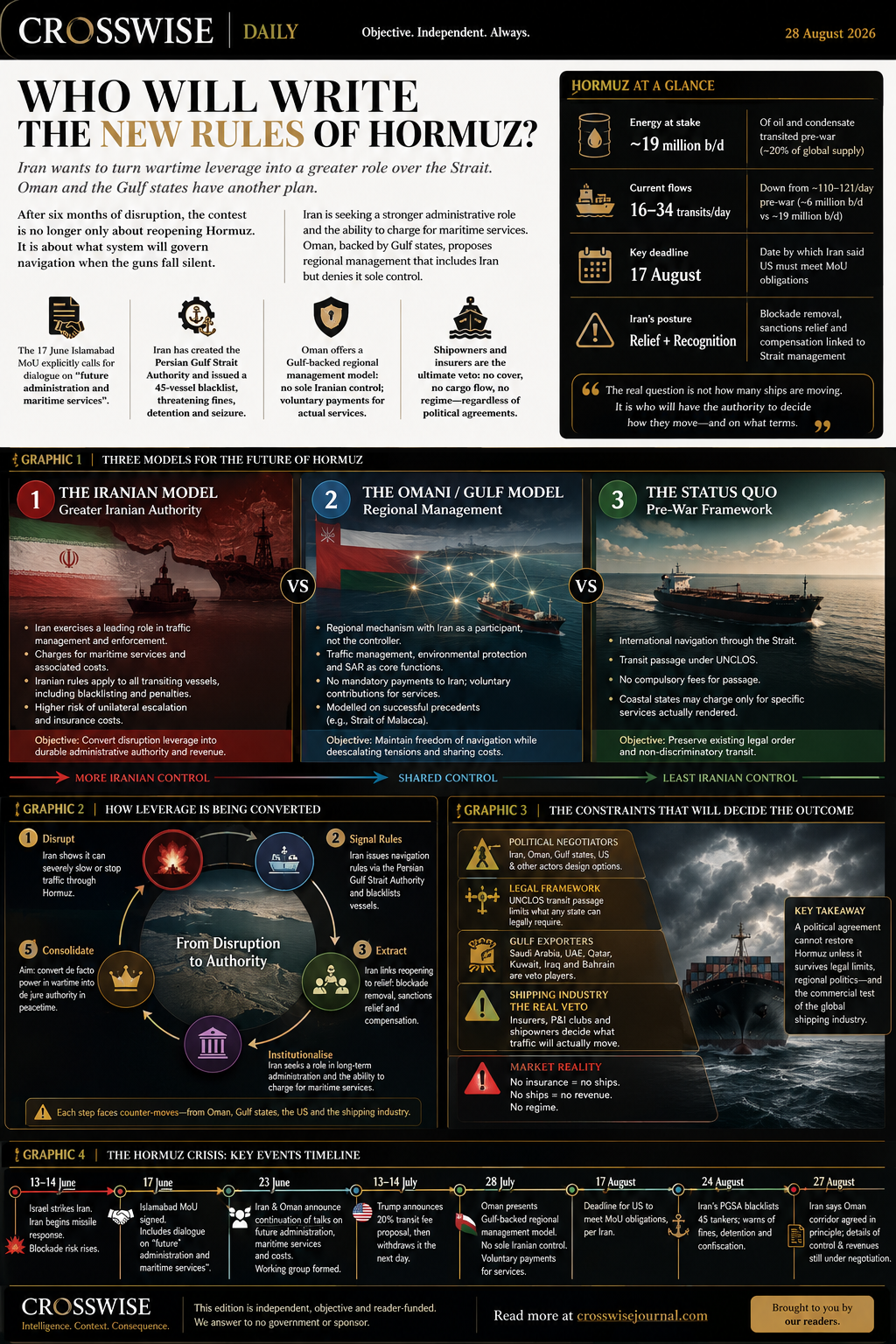
Iran wants to turn wartime leverage into a greater role over the Strait. Oman and the Gulf states have another plan.
WHY THIS STORY
The Strait of Hormuz has spent six months as a battlefield. It is now becoming something else: a negotiation over the rules that could govern navigation while the conflict continues and in whatever settlement eventually follows.
Iran is preparing conditions for normalisation. Tehran and Muscat are negotiating a corridor and longer-term arrangements covering control and revenues. Gulf states have backed an Omani counterproposal designed to include Iran without granting it sole control. Iran, meanwhile, has created a new Strait authority and blacklisted vessels it says violated its rules.
That makes today's story different from the earlier Crosswise examination of ship movements through Hormuz. The question is no longer principally how many vessels can get through. It is whether Iran can turn the ability to disrupt a global chokepoint into a durable role in administering it - and what Oman, the Gulf states, Washington and the shipping market will permit.
RESEARCH SUMMARY
Crosswise conducted two independent research passes, compared their findings, and then targeted disputed claims for verification. A hostile red-team review was subsequently adjudicated against the underlying record.
The evidence supports a narrower and stronger conclusion than the first draft: Iran has demonstrated substantial denial power over commercial navigation and is seeking a greater role in managing the Strait. But Tehran is not writing the rules alone. Oman and other Gulf states are advancing a regional model that would include Iran while denying it sole control, and the commercial shipping industry retains a practical veto over any arrangement that insurers and operators consider unsafe or legally problematic.
The key distinction is between coercive leverage, negotiated administrative influence and internationally recognised authority. Iran clearly possesses the first. It is bargaining over the second. It has not secured the third.
01 | WHAT WE KNOW
The June agreement opened an administrative question
On 17 June, the United States and Iran signed a 14-point memorandum in Islamabad. For 60 days Iran was to use its best efforts to provide safe commercial passage without charge, while the United States was to end its naval blockade under the framework's terms.
Clause 5 went further. It said Iran would conduct dialogue with Oman to define the future administration and maritime services in the Strait of Hormuz, in discussion with other Persian Gulf littoral states and in line with applicable international law and coastal-state sovereign rights.
On 23 June, Iran and Oman announced that they would continue those discussions, including maritime services and associated costs, create a joint working group and consult other littoral states and relevant parties. The ceasefire framework later collapsed, but the administrative question survived.
Iran and Oman do not appear to want the same system
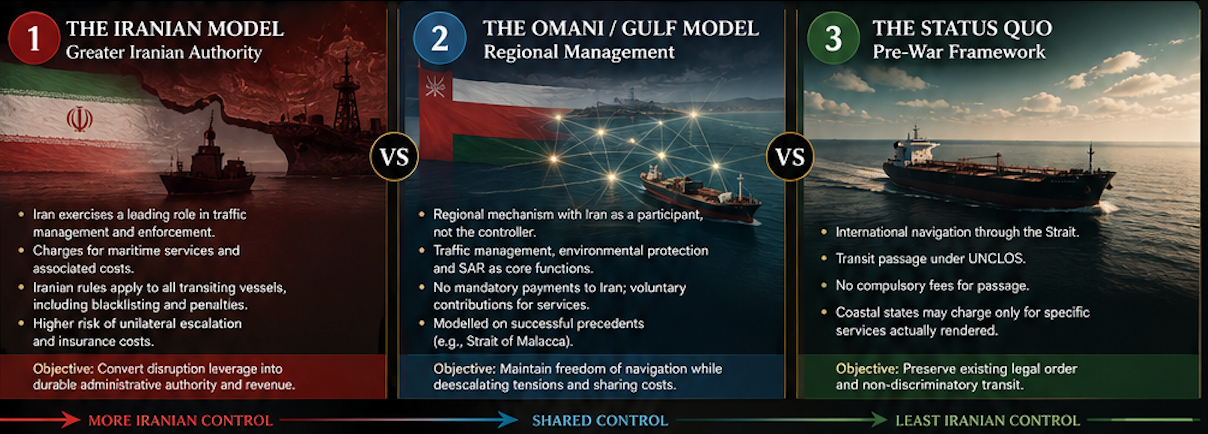
Iran has said it wants to manage the Strait alongside Oman and charge ships for services. One Iranian proposal described a division of traffic management between the two shores.
Oman's counterproposal is materially different. In late July, Reuters reported a Gulf-backed Omani model inspired by the Strait of Malacca: regional management, no sole Iranian control, and voluntary contributions from shipping companies to fund navigation, environmental protection and search-and-rescue services.
That is the emerging contest: whether wartime disruption produces greater unilateral Iranian authority, or instead accelerates a regional system designed to contain that authority.
The negotiation is still moving
On 27 August, Iran's security chief Mohsen Rezaei said Tehran was compiling conditions for reopening after approaches from mediators. He confirmed an agreement with Oman on a shipping corridor running through Iranian and Omani waters, while details over control and revenues remained under negotiation.
Iran's demands also reach beyond maritime administration. They include ending the regional war, lifting what Tehran describes as the US blockade of its ports, compensation and removal of economic sanctions. Hormuz is therefore both a subject of negotiation and a source of leverage within the wider conflict.
Iran is already testing practical authority
Iran's newly formed Persian Gulf Strait Authority has blacklisted 45 tankers for allegedly violating Iranian transit rules and threatened fines, detention and cargo confiscation. The list includes vessels linked to major Gulf and international operators.
The important point is not that those rules have acquired international legitimacy. They have not. It is that commercial actors are responding to the risk: Reuters reported that at least three Indian refiners and a global energy company decided to avoid blacklisted ships, including for ship-to-ship transfers.
02 | THE PERSPECTIVES
TEHRAN | Disruption should translate into influence
Iran's case begins with geography and power. It is one of the two coastal states bordering Hormuz, and the war has demonstrated that any security architecture which excludes Tehran can be made extraordinarily costly.
Tehran is seeking more than a return to the pre-war commercial status quo. Its proposals combine ordinary coastal-state interests - traffic management and maritime services - with more contested demands for fees, clearance and enforcement.
MUSCAT AND THE GULF | Include Iran, constrain control
Oman's proposal points in another direction. Muscat is not simply mediating; it is an interested coastal state protecting its own sovereign role.
The Gulf-backed plan would give Iran a place in regional management while preventing sole Iranian control. Voluntary contributions would fund identifiable maritime services rather than operate as a compulsory price for passage.
That model also gives Saudi Arabia, the UAE, Qatar, Kuwait, Bahrain and Iraq a stake in an arrangement affecting a critical export artery. Their interest is not to legitimise Iranian coercion, but to prevent the Strait from remaining permanently vulnerable to bilateral US-Iran escalation.
WASHINGTON | Do not turn obstruction into entitlement
Washington argues that Hormuz is an international waterway and rejects mandatory Iranian tolls or restrictions on lawful passage. The strategic concern is straightforward: if Iran can disrupt navigation and then obtain a permanent compulsory revenue stream or discretionary authority as the price of restoring it, coercion has been rewarded.
The American record is not perfectly consistent. President Trump briefly proposed a US charge equal to 20% of cargo value in July, describing America as the 'Guardian' of Hormuz. He abandoned that proposal the next day. It was never implemented.
THE SHIPPING MARKET | Governments do not have the final word
Any diplomatic arrangement has another constituency: shipowners, charterers, insurers, refiners and energy companies.
Iran's blacklist already shows why. Companies that do not recognise Tehran's legal claims may still avoid targeted vessels because detention, confiscation, sanctions exposure or insurance complications make the risk commercially irrational.
A political agreement therefore does not itself restore Hormuz. Security conditions, legal clarity, sanctions treatment, insurance availability and operator confidence all have to move together.
03 | EVIDENCE CHECK
CLAIM: Iran is taking control of Hormuz.
VERDICT: NOT SUPPORTED. Iran has demonstrated powerful denial capability and is attempting to impose practical transit rules. But Oman retains sovereign rights, Gulf states reject sole Iranian control, US forces remain present, and third-state navigation rights cannot simply be transferred to Tehran.
CLAIM: Iran has no legitimate role in administering the Strait.
VERDICT: TOO SIMPLE. Iran is a coastal state and has legitimate interests in safety, traffic management, environmental protection and services. The dispute concerns the extent of that role - especially whether it can become compulsory control over international passage.
CLAIM: Iran can legally charge ships simply to pass through Hormuz.
VERDICT: NOT SUPPORTED. International law strongly protects transit through straits used for international navigation. Charges for passage as such face serious legal objections. Charges for specific services actually rendered are a narrower category, provided they are not a disguised toll on the right of transit.
CLAIM: Oman is helping Iran institutionalise control.
VERDICT: MISLEADING. Oman's Gulf-backed proposal is explicitly designed to prevent sole Iranian control. Muscat is trying to convert a dangerous bilateral contest into a constrained regional mechanism.
CLAIM: A diplomatic deal would reopen Hormuz.
VERDICT: INCOMPLETE. A deal can reduce political and security risk, but commercial normalisation also requires insurers and operators to accept the rules, sanctions exposure and residual physical danger.
04 | WHAT WE DON'T KNOW
The final Iran-Oman arrangement
A corridor has been agreed in principle, but details over control, revenues and longer-term management remain unsettled.
How far Tehran will trade authority for economic relief
Iran's conditions combine maritime demands with blockade removal, sanctions relief and compensation. The public record does not reveal the hierarchy among those objectives.
Whether the Omani/Gulf model can survive Iranian resistance
Tehran has resisted arrangements that dilute its claimed authority. Negotiations remain fluid.
How commercial actors will price any settlement
A legally elegant compromise can still fail if insurers, owners or charterers regard the residual risk as unacceptable.
Whether a new mechanism becomes durable
The war is ongoing. No current proposal should be described as a settled post-war architecture.
05 | CROSSWISE ASSESSMENT
Hormuz is no longer only a test of naval power. It is becoming a test of whether coercive power can be converted into institutional influence.
Iran has demonstrated the first half of that equation. It can make normal use of the Strait sufficiently dangerous and expensive that reopening becomes a diplomatic objective. That has given Tehran bargaining power even against a militarily superior opponent.
But the second half is much harder. Oman possesses its own coastal-state rights. Gulf exporters have direct interests in the rules. Washington rejects compulsory Iranian restrictions. International navigation law constrains what coastal states can demand. And commercial operators can refuse to use an arrangement they regard as unsafe or uninsurable.
The June memorandum is important not because it handed Iran control - it did not - but because it formally placed future administration and maritime services on the negotiating agenda. Subsequent Iran-Oman talks and the Gulf-backed Omani counterproposal show that this agenda is real.
The emerging contest is between two possible lessons from the war. Tehran wants the settlement to recognise that Iran cannot be excluded from the functioning of a waterway it has shown it can disrupt. Oman and the Gulf states are trying to turn the same fact into a regional mechanism that includes Iran while denying it unilateral control.
Iran has turned disruption into a seat at the negotiating table. It has not yet turned that seat into recognised authority. Who writes the eventual rules of Hormuz remains open.
CROSSWISE RADAR
Gulf infrastructure | Building around Hormuz
The war is accelerating investment in pipelines, Red Sea ports and eastern Gulf terminals designed to reduce dependence on the Strait. The strategic consequence may outlast the conflict: even a successful reopening could leave Hormuz less indispensable at the margin.
US air-defence stocks | The second-theatre cost
Sustained Middle East operations continue to raise questions about high-end interceptor inventories and replenishment capacity across other theatres. Watch procurement, production rates and any deployment changes affecting Europe or the Indo-Pacific.
Nepal-Tibet | A different kind of systemic risk
The Himalayan disaster continues to raise questions about glacier retreat, unstable slopes and infrastructure exposure. Event-specific climate attribution remains uncertain; the broader risk environment warrants attention.
GRAPHICS: CROSSWISE ANALYSIS • SOURCE BASIS: PRIMARY RECORDS, REUTERS, MARITIME AND ENERGY DATA • AUGUST 2026
THE RECEIPTS
Research Ledger
Crosswise used independent research passes, a gap analysis, targeted verification and a hostile red-team review followed by adjudication. Claims that did not survive verification were excluded. The reader-facing methodology does not depend on any single news organisation.
How Crosswise Counts
This edition is not a ship-count story. Vessel data are used only as evidence of the coercive environment. AIS-dark movements and different definitions of Gulf exports versus Hormuz transit make single-point flow estimates hazardous. Institutional claims are therefore assessed from agreements, official positions, observable enforcement behaviour and commercial response.
Primary & Official Records
The June Islamabad Memorandum of Understanding is the central primary record. Clause 5 explicitly calls for Iran-Oman dialogue to define the future administration and maritime services of the Strait in discussion with other Gulf littoral states, subject to applicable international law and coastal-state rights.
Specialist / Data Sources
Kpler and commercial shipping evidence were used to contextualise traffic conditions. Industry behaviour - including avoidance of blacklisted vessels - was treated as evidence of practical risk, not recognition of Iranian legal authority.
Independent & Regional Reporting
Reuters reporting was used extensively for the Iran-Oman negotiations, Gulf-backed Omani proposal, Iranian conditions and blacklist. Crosswise also checked the June provision against independent reproductions and analysis of the primary text.
Key Claims Crosswise Triangulated
1. The June framework explicitly contemplated future Iran-Oman dialogue on administration and maritime services - CONFIRMED.
2. Iran and Oman subsequently created a working process covering navigation, services and associated costs - CONFIRMED.
3. Oman proposed a Gulf-backed regional mechanism with voluntary contributions and no sole Iranian control - CONFIRMED.
4. Iran is seeking a greater management role and service-related revenues - SUPPORTED; final terms remain unsettled.
5. Iran's Persian Gulf Strait Authority blacklisted 45 tankers and threatened fines, detention and confiscation - CONFIRMED.
6. Some commercial operators changed behaviour because of the blacklist - CONFIRMED.
7. Iran has obtained internationally recognised control of Hormuz - NOT SUPPORTED.
8. A final political agreement alone would guarantee commercial normalisation - NOT SUPPORTED.
What We Could Not Obtain
Crosswise could not obtain a final Iran-Oman agreement, a definitive hierarchy of Iran's negotiating objectives, unpublished annexes, or evidence that any current arrangement has acquired durable international recognition. We also excluded unsupported claims encountered during research, including allegations of US threats to strike Omani infrastructure and uncorroborated claims about large numbers of physical US interdictions.
Radar Sources
Radar items are based on current credible reporting but have not undergone the same depth of verification as the lead story.
Found Something We Missed?
If you have a primary document, dataset or credible source that materially changes this assessment, contact editor@readcrosswise.com. Corrections that alter the evidence will be reflected transparently.
Source Record
Islamabad Memorandum of Understanding - reproduced text - Clause 5 on future administration and maritime services.
https://jordantimes.com/jordantimes/uploads/pdf/2026/06/19/-20260619-1.pdf
Reuters - Oman and Iran pursue talks - Joint working group, future administration, services, costs and littoral-state consultation.
https://www.internazionale.it/ultime-notizie-reuters/2026/06/23/oman-and-iran-to-pursue-talks-on-managing-navigation-in-strait-of-hormuz
Reuters - Oman's Gulf-backed proposal - Regional management, voluntary contributions and no sole Iranian control.
https://www.reuters.com/world/asia-pacific/gulf-states-back-plan-let-iran-collect-voluntary-fees-use-hormuz-2026-07-28/
Reuters - Iran's reopening conditions - Corridor, control/revenue negotiations, blockade relief, sanctions and compensation.
https://www.reuters.com/world/middle-east/irans-security-chief-denies-allegations-iranian-plot-assassinate-trumps-son-al-2026-08-27/
Reuters - tanker blacklist - 45-vessel blacklist and threatened penalties.
https://www.reuters.com/world/middle-east/iran-warns-vessels-violating-hormuz-transit-rules-fines-detention-2026-08-24/
Reuters - commercial response to blacklist - Refiners and energy companies avoiding blacklisted vessels.
https://www.reuters.com/business/energy/some-oil-companies-avoid-ships-iran-blacklist-sources-say-2026-08-26/
Reuters - Trump 20% proposal and legal context - US fee proposal and law-of-the-sea context.
https://www.reuters.com/world/middle-east/can-iran-charge-fees-ships-transit-strait-hormuz-2026-07-14/
Reuters - withdrawal of US 20% proposal - Trump stepped back from the proposal before implementation.
https://www.reuters.com/business/energy/oil-climbs-one-month-high-us-iran-step-up-attacks-strait-hormuz-2026-07-14/